

Apple vs. Oval Body Shape: Bust, Midsection & Tummy Proportions
Explore the distinctions between Apple and Oval body types. Master empire silhouettes, vertical dusters, and WHO waist-to-hip health benchmarks.
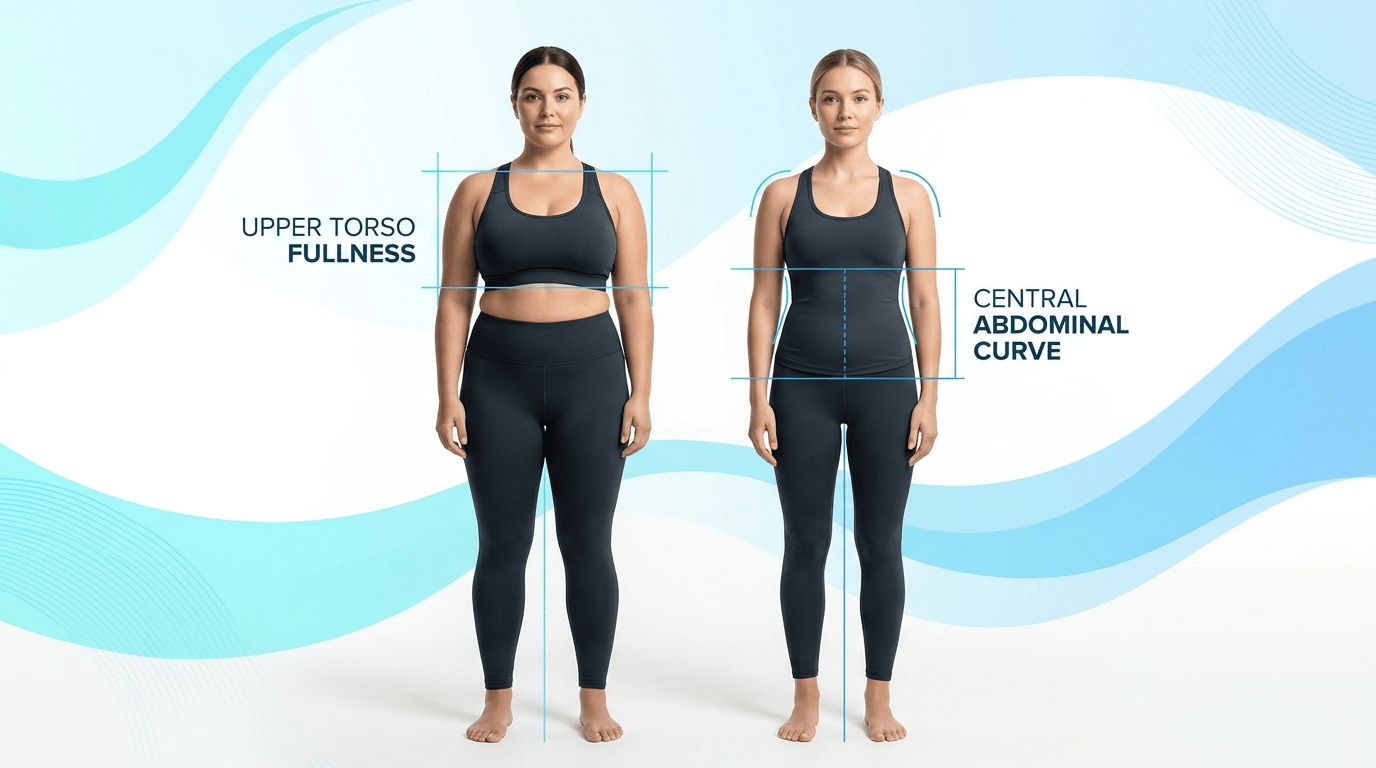
Derived from the World Health Organization (WHO) expert consultation on abdominal adiposity and clinical styling biomechanics. Midsection-dominant silhouettes are evaluated by comparing natural waist-to-hip circumferences (WHR ≥ 0.85 for women, ≥ 0.95 for men) and identifying whether upper-chest volume or midriff projection establishes the primary contour.
Apple vs. Oval Body Shape (Direct Answer)
While both the Apple and Oval silhouettes carry their primary circumference around the central torso, they differ in bust volume and shoulder structure.
An Apple Shape features an expanded upper frame with an average-to-full bust, broad ribcage, and fullness across the chest and upper abdomen that tapers down to relatively narrow pelvic hips and slender, shapely legs. An Oval Shape (often termed a central round silhouette) features softer, narrower shoulders, a modest bust, and concentrated weight focused directly around the central midriff and stomach—making the midsection clearly wider than both the bust above and the hips below.
Both silhouettes frequently share exceptional, slender lower legs and calves, which serve as their primary styling asset. You can calculate your exact waist-to-hip ratio and silhouette category in our interactive Body Shape Calculator.
Anatomical Differences: Upper-Torso Apple vs. Midsection Oval
Understanding where volume originates helps determine the ideal neckline, waistband, and dress silhouette:
Upper-Torso & Chest Dominant
- • Upper Body: Broad shoulders, broad back, and a full, pronounced bust.
- • Midsection: Flattens upward into the chest without a defined natural waist indent.
- • Hips & Pelvis: Hips are narrower than the bust and equal to or smaller than the waist.
- • Greatest Asset: Toned, slender legs, delicate ankles, and slender forearms.
- • WHR Marker: Waist-to-hip ratio typically ranges from 0.85 to 0.95.
Central Midriff Dominant
- • Upper Body: Sloped, softer shoulders with a modest or medium bust.
- • Midsection: Stomach and high waist are the widest circumference of the entire body.
- • Hips & Pelvis: Flat buttocks and narrow pelvic bones.
- • Greatest Asset: Shapely calves, neck, and lower arms.
- • WHR Marker: Waist-to-hip ratio frequently equals or exceeds 1.00.
Wardrobe Solutions: Dressing the Apple & Oval Silhouette
The core styling principle for midsection-dominant frames is to draw attention upward toward the face and neckline, elongate the torso with uninterrupted vertical lines, and highlight fabulous legs:
| Design Element | Apple Recommendations | Oval Recommendations |
|---|---|---|
| Dress Silhouettes | Empire waist, A-line tunic, wrap dress tying just under the bust | Fluid shift dresses, drop-waist cuts, unstructured trapeze dresses |
| Necklines | Deep V-neck, sweetheart, open scoop necklines | V-neck, boatneck, open collar that widens shoulders |
| Outerwear & Layers | Single-breasted open blazers, unbuttoned long dusters | Straight tailored dusters, open cardigans creating vertical side columns |
| Bottoms & Trousers | Straight leg, slim trousers, ankle pants showcasing calves | Pull-on flat front stretch trousers, bootcut or straight cuts |
| What to Avoid | Clingy jersey fabrics across stomach; thick waist belts | High-waisted rigid jeans that pinch the abdomen; horizontal waistlines |
Health Context: Understanding Visceral vs. Subcutaneous Fat
From a health perspective, Apple and Oval silhouettes correspond to what clinical researchers term Android fat patterning. Unlike subcutaneous fat stored in the thighs and hips (Gynoid fat), adipose tissue stored in the abdominal cavity surrounds vital organs like the liver and pancreas as visceral fat.
The World Health Organization (WHO) identifies a Waist-to-Hip Ratio above 0.85 in women and 1.00 in men as a primary risk indicator for metabolic syndrome and cardiovascular stress. Pairing intentional resistance training with steady aerobic activity and low-glycemic nutrition helps preserve lean muscle mass and optimize insulin sensitivity.
The Bottom Line: Elegance Through Vertical Lines
Having an Apple or Oval silhouette is not a styling limitation—it is a clear roadmap to effortless, chic dressing. By skipping rigid horizontal waistbands in favor of flowing A-line tunics, elegant empire waists, and structured open dusters, you can showcase your legs and décolletage with timeless sophistication.
Check Your Waist-to-Hip Ratio on ToolWingz
Enter your waist and hip measurements to calculate your clinical WHR risk tier and explore flattering wardrobe advice customized for your frame.
Educational Disclaimer: ToolWingz provides WHO waist-to-hip ratio benchmarks and silhouette analysis for educational awareness.