

BAC in Men vs. Women: Why the Same Drinks Can Produce Different Results
Explore why identical drinks produce different blood alcohol levels in men and women due to body water, composition, and metabolism.
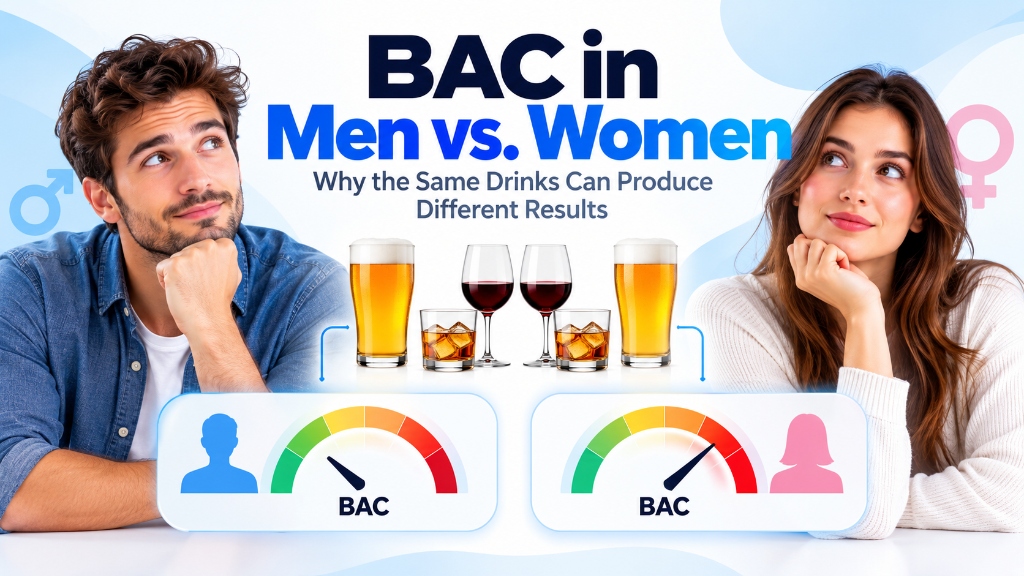
Why Does Alcohol Affect Men and Women Differently? (Direct Answer)
When a biological female and a biological male of identical scale weight drink the exact same amount of alcohol at the same speed, the female will almost always register a substantially higher Blood Alcohol Concentration (BAC).
This physiological disparity is not a matter of practice, subjective tolerance, or mindset. It is governed by two fundamental biological realities documented extensively by the National Institute on Alcohol Abuse and Alcoholism (NIAAA): lower average total body water in biological females and differences in gastric alcohol dehydrogenase (ADH) first-pass metabolism.
To see how these gender-specific constants alter calculated blood alcohol curves in real time, explore the Toolwingz BAC Calculator.
1. Total Body Water Distribution: The Dilution Reservoir
The single most powerful physiological factor driving BAC differences between sexes is total body water. Ethanol is highly water-soluble (hydrophilic) and does not dissolve in fat cells (adipose tissue):
Biological Males
~60% – 68% WaterBiological males generally possess greater lean muscle mass, which is approximately 73% water by weight. Consequently, alcohol consumed by a male is diluted into a significantly larger total volume of bodily fluid.
Biological Females
~50% – 55% WaterBiological females naturally possess a higher baseline percentage of adipose (fat) tissue, which contains minimal water. Therefore, the same dose of alcohol dissolves into roughly 15% to 25% less fluid, creating a higher concentration.
2. Gastric Alcohol Dehydrogenase (ADH) Enzymes
Before alcohol reaches circulating blood, a portion is oxidized directly inside the stomach lining through a process termed first-pass gastric metabolism. Research indicates that biological females typically exhibit lower gastric alcohol dehydrogenase (ADH) enzyme activity than males.
• Because less alcohol is broken down in the female stomach lining before emptying into the small intestine, a higher percentage of the ingested ethanol enters the bloodstream intact.
• Once alcohol enters the bloodstream, however, hepatic (liver) clearance rates are comparable between sexes, averaging roughly 0.015% BAC per hour across both men and women.
3. Hormonal Fluctuations & Oral Contraceptives
Fluctuations in estrogen and progesterone during the menstrual cycle influence gastric emptying times and hydration status. Clinical research indicates that peak BAC can be reached more rapidly immediately before menstruation or during ovulation. In addition, birth control pills containing estrogen can slow the liver’s clearance of ethanol, extending the duration of elevated blood alcohol levels.
Side-by-Side Physiological Comparison: Alex vs. Jordan
Consider two healthy 28-year-old adults of the exact same scale weight enjoying a meal together:
| Comparison Parameter | Alex (Biological Male) | Jordan (Biological Female) |
|---|---|---|
| Scale Weight | 160 lbs (72.5 kg) | 160 lbs (72.5 kg) - Identical |
| Drinks Consumed | 3 standard 12 oz beers (5% ABV) | 3 standard 12 oz beers (5% ABV) - Identical |
| Drinking Duration | Paced over 90 minutes | Paced over 90 minutes - Identical |
| Widmark Water Factor (r) | r = 0.68 | r = 0.55 |
| Estimated Peak BAC | ~0.060% – 0.068% | ~0.082% – 0.092% |
| Legal Status | Under 0.08% threshold | Exceeds 0.08% legal limit |
Safety and Public Health Implications
Because of these physiological differences, generic drinking advice (like “two drinks is safe for everyone”) is scientifically inaccurate and dangerous. Women experience faster cognitive deterioration, greater risk of liver inflammation, and higher vulnerability to alcohol-related harm at equivalent intake levels.
Key Safety Takeaway:
Never assume that a female can consume the same volume of alcohol as a male companion of equal weight without experiencing significantly greater intoxication and higher BAC. Always arrange safe, sober transportation.
Key Scientific Questions on Sex Differences in Alcohol Clearance
Does liver size or metabolic clearance rate differ between men and women?
Interestingly, healthy women often eliminate alcohol slightly faster per unit of liver volume than men (frequently measured around 0.017% to 0.019% BAC per hour compared to 0.015% in men), potentially driven by higher liver-to-body-mass ratios. However, because women start from a significantly higher peak concentration due to smaller body water volumes, the total clearance duration is often longer or equivalent despite this modest hepatic acceleration.
How do hormonal cycles impact BAC in women?
Clinical studies demonstrate that fluctuations in estrogen and progesterone across the menstrual cycle can alter gastric emptying speed and hepatic enzyme activity. Elevated estrogen during the premenstrual and ovulatory phases is associated with more rapid ethanol uptake and prolonged elevated peak blood alcohol concentrations compared to the mid-follicular phase.
Why do official dietary guidelines recommend fewer drinks for women?
Public health organizations such as the CDC and USDA recommend a maximum of 1 drink per day for women versus 2 drinks for men specifically because of the ~30% higher systemic blood concentration generated per standard drink, which over time correlates with higher risks of cardiovascular disease, liver cirrhosis, and neurological impairment.