

BUI vs. DUI: Legal BAC Limits for Boating Under the Influence
Understand boating under the influence (BUI), how environmental water stressors compound intoxication, and why BUI can suspend your road driver’s license.
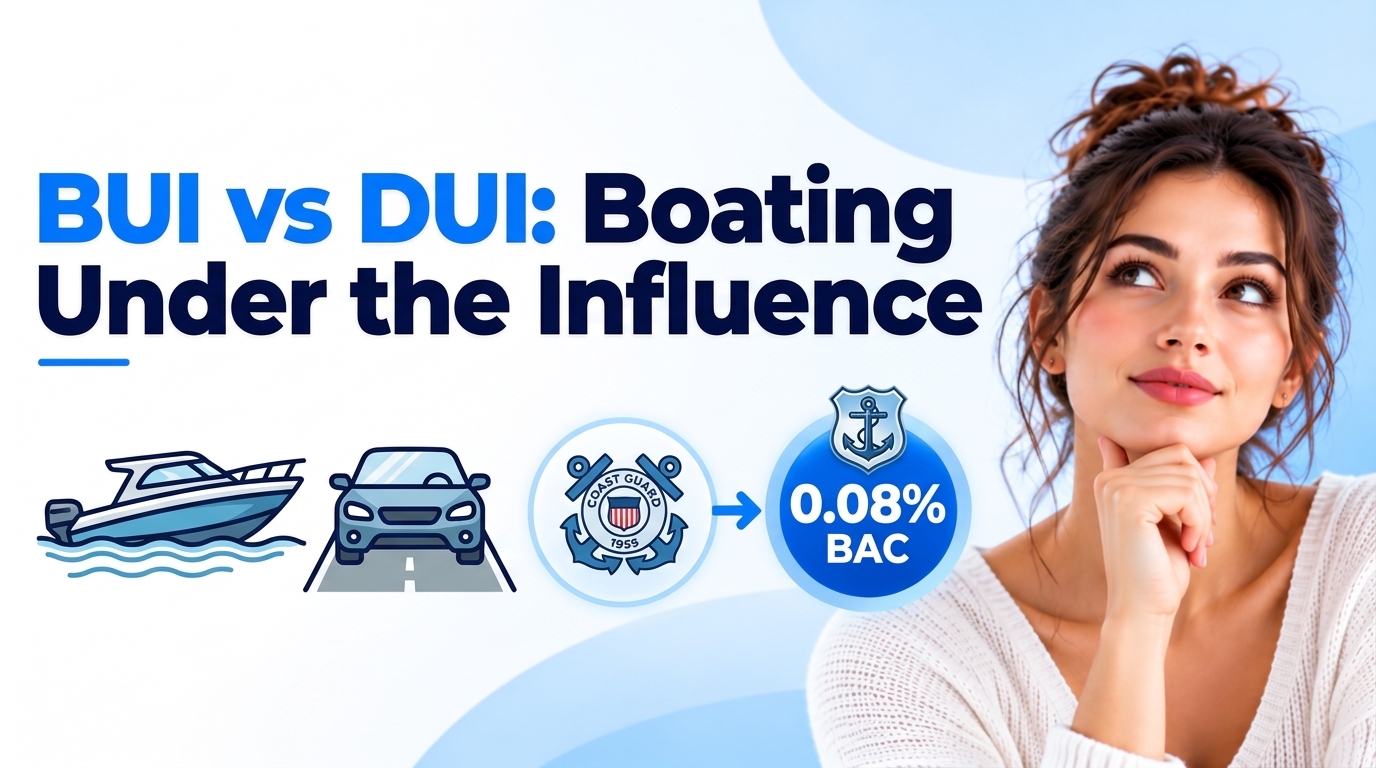
Derived from the maritime navigation codes codified under 33 CFR Part 95, federal boating safety statistics compiled by the U.S. Coast Guard (USCG), and comparative criminal statutes across all 50 state wildlife and marine patrol agencies.
What Is BUI and How Does It Compare to a DUI? (Direct Answer)
Boating Under the Influence (BUI) is the maritime equivalent of driving under the influence (DUI). Under both federal maritime law (46 U.S.C. § 2302) and state marine codes across all 50 states, the legal Blood Alcohol Concentration (BAC) limit for operating any motorized vessel, sailboat, or personal watercraft (jet ski) is 0.08%.
While many recreational boaters mistakenly assume that drinking on the water carries fewer legal risks than drinking on the highway, BUI is a serious criminal offense. Operating a vessel with a BAC at or above 0.08% carries substantial criminal misdemeanor or felony penalties, heavy monetary fines, mandatory alcohol education, and potential imprisonment.
Moreover, in an increasing number of states, a BUI conviction results in the immediate suspension of your driver's license for motor vehicles on the road. To understand how drinks impact your blood alcohol curve, test your numbers on our Toolwingz BAC Calculator.
The “Boater's Hypnosis” Effect: Why Alcohol Is More Dangerous on Water
According to the U.S. Coast Guard, alcohol is the single leading known contributing factor in fatal recreational boating accidents. But why do boaters become impaired so much faster than automobile drivers? Forensic marine research points to a phenomenon known as environmental stressor compounding:
The 4 Marine Stressors (Boater's Fatigue)
When spending a day on a boat, the human central nervous system is bombarded by continuous physical inputs that do not exist inside an air-conditioned passenger car:
- Continuous Hull Motion & Wave Vibration: Your vestibular balance system works overtime to keep you upright, producing rapid physical fatigue.
- Sun Exposure and Thermal Load: Intense solar radiation accelerates cellular dehydration, reducing blood plasma volume.
- Wind & Engine Noise: High decibel levels and constant air pressure blunt cognitive vigilance and acoustic hazard detection.
- Water Glare: Sunlight reflecting off open water causes optical fatigue and decreases peripheral tracking.
BUI vs. DUI: 4 Critical Differences You Must Know
While the chemical threshold (0.08%) is the same, enforcement and search procedures on the water are vastly different from the highway:
Safety Stops
On highways, police need reasonable suspicion to stop a car. On the water, the Coast Guard or marine patrol can stop and board any vessel at random for a “safety equipment inspection.”
Legal for Passengers
In most states, open alcoholic containers are legal on boats for passengers. However, the vessel operator must remain strictly below 0.08% BAC at all times.
Modified SFSTs
Because boats rock, standing tests like Walk-and-Turn cannot be safely conducted on deck. Officers use validated Seated Standardized Field Sobriety Tests (Finger-to-Nose, Palm Pat).
Federal Court
On navigable waters, bays, and oceans, BUI citations issued by the USCG are prosecuted in U.S. Federal District Court rather than local municipal court.
Side-by-Side Legal Comparison: BUI vs. DUI
Compare the statutory benchmarks, stop requirements, and consequences between highway and maritime violations:
| Legal Dimension | Driving Under the Influence (DUI) | Boating Under the Influence (BUI) |
|---|---|---|
| Per Se Legal Limit | 0.08% (0.05% in Utah) | 0.08% nationwide |
| Enforcement Agencies | State Police, Sheriff, City Police | U.S. Coast Guard, State Marine Patrol, DNR / Wildlife Officers |
| Legal Right to Stop | Requires reasonable suspicion of violation | Random boarding permitted for safety inspections |
| Open Container Legality | Strictly illegal inside vehicle cabin | Generally legal for passengers on recreational boats |
| Impact on Driver's License | Automatic license suspension | Suspends road driver's license in over 20 states (CA, TX, FL, WA) |
Real-World Scenarios: How Boaters Get Arrested for BUI
Consider these two typical recreational scenarios illustrating how quickly maritime enforcement can escalate:
The Sandbar Afternoon Anchor
A boat operator spends five hours anchored at a popular lake sandbar, drinking four light beers while swimming and sunbathing. Heading back to the marina at sunset, marine patrol flags him down for an unlit stern navigation light.
Upon boarding to check life jackets, officers smell alcohol. They administer a seated horizontal gaze nystagmus test and a breathalyzer reading 0.085% BAC. He is arrested for BUI, his boat is towed, and his automobile driver's license is suspended for 6 months.
Renting a Jet Ski After Two Cocktails
A vacationer drinks two rum cocktails at a beachfront resort and rents a personal watercraft. She jumps waves too close to a marked swim zone.
State environmental police pull alongside. Her measured BAC is 0.065%. While below 0.08%, she is charged with reckless operation and maritime impaired operation. Her criminal conviction results in $1,500 in fines and mandatory boater education.
The 0.08% limit applies to water just like asphalt.
Sun, wind, and waves amplify alcohol's intoxicating effects on the water. A BUI conviction brings criminal records, heavy fines, and loss of your road driver's license. Always designate a sober skipper before leaving the dock.
Estimate Your BAC with the Toolwingz BAC Calculator
Calculate theoretical blood alcohol curves and explore how body weight, drink strength, and elapsed time influence clearance with 100% privacy.
Educational Disclaimer: Toolwingz BAC Calculator provides an estimate for informational purposes. It does not measure your actual BAC and cannot determine whether you are safe or legally permitted to drive.