

Can Mouthwash or a Keto Diet Fail a Breathalyzer? Forensic Science Explained
Discover the forensic science behind breathalyzer false positives: why mouthwash spikes readings for 15 minutes and how keto diet breath acetone affects sensors.
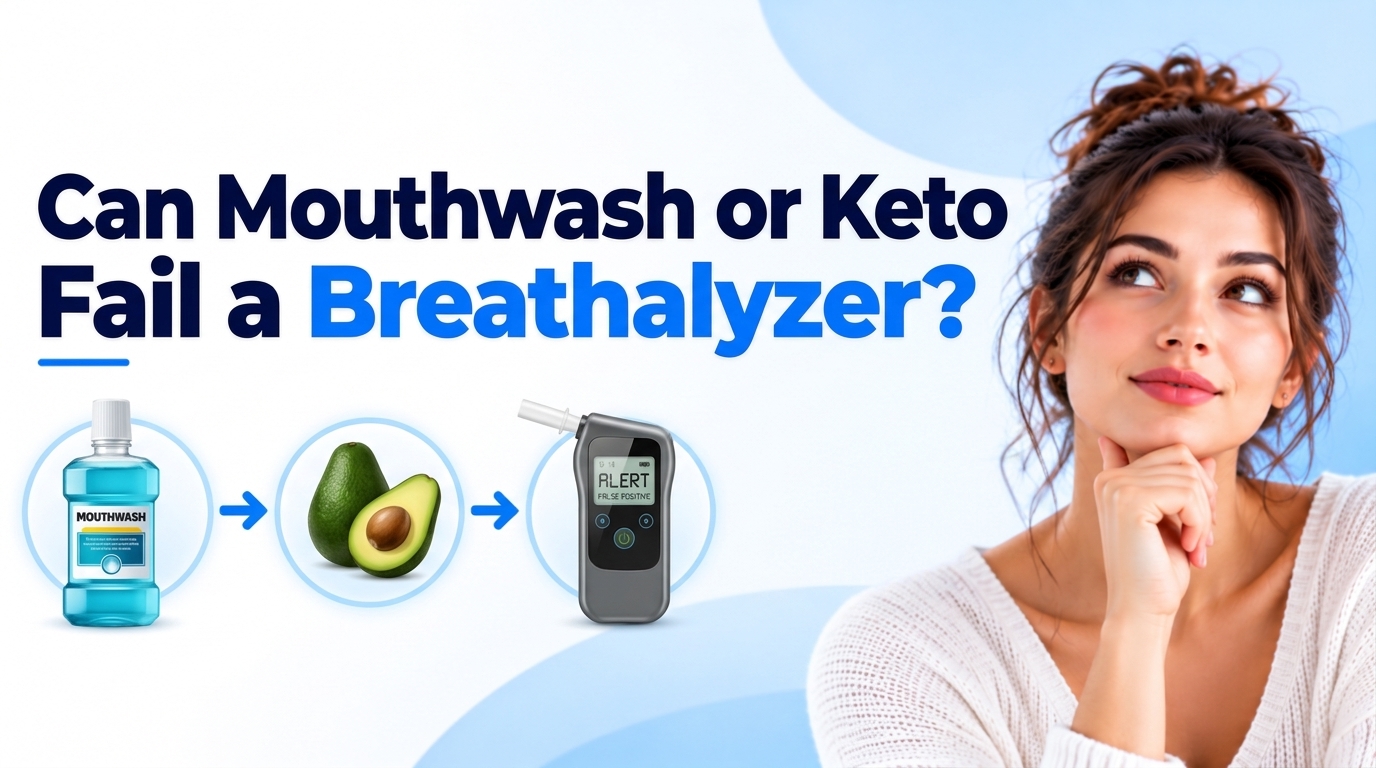
Researched against forensic breath testing specifications from the National Highway Traffic Safety Administration (NHTSA), peer-reviewed studies published in the Journal of Forensic Sciences, and clinical biochemistry on diabetic and ketogenic acetonemia.
Can Mouthwash or a Keto Diet Cause a False Positive on a Breathalyzer? (Direct Answer)
Yes, both mouthwash and a ketogenic diet can cause false positive readings on breathalyzers, but through completely different chemical and physiological mechanisms:
- Antiseptic Mouthwash: Produces a massive but short-lived spike in mouth alcohol. Many popular mouthwashes contain 21% to 26% pure ethanol. Rinsing right before blowing can produce an immediate, staggering breathalyzer reading of 0.20% to 0.40% BAC—levels that would signify coma if circulating in the blood. However, this mouth alcohol dissipates completely within 15 to 20 minutes.
- Ketogenic Diet & Diabetes: Produces systemic breath acetone (a ketone body). While modern police station infrared spectrometers filter out acetone, cheaper handheld fuel-cell and semiconductor breath devices can cross-react with isopropyl alcohol/acetone metabolites, falsely reading between 0.01% and 0.05% BAC even in people who have never had a drink.
Understanding how breath testing instruments measure ethanol versus non-beverage compounds is vital for motorists. To estimate true physiological blood alcohol levels based on consumed beverages, use the Toolwingz BAC Calculator.
How Mouthwash Fools a Breathalyzer (The 15-Minute Rule)
Breathalyzers are designed to measure alveolar (deep lung) air. The instrument assumes that any ethanol detected in your breath diffused out of the capillary blood in your lungs at a standard partition ratio of 2,100:1.
The Concentration Paradox
When you gargle with an alcohol-based mouthwash (such as classic Listerine, which contains 26.9% alcohol), you are coating the oral mucosal tissue, gums, tongue, and dental crevices with liquid that has a higher alcohol concentration than 50-proof liquor.
If an officer stops you 2 minutes after rinsing and you blow into a roadside Preliminary Breath Tester (PBT), the device measures the concentrated ethanol vapors evaporating directly from your mouth—not your lungs. The reading can easily spike to 0.30% BAC.
How Ketosis Can Interfere with Chemical Breath Testing
Unlike mouthwash, which is an external oral contaminant, the interference caused by a ketogenic diet (or diabetic ketosis) is endogenous and physiological.
Fat Metabolism & Acetoacetate
When a person strictly limits carbohydrate intake (under 20–50 grams per day) or fasts, the liver depletes glycogen and shifts to burning fatty acids, producing ketone bodies: beta-hydroxybutyrate, acetoacetate, and acetone.
Acetone Exhalation in Breath
Because acetone is volatile, it diffuses into lung alveoli and is exhaled on the breath. In individuals with elevated ketosis, liver enzymes can also convert trace acetone into isopropanol, which reacts directly on fuel cell sensors.
Breathalyzer Technologies: How Modern Devices Distinguish False Positives
Not all breath testing devices are engineered equally. Compare how different sensor types handle mouthwash, ketones, and dietary compounds:
| Device Category | Sensor Technology | Mouthwash Vulnerability | Keto / Acetone Vulnerability |
|---|---|---|---|
| Consumer / Personal Handhelds | Semiconductor Sensor | Extreme (blows off chart) | High (false positive up to 0.05%) |
| Roadside Police PBT | Electrochemical Fuel Cell | Extreme within first 10 minutes | Low-Moderate (calibrated for ethanol) |
| Station Evidentiary Machine (Intoxilyzer 8000/9000, DataMaster) | Dual-Wavelength Infrared Spectroscopy | Triggers “Mouth Alcohol Detected” slope error abort | Immune (Filters 3.4 µm vs 3.48 µm absorption wavelengths) |
Other Everyday Triggers for Breathalyzer False Positives
GERD & Acid Reflux
Severe acid reflux brings stomach gas and undigested liquids back up the esophagus into the mouth, bringing residual stomach ethanol directly into the breath sample.
Breath Sprays & Inhalers
Certain asthma inhalers (e.g., albuterol propelled by ethanol carriers) and binaca breath sprays leave pure alcohol in mouth tissues that can register 0.15% if tested immediately.
Dentures & Dental Work
Dental adhesive resins, periodontal pockets, and false teeth can trap small pockets of alcohol from beverages or rinses for longer than the standard 15-minute window.
Mouthwash dissipates in 15 minutes; blood tests reveal the ultimate truth.
If you ever register a positive roadside breath test after using mouthwash or while in deep ketosis, immediately demand a 20-minute waiting period and insist on an evidentiary blood test. While breath instruments can be fooled by mouth vapors, gas chromatography blood testing only detects true circulating beverage ethanol.
Estimate Your BAC with the Toolwingz BAC Calculator
Calculate theoretical blood alcohol curves and explore how body weight, drink strength, and elapsed time influence clearance with 100% privacy.
Educational Disclaimer: Toolwingz BAC Calculator provides an estimate for informational purposes. It does not measure your actual BAC and cannot determine whether you are safe or legally permitted to drive.