

Can You Change Your Body Shape with Exercise? The Biomechanics of Hypertrophy
The biomechanics of changing your body shape: fixed skeletal bone frameworks versus targeted muscle hypertrophy to create optical curves.
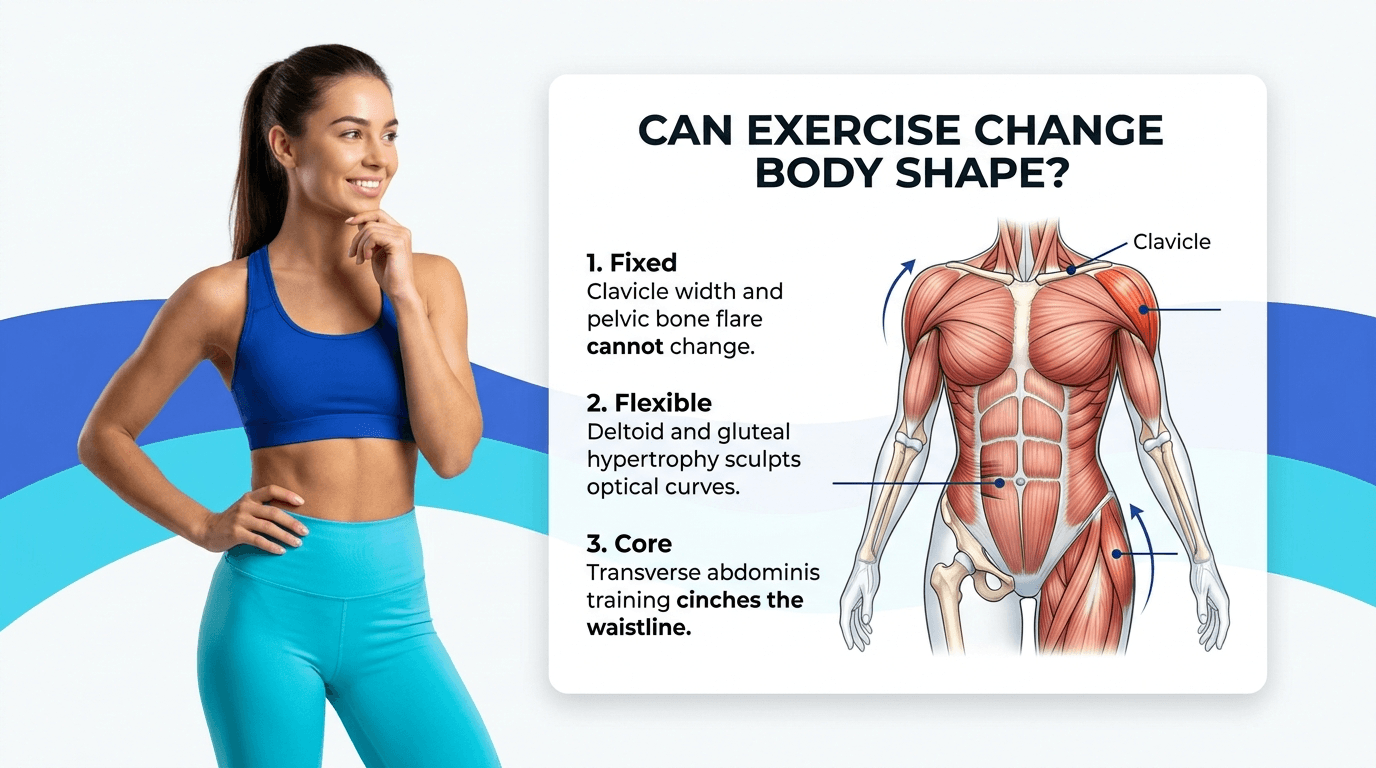
Constructed upon evidence-based resistance training physiology and clinical biomechanics. Details precisely which aspects of human morphology are genetically fixed by adult skeletal architecture versus which proportional dimensions can be transformed through regional muscular hypertrophy.
Can You Change Your Body Shape with Exercise? (Direct Answer)
The honest scientific answer is both yes and no:
- What You CANNOT Change (Skeletal Anatomy): You cannot widen or narrow adult bone structure. Your clavicular span, rib cage diameter, pelvic bone width (bi-iliac distance), and vertical torso height are genetically locked once growth plates fuse.
- What You CAN Change (Muscular Proportions): Through targeted muscle hypertrophy, you can add 1 to 2+ inches of muscle tissue to specific anatomical zones (such as the lateral shoulders, upper back, and glutes). This creates dramatic optical illusions that alter your circumference ratios, allowing an athletic rectangle or pear to forge an artificial hourglass taper.
Check your current baseline proportions using our interactive Body Shape Calculator.
The 3 Muscle Levers to Reshape Your Silhouette
1. Upper V-Taper
Targeting the lateral deltoids (lateral raises) and latissimus dorsi (lat pulldowns/pullups) broadens the upper back. This makes the natural waistline look noticeably smaller by contrast.
2. Lower Gluteal Shelf
Developing the gluteus maximus and gluteus medius through hip thrusts, Bulgarian split squats, and Romanian deadlifts adds horizontal hip and posterior projection.
3. Transversus Tightening
Strengthening the deep transversus abdominis via stomach vacuums and anti-rotational planks acts as an internal corset, flattening the abdominal wall without widening the waistline.
Training Warning: Why Heavy Oblique Exercises Can Thicken Your Waist
The Danger of Weighted Side Bends
Many gym-goers perform heavy dumbbell side bends attempting to “burn love handles.” However, like any skeletal muscle subjected to heavy progressive resistance, the internal and external obliques undergo muscular hypertrophy. Thickening these lateral core muscles adds 1 to 2 inches directly to the sides of your waist, turning a tapered hourglass into a rectangular silhouette.
Track Your Proportion Changes Over Time
Enter your tape measurements before and after your training blocks to see how muscle hypertrophy shifts your waist-to-hip ratio and visual classification.
Educational Disclaimer: ToolWingz provides body shape and ratio analysis for wellness and style awareness.