

The Genetics of Body Shape: Why Fat Distributes Differently Across Silhouettes
Delve into the genetic determinants of body fat distribution: GWAS loci, estrogen receptors, and why your DNA dictates silhouette curves.
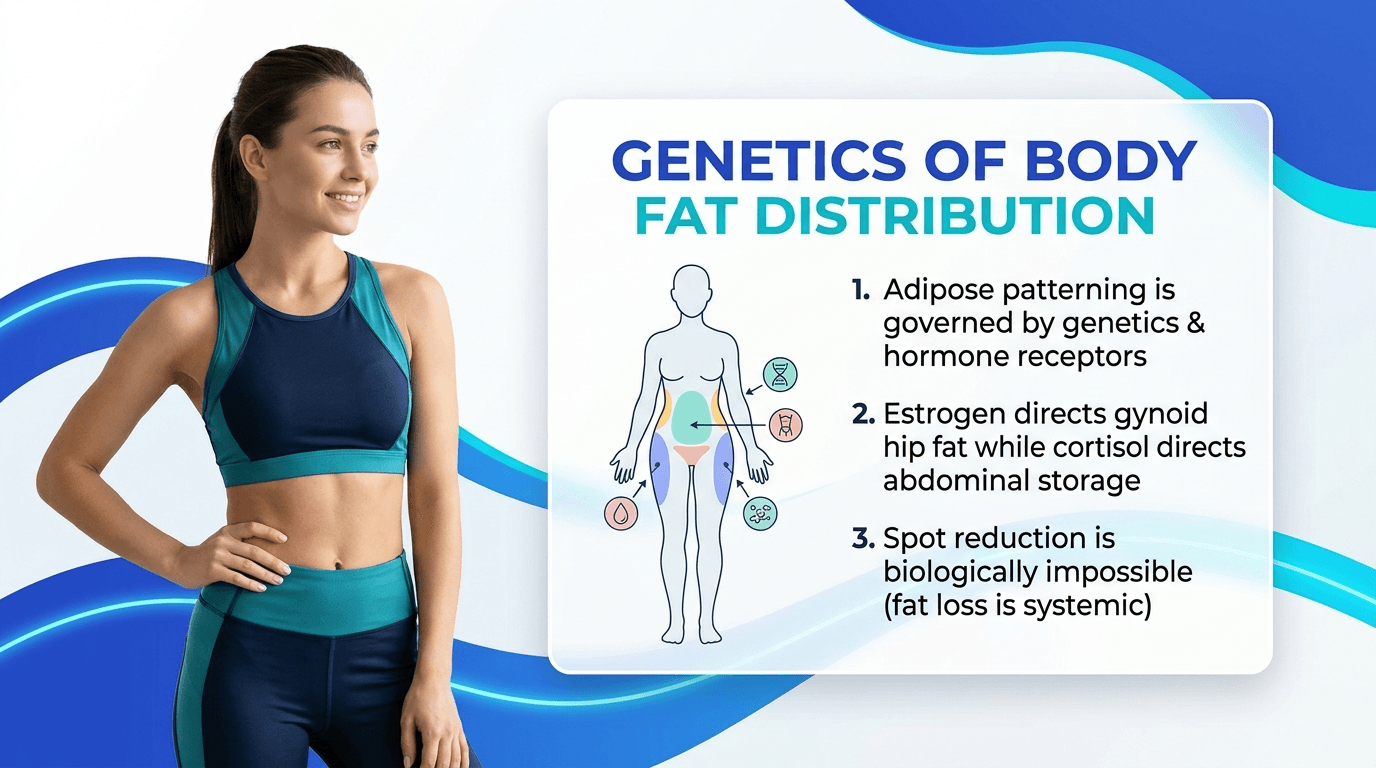
Derived from large-scale Genome-Wide Association Studies (GWAS) analyzing over 300 genomic loci linked to the Waist-to-Hip Ratio. Explains why regional adipose deposition is 50% to 70% heritable and biochemically governed by estrogen receptor density and adrenergic receptor ratios.
How Genetics Dictate Your Body Shape (Direct Answer)
Your overall silhouette—whether you are an Hourglass, Pear, Rectangle, or Apple—is fundamentally determined by your genetically programmed adipose distribution pattern combined with your underlying skeletal architecture.
While total caloric intake determines how much body fat you store, your DNA directs where those lipid droplets are assigned:
- Heritability Index: Twin and genomic studies published in Nature reveal that 50% to 70% of variation in body fat distribution (measured by WHR) is directly inherited.
- Cellular Receptors: Regional adipocytes express different densities of Alpha-2 (anti-lipolytic, fat-trapping) and Beta-2 (lipolytic, fat-releasing) adrenergic receptors.
- Endocrine Programming: Estrogen receptors (ER-alpha) direct lipids to gluteofemoral depots, whereas elevated cortisol and testosterone promote visceral abdominal storage.
You can verify your current anthropometric distribution using our interactive Body Shape Calculator.
The 3 Biological Drivers of Regional Fat Storage
1. Lipoprotein Lipase (LPL)
LPL is the “gatekeeper” enzyme for fat storage. In pear and hourglass shapes, femoral LPL activity is heavily upregulated, pulling circulating triglycerides into hips and thighs before they reach the abdomen.
2. Adrenergic Receptor Ratios
Lower-body subcutaneous fat has a high concentration of Alpha-2 receptors, which resist fat burning. Upper-torso and visceral fat have more Beta receptors, which break down rapidly during caloric deficits.
3. Estrogen vs Cortisol Ratio
Estrogen acts as a protective shield favoring peripheral fat. When cortisol or insulin chronically rises—or during perimenopausal estrogen reduction—adipose deposition shifts automatically into intra-abdominal spaces.
Case Study: Same Caloric Surplus, Completely Different Body Shapes
Weight Gain: +15 lbs | Measurements: 34″ - 27″ - 42″
- • Primary Deposition Depot: Gluteofemoral subcutaneous tissue
- • Abdominal Impact: Waist circumference increases by only 1.0 inch
- • WHR Result: 27 / 42 = 0.642 (Deep waist taper maintained)
- • Cardiometabolic Risk: Remains low despite higher total body fat.
Weight Gain: +15 lbs | Measurements: 38″ - 35″ - 37″
- • Primary Deposition Depot: Visceral mesenteric and omental space
- • Abdominal Impact: Waist expands by 4.5 inches
- • WHR Result: 35 / 37 = 0.945 (Exceeds high-risk cutoff)
- • Cardiometabolic Risk: Elevated insulin resistance and blood pressure.
Why Spot Reduction Is Biologically Impossible
When muscle contracts during an exercise—such as crunches or side leg raises—it utilizes glucose and intracellular glycogen. To burn stored fat, the body must release systemic hormones (epinephrine and norepinephrine) into the bloodstream:
These hormones circulate throughout the entire body, binding to whatever fat cells have the highest density of Beta receptors. You cannot command your nervous system to mobilize lipids exclusively from the waist or thighs through local movement.
Calculate Your Body Proportions on ToolWingz
Plug your numbers into our body shape algorithm to uncover your genetic silhouette archetype and personalized styling advice.
Educational Disclaimer: ToolWingz provides body shape and ratio analysis for wellness and style awareness.