

Hip Dips vs. Body Shape: Pelvic Anatomy & Why You Can’t Exercise Them Away
The science of hip dips: pelvic bone structure, trochanteric depressions, and the biomechanical reason why workouts cannot erase normal skeletal anatomy.
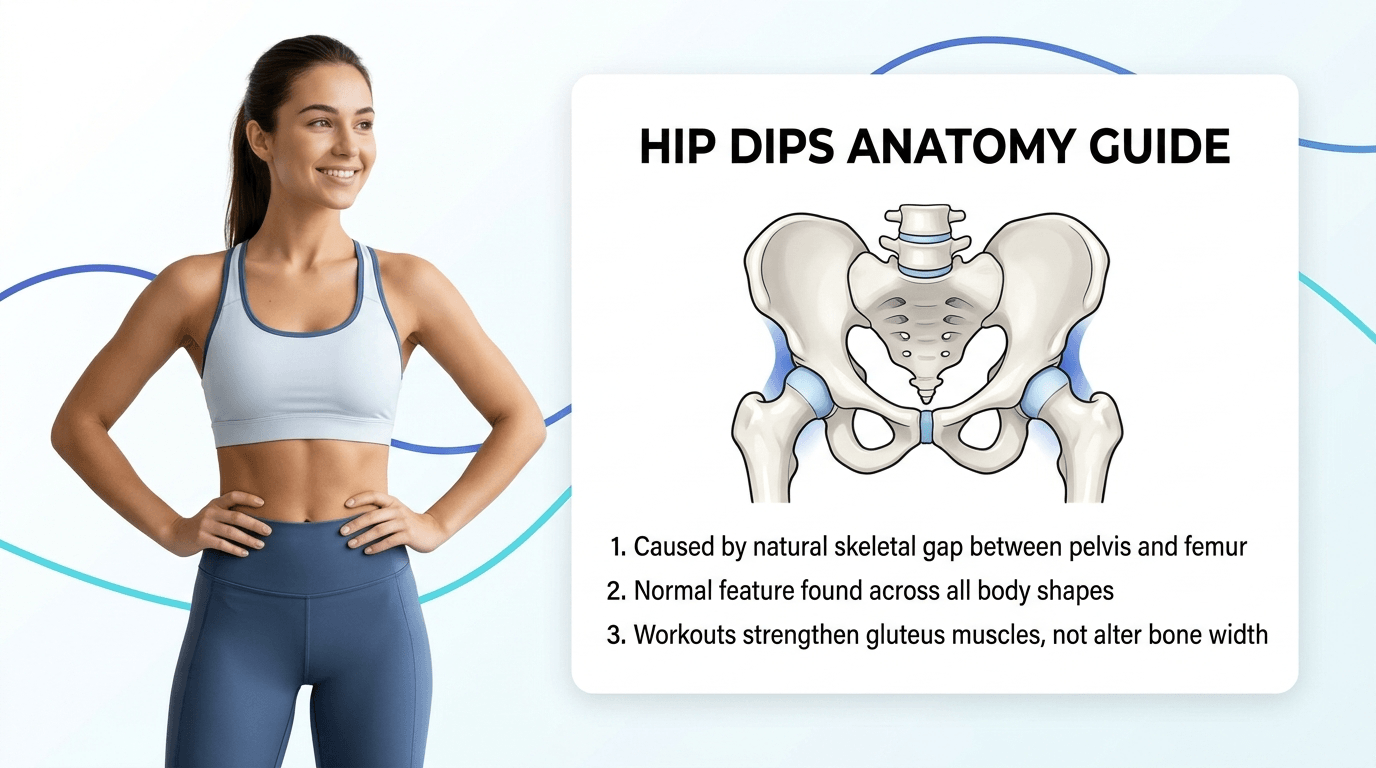
Constructed upon radiographic orthopaedic anatomy and kinematic surface scans. Explains why trochanteric depressions (hip dips) are standard skeletal architecture determined by the vertical distance between the iliac crest and femoral head, not muscular weakness or excess adipose tissue.
What Are Hip Dips? (Direct Answer)
Hip dips (medically termed trochanteric depressions or historically “violin hips”) are natural inward indentations along the lateral contour of your body, situated directly between the flare of your pelvic iliac crest and the top of your thigh bone (greater trochanter).
They are 100% normal human skeletal anatomy. Their prominence is dictated by bone morphology:
- Pelvic Height & Width: A wider vertical gap between the top rim of the pelvis and the hip socket creates a larger anatomical recess.
- Femoral Neck Angle: How the head of the femur sits inside the acetabulum dictates how far outward the trochanter protrudes.
- Subcutaneous Distribution: Adipose tissue is genetically programmed to deposit either above (high hip) or below (gluteal curve), rarely filling the bony hollow between them.
You can evaluate how your high-hip and low-hip measurements interact by using our interactive Body Shape Calculator.
The 3 Bone Structures That Create Hip Dips
1. The Iliac Crest
The high rim of your pelvis. If your ilium is wide and sits high relative to your sacrum, it creates a pronounced upper shelf that casts an inward shadow below it.
2. Greater Trochanter
The bony knob at the top of the femur. The distance between the iliac crest and this joint forms the skeletal indentation known as the trochanteric depression.
3. Gluteus Medius Gap
The gluteus medius and minimus tendons run diagonally across this void. Because muscles cannot span air into bony recesses, the indentation remains visible regardless of fitness.
The Myth: Why You Cannot “Fix” or Exercise Away Hip Dips
Biomechanical Fact: Muscle Cannot Grow Across a Bony Void
Countless fitness influencers market 10-minute hip dip workouts claiming to “fill in” the curve with fire hydrants and side leg raises. While these exercises strengthen the gluteus medius muscle, the muscle belly sits primarily toward the upper posterior pelvis, not directly inside the lateral depression. In fact, reducing subcutaneous body fat through training frequently makes hip dips more defined, as underlying bone outlines become clearer.
How Hip Dips Manifest Across Different Body Silhouettes
Figure 8 & Spoon Shapes
Possess a high, abrupt iliac shelf. The sudden inward drop beneath the pelvic shelf makes hip dips more visually distinct before the curve flares outward again at the lower thighs.
Classic Hourglass & Pear
When the vertical distance between the iliac crest and femur head is compact, soft tissue and gluteofemoral adipose drape continuously, creating a softer continuous outward slope.
Discover Your Silhouette & Pelvic Ratios
Input your high-hip and full-hip measurements to see how your proportions align with classic and high-shelf silhouettes.
Educational Disclaimer: ToolWingz provides anatomical proportion analysis for styling and fitness awareness.