

Hourglass Body Shape: Complete Measurement Guide & Proportions
Discover the exact mathematical formulas, bust-to-hip ratios, and anatomical traits that define the true classic hourglass silhouette.
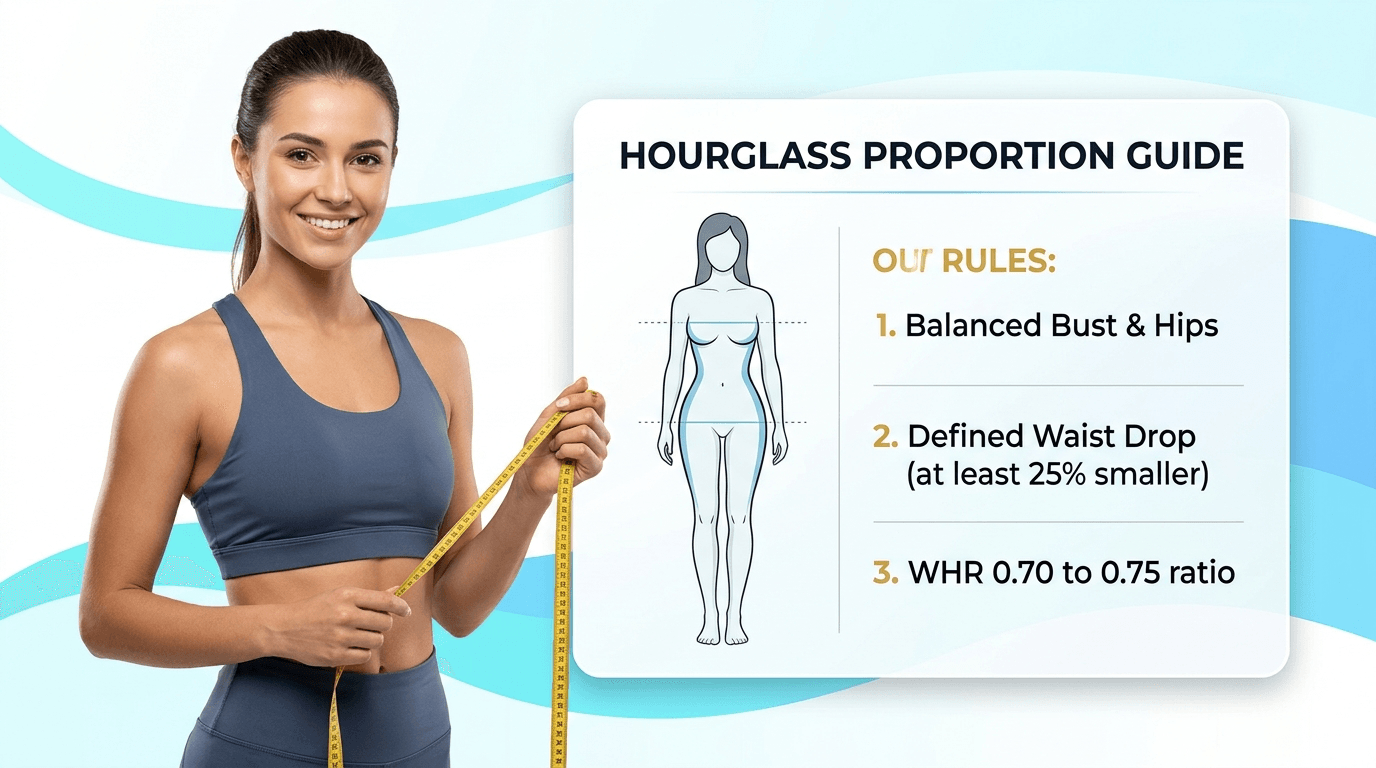
Derived from kinanthropometric standards and 3D surface scanning criteria established in standard apparel engineering (including SizeUSA data). Mathematical ratios evaluate bust-to-waist and hip-to-waist proportional symmetry independently of body mass index.
What Is the Hourglass Body Shape? (The Mathematical Definition)
An Hourglass body shape (often classified anthropometrically as an “X-silhouette”) is characterized by roughly equal bust and hip circumferences paired with a significantly narrower, sharply defined natural waistline.
According to apparel measurement and ergonomic algorithms:
- Bust-to-Hip Symmetry: Your bust and hip measurements are within 5% of each other (or generally within 1 to 2 inches / 2.5–5 cm).
- Waist Indentation: Your natural waist measurement is at least 25% smaller than both your bust and hips (or a difference of at least 8 to 10 inches / 20–25 cm).
- Waist-to-Hip Ratio (WHR): The mathematical ratio typically measures 0.75 or below (e.g., a 26-inch waist divided by 37-inch hips equals 0.70).
You can verify your exact mathematical category in seconds using our interactive Body Shape Calculator.
The 4 Precision Measurement Formulas for Hourglass Classification
Standard body classification algorithms use four criteria to confirm whether an individual falls into the true hourglass cluster or an adjacent shape:
| Parameter | Mathematical Condition | What It Means In Practice |
|---|---|---|
| Bust / Hip Balance | 0.95 ≤ (Bust / Hips) ≤ 1.05 | Bust and hips are almost identical in visual width and circumference. |
| Waist-to-Hip Ratio (WHR) | Waist / Hips ≤ 0.75 | Strong inward waist curvature creates the signature indentation. |
| Waist-to-Bust Ratio (WBR) | Waist / Bust ≤ 0.75 | Prevents misclassifying inverted triangles whose bust overwhelms waist. |
| Shoulder-to-Hip Parallel | ± 1.0 inch span differential | Acromion shoulder points line up vertically with outer greater trochanters. |
Case Study: Hourglass vs. False Positive Classifications
Many people assume they have an hourglass silhouette merely because their hips are curved, or conversely dismiss having one because they feel they carry weight in their midsection. Observe two comparative datasets:
Bust 36″ | Waist 26″ | Hips 37″
- • Bust / Hip Ratio: 36 / 37 = 0.973 (Within 5% margin of balance)
- • Waist / Hip Ratio: 26 / 37 = 0.702 (Distinctly below 0.75 threshold)
- • Waist / Bust Ratio: 26 / 36 = 0.722 (Distinctly below 0.75 threshold)
- • Classification Result: Classical Balanced Hourglass (X-Shape).
Bust 36″ | Waist 31″ | Hips 37″
- • Bust / Hip Ratio: 36 / 37 = 0.973 (Matches Hourglass balance)
- • Waist / Hip Ratio: 31 / 37 = 0.838 (Exceeds 0.75 cutoff by 0.088)
- • Waist / Bust Ratio: 31 / 36 = 0.861 (Insufficient indentation)
- • Classification Result: Athletic Rectangle (Balanced torso, subtle curve).
The 3 Subtle Variations of the Hourglass Shape
Anthropometric research categorizes the hourglass into three distinct structural variations based on secondary adipose and skeletal variations:
1. Neat (Classic) Hourglass
Bust and hips match within 1 inch. Moderate bust size (B or C cup), slender ribs, and an evenly distributed weight profile across upper arms and thighs.
2. Full Hourglass
Larger bust (D cup and above) matched by rounded glutes and full thighs, maintaining an accentuated 10+ inch waist reduction despite higher overall body mass.
3. Bottom Hourglass
Hips are slightly wider than the bust (e.g., hips 38″, bust 36″), but the waist remains deeply indented (≤ 26″), sitting right on the border of a pear silhouette.
Common Myths About the Hourglass Body Shape
Myth: You Must Have a 36-24-36 Measurement
Reality: 36-24-36 is simply one numerical expression of the ratio. A person measuring 44-32-45 is an authentic full hourglass, just as someone measuring 32-23-33 is an authentic petite hourglass. Ratios dictate morphology, not arbitrary numbers.
Myth: Hourglass Is the Most Common Female Shape
Reality: Landmark 3D anthropometry research by North Carolina State University (SizeUSA study analyzing 10,000+ women) established that only 8.4% of modern women possess an authentic hourglass profile. The rectangle (46.1%) and pear (20.9%) are far more common.
Verify Your Proportions on ToolWingz
Enter your bust, waist, high hip, and low hip measurements to calculate your exact silhouette score in seconds.
Educational Disclaimer: ToolWingz provides algorithmic body shape analysis for informational and styling guidance.