

How to Measure Your Body for a Body Shape Calculator (Bust, Waist, Hips & High-Hip)
Master the clinical 4-point measurement protocol for bust, natural waist, high-hip shelf, and fullest hips to eliminate body shape calculator errors.
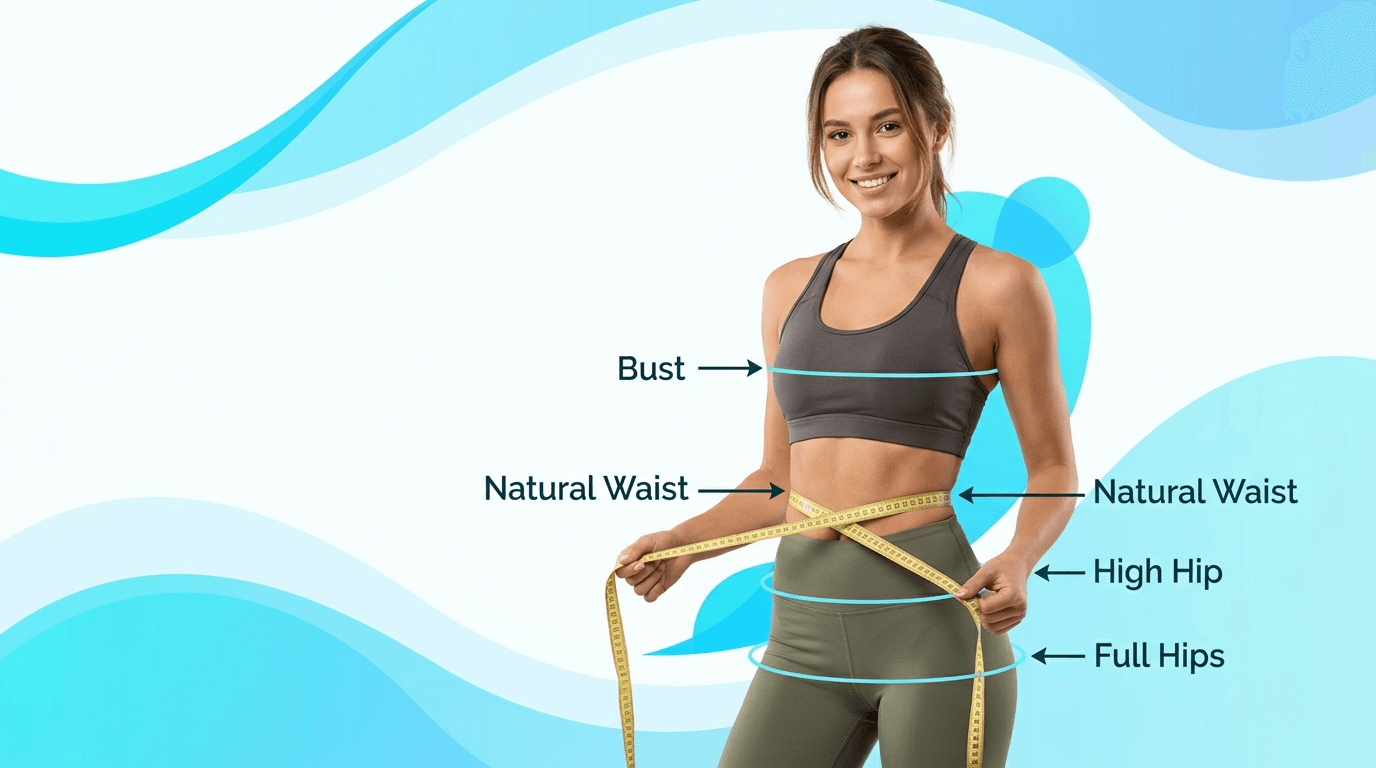
Formulated in accordance with the International Society for the Advancement of Kinanthropometry (ISAK) surface anthropometry protocols and the World Health Organization (WHO) physical status measurement guidelines. All circumference measurements require a non-stretchable, flexible fiberglass tape positioned parallel to the horizontal floor.
How to Measure Your Body for a Body Shape Calculator (Direct Answer)
To obtain an accurate classification from a body shape calculator, you must record four distinct anatomical circumferences: Bust, Natural Waist, High Hip, and Fullest Hip.
The single most common error is placing the tape measure over clothing, pulling it taut enough to compress soft tissue, or measuring the waist at the belly button rather than the true biological waistline. An error of merely 1.5 inches (3.8 cm) in waist placement can falsely misclassify a classic Hourglass silhouette as a Rectangle, or an Inverted Triangle as an Apple.
Before taking measurements, remove restrictive outerwear, stand upright on a flat surface with feet shoulder-width apart, and breathe out naturally to functional residual capacity. You can verify your ratios instantly using our interactive Body Shape Calculator, which processes four-point inputs across both Imperial (inches) and Metric (cm) standards.
The 4-Point Kinanthropometric Measurement Protocol
Follow these standardized clinical instructions for each primary circumference to ensure your mathematical ratios reflect true skeletal and adipose proportions:
Bust / Chest Circumference
Wrap the tape around the fullest part of your bust (typically across the apex or nipple line) while passing directly under the armpits and straight across the back shoulder blades (scapulae).
Natural Waistline
Locate the narrowest horizontal circumference of your torso, situated approximately halfway between the lower costal margin (bottom rib) and the top of the iliac crest (pelvic bone). This is typically 1 to 2 inches (2.5–5 cm) above the umbilicus (belly button).
High-Hip (Pelvic Shelf)
Position the tape measure directly across the upper pelvic bone ridge (iliac crest), roughly 3 to 4 inches (7 to 10 cm) below the natural waistline. This point traverses the lower abdominal shelf.
Low Hip / Fullest Hip
Stand with heels together and wrap the tape around the widest horizontal perimeter of your hips, buttocks, and upper thigh trochanters. Look into a full-length mirror from the side to verify the tape rests on the apex of your gluteal curves.
Standardized Anthropometric Measurement Reference Grid
The following reference chart details clinical landmark definitions, respiratory status, and common procedural errors identified during kinematic studies:
| Measurement Point | Anatomical Landmark | Respiratory State | Frequent Measurement Error |
|---|---|---|---|
| Bust / Chest | Fourth intercostal space / nipple line level across lower scapulae | Mid-tidal respiration (gentle exhale) | Measuring while holding deep breath (+1.5 to +2.5 in error) |
| Natural Waist | Midpoint between lower costal rib margin and superior iliac crest | End of normal expiration without abdominal vacuuming | Sucking in stomach or measuring at the belly button line |
| High-Hip Shelf | Superior margin of the anterior superior iliac spine (ASIS) | Neutral standing stance | Skipping this step, masking high-hip shelf silhouette |
| Low Hip / Gluteal | Prominence of the greater trochanters and maximum gluteal arc | Neutral, heels touching together | Standing with wide feet posture, falsely narrowing gluteal tape perimeter |
Real-World Case Study: How a 2-Inch Waist Error Distorts Your Classification
Examine this side-by-side comparative analysis of the same individual measured correctly versus incorrectly:
Measured at Anatomical Natural Waist
• Bust: 37.0 in (94.0 cm)
• Natural Waist: 27.0 in (68.6 cm) (Measured 1.5 in above navel)
• Hips: 38.0 in (96.5 cm)
• Waist-to-Hip Ratio (WHR): 27 / 38 = 0.71
• Bust-to-Waist Difference: 10.0 in (25.4 cm)
• Bust-to-Hip Delta: 1.0 in (2.5 cm)
Measured Over Low Pants at Belly Button
• Bust: 37.0 in (94.0 cm)
• Reported Waist: 31.5 in (80.0 cm) (Measured over denim waistband)
• Hips: 38.0 in (96.5 cm)
• Waist-to-Hip Ratio (WHR): 31.5 / 38 = 0.83
• Bust-to-Waist Difference: 5.5 in (14.0 cm)
• Waist-to-Hip Indentation: Under 17%
5 Common Measurement Pitfalls That Invalidate Calculator Results
1. Using a Metal Hardware Tape Measure
Carpenter or steel retractable tape measures cannot contour to bodily circumferences without buckling, flattening curved soft tissue, and adding false inches. Always use a soft tailor’s vinyl or fiberglass measuring tape.
2. Confusing Bra Band Size with Bust Measurement
A bra labeled “34D” does not mean your bust is 34 inches. The “34” reflects the ribcage circumference under the bust; a “D” cup indicates approximately a 4-inch projection, meaning the actual bust circumference is around 38 inches (96.5 cm).
3. Measuring Over Denim or Bulk Clothing
Heavy denim, thick belt loops, and fleece pockets add anywhere from 1.0 to 3.0 inches (2.5 to 7.5 cm) of false width. Take all measurements against bare skin or lightweight, non-compressing undergarments.
4. Compressing Soft Tissue (The Pinching Effect)
The tape measure should sit flat and snug against the dermis without digging in or causing flesh to bulge over or under the ribbon. The tape should slide smoothly without friction.
5. The Posture & Foot-Spacing Distortion
Standing with feet spread wide contracts the tensor fasciae latae and rotates the hips inward, artificially shrinking the true gluteal measurement. Always position heels together or no more than 2 inches apart during hip assessments.
The Bottom Line: Accurate Data Delivers Accurate Proportions
Your body shape is a geometric ratio, not an arbitrary judgment of weight or fitness. A person weighing 115 lbs can possess an Hourglass, Inverted Triangle, or Rectangle frame, exactly like someone weighing 210 lbs. The silhouette depends entirely on the mathematical relationships between your skeletal clavicle width, lower rib cage, pelvic rim, and femur placement.
Once you have your accurate numbers, you can explore personalized wardrobe guidelines, identify your exact high-hip shelf dynamics, and evaluate your cardiovascular health benchmarks using standardized World Health Organization Waist-to-Hip Ratio thresholds.
Put Your Measurements into the ToolWingz Body Shape Calculator
Enter your verified bust, natural waist, high-hip shelf, and fullest hip numbers to discover your exact silhouette, proportional ratios, and personalized styling guidelines.
Educational Disclaimer: ToolWingz Body Shape Calculator provides geometric silhouette classifications and WHO health ratio benchmarks for informational purposes.