

International BAC Driving Limits by Country: Global Legal Alcohol Thresholds
A global guide to drink-driving laws across 50+ countries. Learn why the American 0.08% limit is an outlier and what tourists must know before driving abroad.
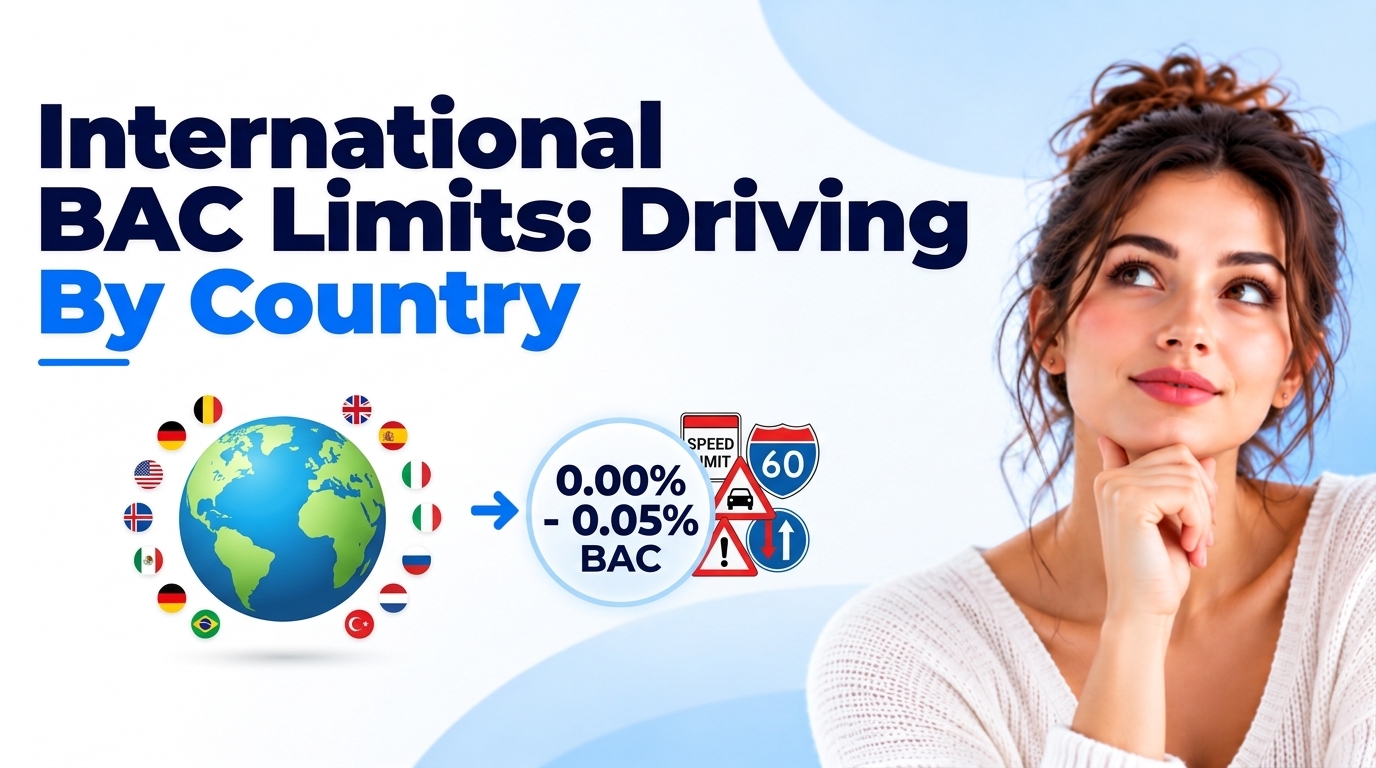
Synthesized from comparative traffic safety databases published by the World Health Organization (WHO) Global Status Report on Road Safety, the European Transport Safety Council (ETSC), and national transport ministries worldwide.
What Are the Legal BAC Limits for Driving Around the World? (Direct Answer)
While the standard legal blood alcohol limit for adult passenger vehicle drivers in the United States, Canada, and the United Kingdom (excluding Scotland) is 0.08% BAC, this is actually among the highest and most lenient limits in the developed world.
Globally, the vast majority of countries enforce substantially stricter drink-driving thresholds:
- 0.05% BAC: The prevailing international standard adopted across most of Western Europe, Australia, New Zealand, Argentina, and South Africa.
- 0.02% BAC: Enforced in Norway, Sweden, Poland, China, and Estonia—effectively a zero-tolerance operational policy with a minimal buffer for biological variance.
- 0.00% Absolute Zero Tolerance: Strictly enforced across Brazil, the Czech Republic, Hungary, Romania, Slovakia, Japan, and most Islamic nations.
International travelers who assume American 0.08% rules apply overseas routinely face instant arrest, vehicle impoundment, hefty criminal fines, and deportation. To understand how your personal drink count translates into blood concentration, use our BAC calculator before traveling.
Why Does Most of the World Reject the 0.08% Standard?
The global shift toward 0.05% and 0.02% thresholds is grounded in epidemiological road safety research conducted by the World Health Organization and the European Union:
The Exponential Crash Risk Curve
Forensic epidemiological data demonstrate that a driver's risk of being involved in a fatal road crash does not rise linearly—it increases exponentially with blood alcohol concentration.
At 0.05% BAC, a driver is approximately twice as likely to crash compared to a completely sober driver. By the time a driver reaches 0.08% BAC, that crash probability surges to nearly five times higher, and at 0.10% it spikes to over twelve times. European governments lowered limits to 0.05% because cognitive impairment and delayed braking reflexes are already clinically significant at 0.04%–0.05%.
The “Clear Social Norm” Philosophy
Sociological safety studies in countries like Norway, Sweden, and Japan demonstrate that when the limit is set at 0.08%, motorists engage in mental calculations trying to guess whether they are at two drinks or three drinks, often miscalculating. When the limit is 0.02% or 0.00%, the cultural message is unambiguous: if you drink any alcohol, you do not drive.
The 4 Global Drink-Driving Tiers
National drink-driving frameworks fall into four distinct legislative philosophies:
US, UK & Canada
Focuses enforcement primarily on visibly heavy intoxication; allows 1–3 standard drinks depending on body mass.
Most of Europe & Australia
The international benchmark recommended by the WHO; allows at most one modest drink with a meal.
Scandinavia & China
Zero tolerance with a minor buffer for mouthwash, metabolic fermentation, or breathalyzer margin of error.
Brazil, Japan & Middle East
Total legal ban on driving with any measurable ethanol; criminal sanctions trigger at 0.001%.
Comprehensive Country-by-Country Legal BAC Limits
The table below outlines standard passenger vehicle limits, novice/professional thresholds, and typical penalties across 25 major tourist and transit destinations:
| Country / Jurisdiction | Standard Driver Limit | Novice / Professional | Notable Penalties & Enforcement |
|---|---|---|---|
| United States | 0.08% (0.05% in Utah) | 0.00%–0.02% (Under 21); 0.04% (CDL) | Fines up to $2,000, license suspension, ignition interlock device. |
| United Kingdom (England/Wales) | 0.08% (80 mg/100ml) | 0.08% (all drivers) | Mandatory minimum 12-month driving ban, unlimited fine, up to 6 months prison. |
| Scotland | 0.05% (50 mg/100ml) | 0.05% (all drivers) | Lowered in 2014; mandatory 12-month ban and criminal record. |
| France | 0.05% (0.5 g/L) | 0.02% (Novice drivers < 3 yrs) | €135 fine and 6 license points; above 0.08% carries €4,500 fine and 2 yrs prison. |
| Germany | 0.05% (0.5 g/L) | 0.00% (Novice < 21 yrs & probationary) | €500–€1,500 fine, 1–3 month driving ban; criminal DUI at 0.03% if fault in crash. |
| Norway & Sweden | 0.02% (0.2 g/L) | 0.02% (all drivers) | Income-based day fines (often exceeding $5,000) plus mandatory prison time. |
| Australia | 0.05% | 0.00% (Learners, P-plates, heavy vehicles) | Random Breath Testing (RBT) checkpoints; roadside license disqualification. |
| Japan | 0.03% BrAC (0.15 mg/L) | 0.00% practical zero tolerance | Up to 5 years prison, ¥1,000,000 fine; passengers and bars serving alcohol also prosecuted. |
| Brazil | 0.00% (Lei Seca) | 0.00% (all drivers) | 12-month license suspension, heavy fines; criminal trial above 0.06% BAC. |
Source: WHO Global Status Report on Road Safety & ETSC Drink-Driving Policy Compendium.
Real-World Scenarios: How Tourists Get Arrested Overseas
American and Canadian tourists frequently experience severe legal shock when driving rental cars abroad:
The Single Beer with Dinner in Oslo
An American visitor has one 16-oz Norwegian lager (5% ABV) with dinner at 7:00 PM and drives a rental car at 8:30 PM. In the US, his BAC of 0.028% would be well within the 0.08% limit.
At a routine police roadside checkpoint in Oslo, an evidentiary breath test registers 0.028%. Because Norway enforces a strict 0.02% threshold, he is detained on the spot, fined 1.5 times his gross monthly income, and banned from driving in Norway for one year.
The Japanese “Accomplice Liability” Law
Under Japanese Road Traffic Law (Article 65), anyone who provides a vehicle to an intoxicated driver, serves alcohol to someone knowing they will drive, or even rides as a passenger in a vehicle driven by an intoxicated person faces criminal prosecution.
Foreign travelers who get into a car driven by an acquaintance who drank two beers can be sentenced to up to 3 years imprisonment and fined up to ¥500,000, even though they never touched the steering wheel.
Never assume foreign police require “probable cause” or erratic driving to pull you over. In Australia, the UK, France, and Scandinavia, law enforcement conducts Random Breath Testing (RBT) checkpoints without needing any suspicion. Every stopped driver is tested.
If traveling internationally, adopt an absolute zero rule: if you plan to drive, do not consume any alcohol whatsoever.
The American 0.08% limit is an anomaly—most of the world stops at 0.05% or 0.00%.
When traveling abroad, one standard drink can easily land you in jail or trigger thousands in fines. When driving internationally, the only safe strategy is 100% total sobriety.
Estimate Your BAC with the Toolwingz BAC Calculator
Calculate theoretical blood alcohol curves and explore how body weight, drink strength, and elapsed time influence clearance with 100% privacy.
Educational Disclaimer: Toolwingz BAC Calculator provides an estimate for informational purposes. It does not measure your actual BAC and cannot determine whether you are safe or legally permitted to drive.