

Inverted Triangle Body Shape: Shoulder-to-Hip Ratios & Styling Guide
Explore the biomechanics of the athletic inverted triangle silhouette: measurement thresholds, shoulder-to-hip balance, and styling strategies.
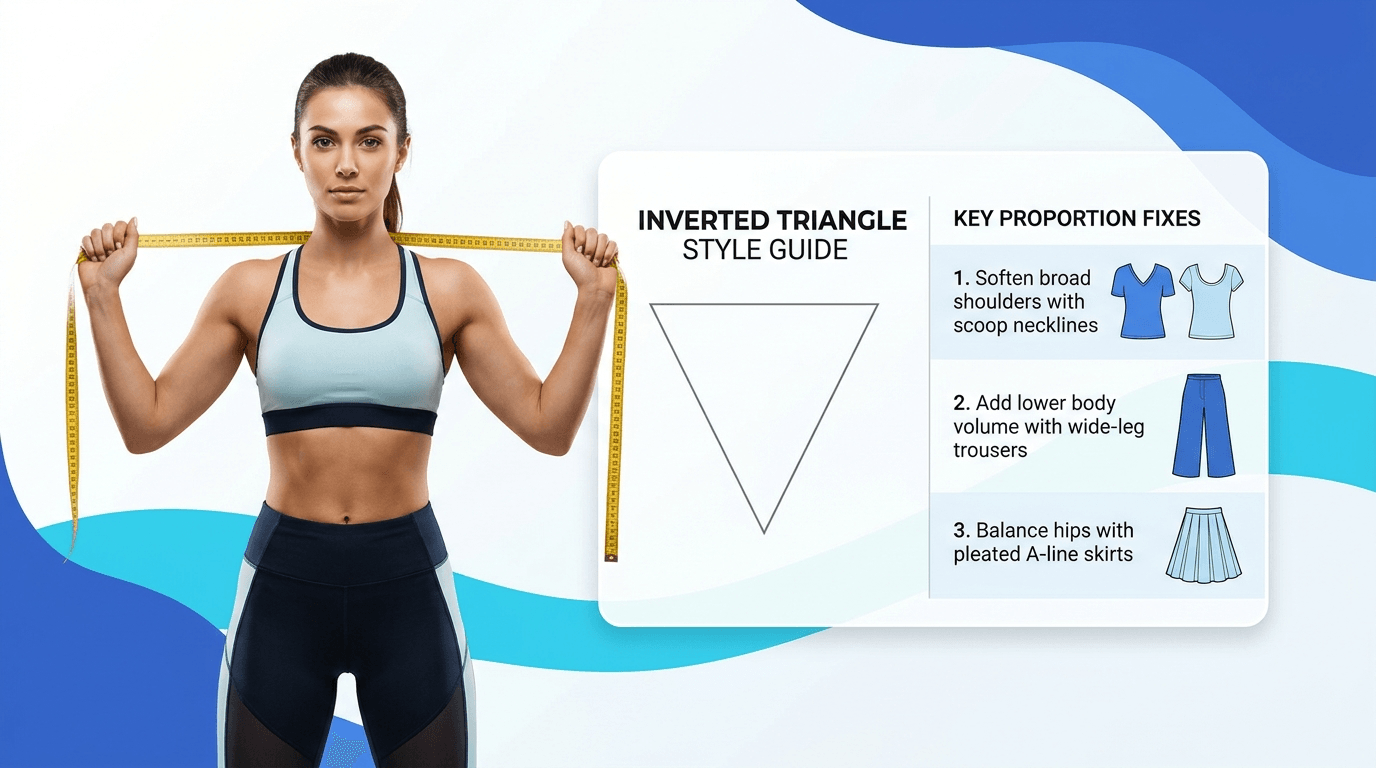
Formulated upon orthopaedic bi-acromial skeletal metrics and apparel pattern-making algorithms. Examines how clavicular span, thoracic circumference, and narrow pelvic structure create the dynamic V-silhouette in both athletic and fashion contexts.
What Is the Inverted Triangle Body Shape? (Direct Answer)
The Inverted Triangle body shape (also recognized as the V-silhouette, athletic taper, or cone shape) is defined by an upper body that is measurably broader and more dominant than the lower body: the shoulders or bust line are the widest horizontal dimension, tapering downward to narrow hips and slender legs.
In algorithmic anthropometry, you are classified as an inverted triangle when:
- Shoulder or Bust Dominance: Your shoulder span or full bust measurement is at least 5% larger than your hips (frequently 2 to 4+ inches / 5–10 cm wider).
- Tapered Lower Half: The pelvic bones, buttocks, and thighs are comparatively slim and straight.
- Linear Waist Transition: The waist has a gentle transition rather than an extreme inward pinch, giving the torso an aerodynamic “V” contour.
To verify whether your upper frame proportions place you in this athletic cluster, use our interactive Body Shape Calculator.
Mathematical Criteria & Metric Thresholds
Standard apparel sizing software distinguishes an inverted triangle from an hourglass or rectangle using three primary ratio checks:
| Proportion Index | Numerical Formula | Anatomical Implication |
|---|---|---|
| Bust-to-Hip Ratio | (Bust / Hips) ≥ 1.05 | Upper thoracic boundary exceeds lower pelvic perimeter by over 5%. |
| Shoulder-to-Hip Ratio | (Shoulders / Hips) ≥ 1.05 | Acromion shoulder tip distance clearly extends past trochanteric width. |
| Hip-to-Waist Differential | < 8.0 inches (20 cm) | Lower body does not display the flaring shelf typical of pears or hourglasses. |
Case Study: Inverted Triangle vs. Top Hourglass
Bust 38″ | Waist 29″ | Hips 34″
- • Bust / Hip Ratio: 38 / 34 = 1.117 (Significantly above 1.05)
- • Waist / Hip Ratio: 29 / 34 = 0.852 (Straight, athletic hip line)
- • Lower Silhouette: Slender hips with minimal gluteal curve
- • Diagnosis: Authentic Inverted Triangle (V-Shape).
Bust 38″ | Waist 26″ | Hips 36″
- • Bust / Hip Ratio: 38 / 36 = 1.055 (Borderline upper fullness)
- • Waist / Hip Ratio: 26 / 36 = 0.722 (Deep waist indentation < 0.75)
- • Lower Silhouette: Moderate curve in hips and glutes
- • Diagnosis: Top Hourglass (Retains classic waist curve).
Visual Harmonization: How to Balance the Inverted Triangle
1. Soften the Shoulders
V-necks, scoop necks, and raglan sleeves break up horizontal chest expanse. Avoid shoulder pads, boat necklines, and puffed sleeve caps.
2. Add Lower-Body Volume
A-line skirts, wide-leg palazzo pants, pleated culottes, and cargo styles add visual weight to the hips, creating an optical hourglass symmetry.
3. Utilize Color Counterbalance
Dark, solid neutral tones on top combined with vibrant prints, lighter pastels, or textured fabrics on trousers and skirts draw the eye downward.
Calculate Your Shoulder-to-Hip Ratio on ToolWingz
Input your shoulder, bust, waist, and hip numbers into our calculator to receive an immediate proportional classification.
Educational Disclaimer: ToolWingz calculations are designed for personal styling and fitness proportion awareness.