

Kibbe Body Types vs. Body Shape Calculator: Yin & Yang vs. Precision Ratios
Artistic Yin/Yang styling versus mathematical geometry: how Kibbe body types compare with objective algorithmic body shape calculators.
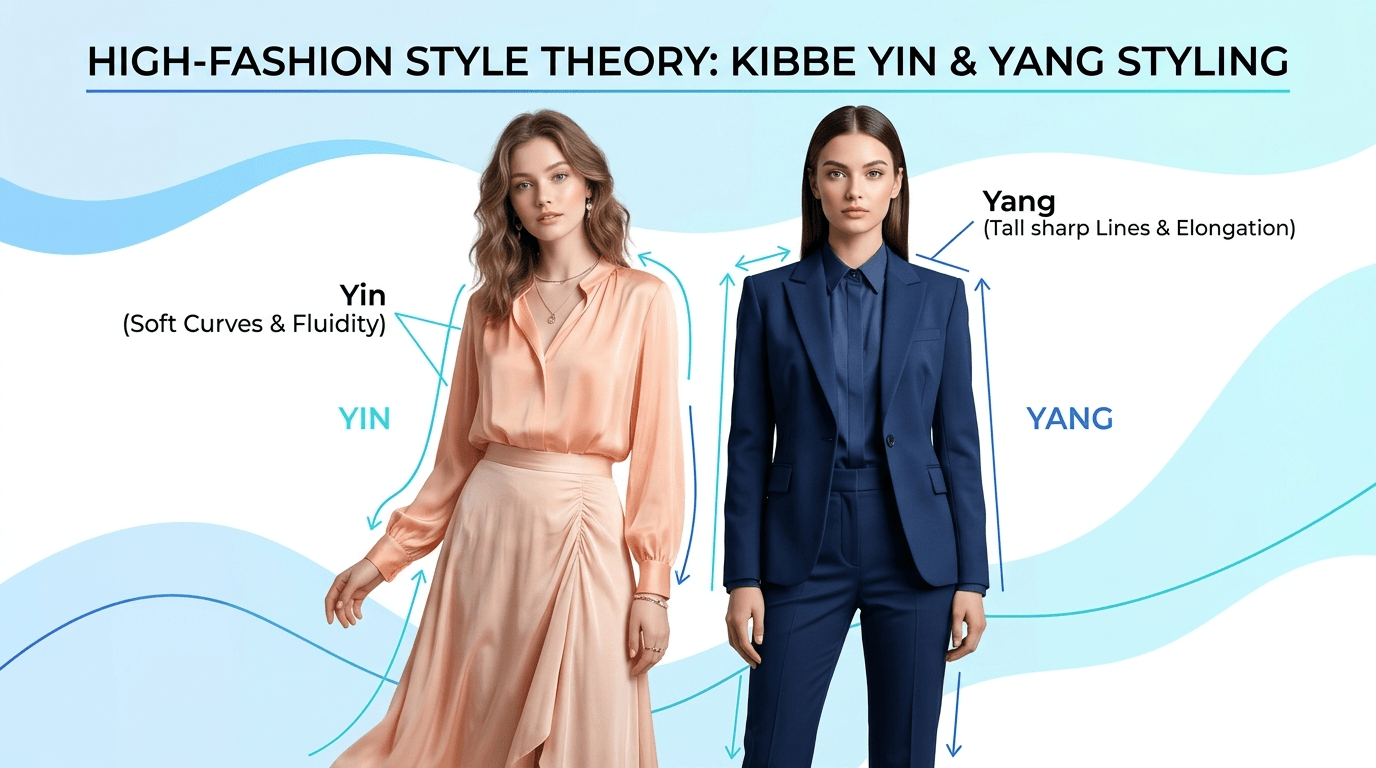
Contrasts David Kibbe's qualitative 13 Image Identity Archetypes (rooted in Yin/Yang artistic philosophy) with modern quantitative 3D anthropometry and tape-measured geometric ratio algorithms.
Kibbe Body Types vs. Body Shape Calculator: What Is the Difference? (Direct Answer)
The difference between David Kibbe's Image Identity System and an Algorithmic Body Shape Calculator lies in subjective artistic harmony versus objective mathematical geometry:
- Kibbe Body Types (13 Archetypes): Created by stylist David Kibbe in his 1987 book Metamorphosis. It categorizes physical presence based on the interplay of Yin (curved, soft, small, delicate) and Yang (sharp, angular, tall, broad) across skeletal framework, flesh distribution, and facial structure.
- Body Shape Calculator: Evaluates pure mathematical circumference ratios between your shoulders/bust, natural waist, and hips. It gives an unambiguous numerical diagnosis (Hourglass, Pear, Rectangle, Inverted Triangle) independent of height, facial features, or artistic mood.
For example, a person with an exact 36-24-36 measurement is always a mathematical Hourglass in our calculator, but in Kibbe she could be a Theatrical Romantic (if petite with delicate bones) or a Soft Dramatic (if tall with a strong vertical line).
Check your mathematical proportions in seconds using our interactive Body Shape Calculator.
The 5 Primary Kibbe Image Families
1. Dramatic (Pure Yang)
Tall, long vertical line, sharp angular bone structure, and narrow silhouette. Flattered by architectural lines, long tailoring, and geometric shapes.
2. Romantic (Pure Yin)
Soft curves, rounded bone edges, lush flesh distribution, and delicate extremities. Flattered by drape, waist emphasis, and fluid fabrics.
3. Classic (Symmetrical)
Balanced Yin and Yang with evenly proportioned limbs and facial symmetry. Flattered by minimalist tailoring, clean lines, and timeless silhouettes.
4. Natural (Soft Yang)
Blunt, athletic bone structure, broad shoulders, and relaxed carriage. Flattered by unstructured garments, asymmetrical drape, and textured weaves.
5. Gamine (Contrasting)
Compact, petite stature featuring sharp Yang bone framework juxtaposed with youthful Yin facial features. Flattered by crisp, broken lines and color blocking.
Direct System Comparison: Which System Should You Use?
| Criteria | Kibbe System | ToolWingz Body Shape Calculator |
|---|---|---|
| Input Required | Full-body photos, height, bone sharpness assessment. | Tape measurements (bust, waist, high hip, low hip). |
| Output Format | Artistic image archetype (e.g., Soft Classic, Flamboyant Gamine). | Geometric silhouette + WHO clinical WHR risk benchmark. |
| Objectivity | Subjective; requires extensive eye training. | 100% objective and mathematically reproducible. |
Calculate Your Objective Proportions Now
Skip the guesswork of subjective image typing. Plug your measurements into our calculator to reveal your precise geometric body shape in seconds.
Educational Disclaimer: ToolWingz provides body shape and ratio analysis for wellness and style awareness.