

Men’s Body Types Explained: Trapezoid, Inverted Triangle, Rectangle, Oval & Triangle
Explore the 5 structural male silhouettes: Trapezoid, Inverted Triangle, Rectangle, Oval, and Triangle. Master tailoring drop ratios and WHO health markers.
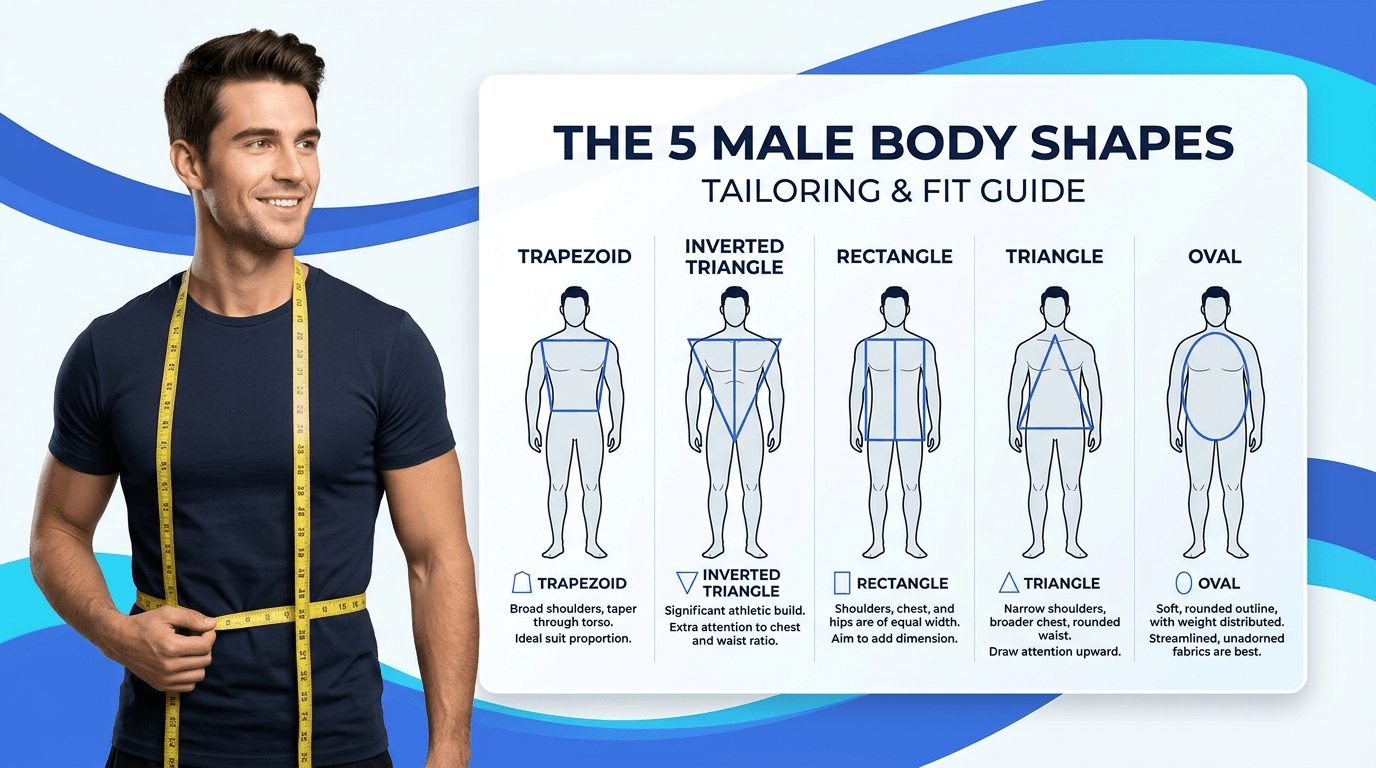
Derived from Savile Row bespoke tailoring standards, military anthropometric sizing surveys (ANSUR II), and the World Health Organization (WHO) male abdominal adiposity risk guidelines. Male silhouettes are determined by the proportional “Drop” ratio between chest, natural waist, and pelvic perimeter.
Men’s Body Types Explained (Direct Answer)
Men’s body shapes are classified into five primary structural silhouettes: Trapezoid, Inverted Triangle (V-Taper), Rectangle, Oval, and Triangle.
Unlike female silhouettes—which are largely defined by the pelvic waist-to-hip flare—male silhouettes are governed by the Chest-to-Waist “Drop” (the mathematical difference between chest circumference and trouser waist) and the biacromial clavicle width relative to the pelvic girdle. While ready-to-wear menswear is almost universally patterned on the balanced Trapezoid model, over 65% of men possess Rectangle, Oval, or Triangle frames that require specific tailoring and fitness strategies.
You can calculate your exact male shape, tailoring drop, and WHO health risk score using our interactive Body Shape Calculator.
The 5 Structural Male Silhouettes: Anatomy & Tailoring Science
Explore the anatomical features, mathematical drop ratios, and styling blueprints for each male frame:
The Trapezoid (Athletic Balanced Standard)
Broad shoulders, an expanded muscular chest, and a natural gentle taper down toward a trim waist and narrow hips. The chest circumference typically exceeds the waist by 6 to 8 inches (standard tailoring Drop 6 to Drop 8).
The Inverted Triangle (Extreme V-Taper)
Massive shoulder span (wide deltoids and lats) paired with a narrow pelvic girdle and slender waist. The chest-to-waist drop exceeds 8 to 10+ inches (Drop 8 to Drop 12), common among competitive swimmers, gymnasts, and bodybuilders.
The Rectangle (Linear / Ectomorphic Frame)
Shoulders, chest, waist, and hips form a continuous vertical line with minimal inward taper. The chest-to-waist difference is narrow (under 4 inches, or Drop 0 to Drop 4). Common among long-distance runners and lean ectomorphs.
The Oval (Round / Endomorphic Core)
Circumference is concentrated primarily in the abdomen, where the waist measurement equals or exceeds the chest and hips (negative drop, or WHR ≥ 0.95). Shoulders and lower legs often remain relatively slender.
The Triangle (Lower Body Dominant)
Sloped, narrow shoulders and a modest chest that widen downward into a broader waist and wider pelvic hips. The lower torso visibly outweighs the upper shoulder line.
The Tailoring “Drop”: The Math of Menswear
In traditional menswear, the “Drop” defines the mathematical difference between your jacket chest size and your trouser waist size:
| Drop Rating | Chest - Waist Delta | Corresponding Body Shape | Suit Fit Category |
|---|---|---|---|
| Drop 0 to Drop 2 | Waist is equal to or wider than chest | Oval / Triangle | Executive / Portly Cut |
| Drop 4 | Chest is 4 in larger than waist | Rectangle | Classic / Regular Fit |
| Drop 6 to Drop 7 | Chest is 6–7 in larger than waist | Trapezoid | Modern / Slim Fit |
| Drop 8 to Drop 12 | Chest is 8–12+ in larger than waist | Inverted Triangle | Athletic Drop / Made-to-Measure |
Male Health Risk & WHO Waist-to-Hip Benchmarks
The World Health Organization (WHO) establishes that male visceral fat accumulation in the abdomen represents a significant predictor of ischemic heart disease, hypertension, and type 2 diabetes.
Low Cardiovascular Risk
Typical of Trapezoid and Inverted Triangle frames with healthy intra-abdominal fat levels.
Moderate Metabolic Risk
Early visceral fat deposition. Recommended lifestyle, nutrition, and aerobic adjustments.
High Metabolic Risk
Typical of Oval silhouettes. High intra-abdominal pressure and cardiac risk profile.
The Bottom Line: Master Your Proportions
Every male body type can look impeccably styled once you understand your underlying skeletal geometry. Rather than forcing your body into arbitrary off-the-rack patterns, knowing your tailoring drop and silhouette allows you to highlight your upper frame, balance your midsection, and dress with timeless sartorial command.
Input your chest, waist, and hip circumferences into the ToolWingz calculator above to determine your exact male body type and tailoring specifications today.
Calculate Your Male Body Type & Tailoring Drop
Input your chest, natural waist, and hip circumferences to determine your exact male silhouette, tailoring drop, and World Health Organization cardiovascular risk score.
Educational Disclaimer: ToolWingz provides anthropometric ratio modeling and health benchmarks for personal fitness, style, and educational awareness.