

Pear Body Shape (Triangle): Measurements, Ratios & Styling Guide
A comprehensive guide to the pear body shape: understanding gynoid fat metabolism, key measurement ratios, and wardrobe balancing rules.
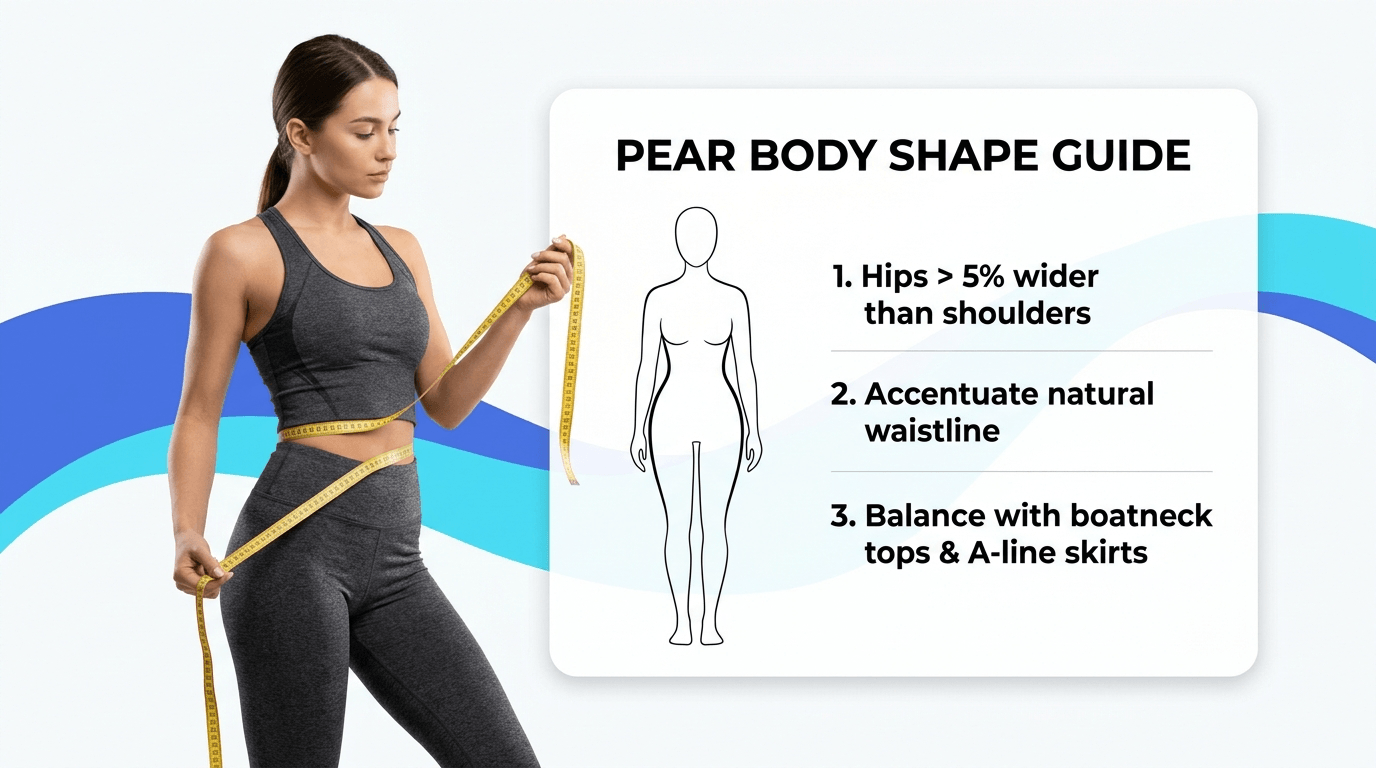
Constructed upon peer-reviewed metabolic endocrinology and ergonomic apparel standards. Highlights why lower-body subcutaneous adipose stores (gluteofemoral) behave differently than visceral abdominal fat depots, alongside precise mathematical ratios for the triangle silhouette.
What Is the Pear (Triangle) Body Shape? (Direct Answer)
The Pear body shape (anthropometrically classified as the Triangle silhouette) is defined by a lower body that is measurably wider than the upper body: hips and thighs are the widest horizontal dimension, while shoulders and bust remain narrower and more delicate.
Mathematically, an individual is classified as a pear silhouette when:
- Hip-to-Bust Disparity: Your hip measurement is at least 5% greater than your bust measurement (often 2 to 4+ inches / 5–10 cm wider).
- Narrow Upper Frame: The shoulder span and chest width are noticeably smaller than the bi-trochanteric hip width.
- Defined Waist: A clear, indented waistline remains intact, producing a low Waist-to-Hip Ratio (WHR) typically under 0.80.
To evaluate your upper-to-lower body ratio with algorithmic precision, test your measurements in our interactive Body Shape Calculator.
Pear Shape Ratio Formulas & Kinanthropometric Thresholds
When size-survey algorithms analyze 3D coordinate points on the human body, the pear classification requires passing three mathematical filters:
| Structural Metric | Mathematical Range | Visual & Biomechanical Manifestation |
|---|---|---|
| Hip-to-Bust Ratio | (Hips / Bust) ≥ 1.05 | Hips exceed the bust line by at least 5% (typically 2 to 6 inches difference). |
| Waist-to-Hip Ratio (WHR) | Waist / Hips ≤ 0.78 | Waist remains distinctly indented; weight gain deposits primarily on thighs and glutes. |
| Shoulder-to-Hip Differential | Bi-deltoid < Bi-trochanteric | Horizontal shoulder line is narrower than the widest pelvic circumference. |
The Biological Superpower: Why Pear Fat Distribution Protects Your Heart
From an endocrinological viewpoint, pear body fat is classified as gynoid subcutaneous adipose tissue, regulated by estrogen receptors (specifically ER-alpha).
Unlike visceral abdominal fat (which sits around internal organs and pours pro-inflammatory cytokines into the portal vein), gluteofemoral fat acts as a metabolic sink:
- Cardiovascular Protection: Epidemiological studies published in the International Journal of Obesity consistently reveal that individuals with low WHR and gynoid fat distribution have lower risks of type 2 diabetes, stroke, and hypertension.
- DHA Lipid Reservoirs: Gluteofemoral fat stores higher concentrations of long-chain polyunsaturated fatty acids (such as docosahexaenoic acid, DHA), biologically conserved for embryonic neurodevelopment during lactation.
- Elevated Adiponectin: Subcutaneous thigh fat secretes adiponectin, an anti-inflammatory hormone that dramatically improves insulin sensitivity throughout muscle tissue.
Comparative Case Analysis: True Pear vs. Bottom Hourglass
Bust 33″ | Waist 26″ | Hips 39″
- • Hip / Bust Ratio: 39 / 33 = 1.18 (Exceeds 1.05 pear threshold)
- • Waist / Hip Ratio: 26 / 39 = 0.666 (Significantly tapered waist)
- • Shoulder Span: Narrower than outer hip line
- • Classification: Classic Triangle / Gynoid Pear.
Bust 37″ | Waist 26″ | Hips 40″
- • Hip / Bust Ratio: 40 / 37 = 1.08 (Hips slightly wider)
- • Waist / Hip Ratio: 26 / 40 = 0.650 (Deep waist indentation)
- • Shoulder Span: Balanced with hips due to broader clavicles
- • Classification: Bottom Hourglass (Sufficient bust volume to balance hips).
Visual Ergonomics: 3 Rules to Harmonize a Pear Silhouette
1. Expand the Upper Line
Boat necklines, off-the-shoulder cuts, structured blazers with light shoulder pads, and cowl necks broaden visual shoulder span to mirror hip width.
2. Skim, Don't Cling, the Hips
A-line skirts, bias-cut slip skirts, and straight or wide-leg trousers flowing straight down from the widest hip marker eliminate hem bunching.
3. Showcase the Natural Waist
Crop jackets that terminate exactly at the natural waist, tuck-ins, and high-rise trousers emphasize the narrowest anatomical point of your torso.
Calculate Your Hip-to-Bust Disparity Score
Plug your measurements into the ToolWingz Body Shape Calculator to discover whether your frame aligns with the pear, spoon, or bottom hourglass profile.
Educational Disclaimer: ToolWingz provides body shape and WHR analysis for lifestyle and styling assistance.