

Rectangle vs. Inverted Triangle: Identifying Athletic Silhouettes
Compare two statuesque athletic silhouettes: Rectangle vs Inverted Triangle. Master shoulder-to-hip ratios, wide-leg balancing, and neckline formulas.
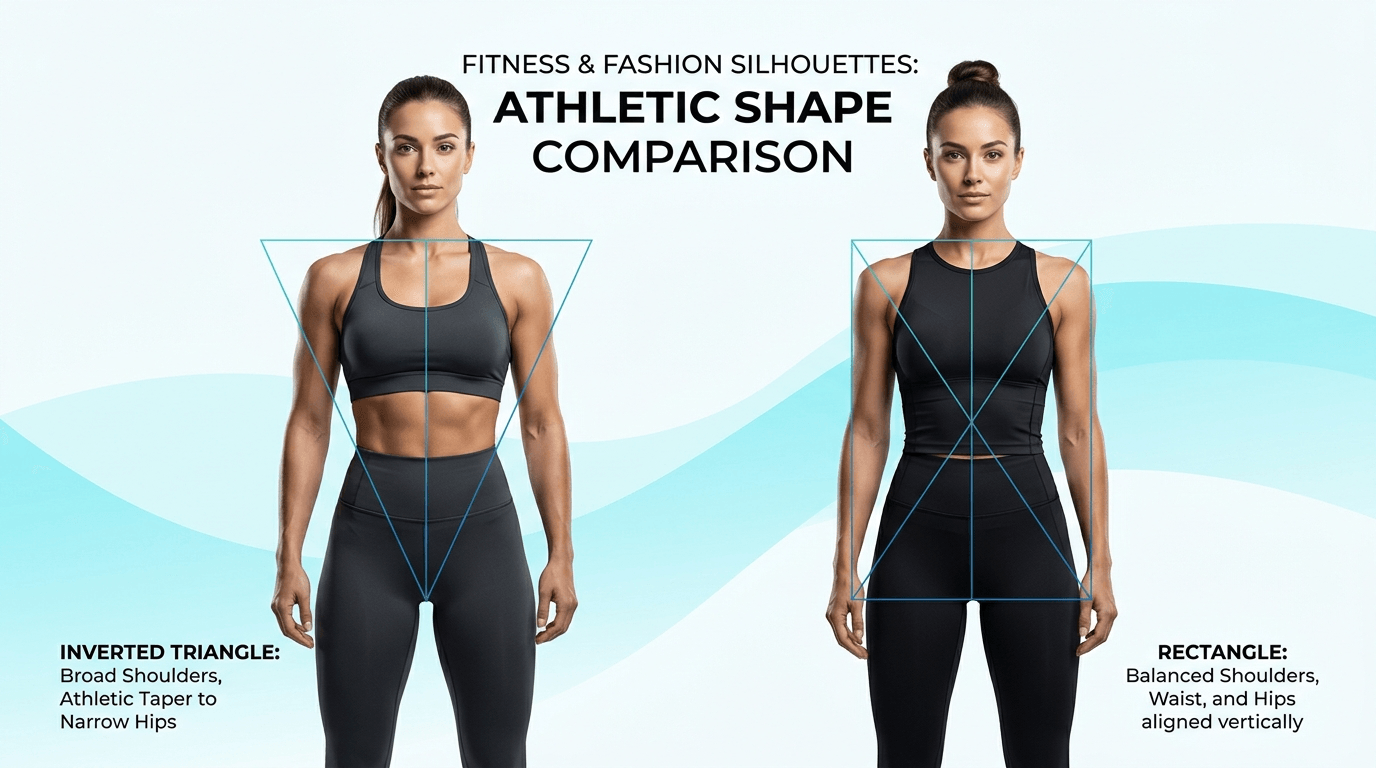
Formulated upon biacromial diameter (shoulder width) to bitrochanteric width (pelvic hip) ratios and 3D athletic body composition surveys. While both Rectangle and Inverted Triangle frames feature sleek, athletic silhouettes, they differ sharply in upper-torso clavicular dominance and lower-pelvic taper.
Rectangle vs. Inverted Triangle (Direct Answer)
The critical difference between a Rectangle (Ruler) and an Inverted Triangle (Strawberry) silhouette is the shoulder-to-hip ratio and upper-body dominance.
A Rectangle body shape features shoulders, bust, and hips that are roughly equal in width, creating a uniform, straight vertical column with little natural waist indentation (bust, waist, and hips all within 5% to 8% of one another). In contrast, an Inverted Triangle features shoulders and bust that are visibly and measurably wider than the hips by 5% or more (bust-to-hip ratio ≥ 1.05), tapering downward into slender hips, a flat buttocks profile, and lean legs.
You can verify your exact upper-to-lower body ratio using our interactive Body Shape Calculator.
Anatomical Differences: Vertical Column vs. Athletic V-Taper
Examine the structural skeletal traits that define both athletic silhouettes:
Linear Athletic Balance
- • Shoulder-to-Hip Balance: Shoulders and hips align along the same vertical line.
- • Waistline: Subtle natural indentation (waist is only 10% to 20% smaller than bust/hip).
- • Bust Volume: Small to medium, proportional to the ribcage.
- • Limb Distribution: Long, slender arms and athletic legs.
- • Tailoring Trait: Shift dresses, tailored suits, and linear column coats fit effortlessly.
Upper-Body Dominant V-Taper
- • Shoulder-to-Hip Balance: Shoulders or bust visibly overhang the lower pelvic perimeter.
- • Waistline: Moderate definition, tapering straight down from an expanded ribcage.
- • Bust Volume: Can be medium to very full, or broad muscular back (swimmer’s back).
- • Lower Body: Compact pelvis, narrow hips, and exceptionally slender calves.
- • Tailoring Challenge: Jackets that fit across the shoulders are too roomy in the hips.
Styling Strategies: Creating Curves vs. Balancing Shoulders
The styling goal for a Rectangle is to create the illusion of waist curvature. For an Inverted Triangle, the goal is to soften the broad shoulder line and add visual volume to the lower hips:
| Garment Feature | Rectangle (Ruler) Rule | Inverted Triangle Rule |
|---|---|---|
| Necklines | Round, sweetheart, scoop, or halter necklines | Deep V-neck, vertical scoop, or asymmetrical plunge |
| Trousers & Pants | Skinny, straight, or tapered with back pocket details | Wide-leg palazzos, cargo pants, pleated trousers, flare jeans |
| Skirts & Bottom Volume | Pleated midi skirts, belted A-lines, tier ruffles | Full circle skirts, peplum ruffles, patterned skirts |
| Jackets & Blazers | Cropped jackets or tailored blazers with nipped waists | Unstructured raglan sleeves, collarless jackets, hip-length cuts |
| What to Avoid | Square boxy tunics that reinforce straight column lines | Heavy shoulder pads, boatneck tops, skinny jeans with tight tops |
Case Study: 36-Inch Bust with Differing Pelvic Widths
Comparing two athletic individuals who both measure a 36-inch bust and 28-inch waist:
• Bust: 36.0 in (91.4 cm)
• Waist: 28.0 in (71.1 cm)
• Hips: 36.5 in (92.7 cm)
• Bust-to-Hip Delta: 0.5 in (Hips match bust within 1.5%)
Analysis: Balanced horizontal symmetry. Torso and hips form a sleek, straight silhouette.
• Bust: 36.0 in (91.4 cm)
• Waist: 28.0 in (71.1 cm)
• Hips: 33.0 in (83.8 cm)
• Bust-to-Hip Delta: 3.0 in (Bust exceeds hips by >9%)
Analysis: Upper perimeter clearly dominates. Wide-leg trousers restore visual equilibrium.
The Bottom Line: Celebrate Your Athletic Foundation
Both Rectangle and Inverted Triangle frames provide an exceptional, statuesque canvas for fashion. By using targeted tailoring—whether adding curved hems and belts to a linear Rectangle or using flared trousers to anchor an athletic Inverted Triangle—you can command any room with striking, balanced confidence.
Calculate Your Athletic Proportion Ratio
Input your shoulder/bust and hip measurements into the ToolWingz calculator to determine whether your frame forms a linear Rectangle or a tapered Inverted Triangle.
Educational Disclaimer: ToolWingz provides geometric silhouette modeling for personal fitness and wardrobe guidance.