

Spoon vs. Pear Shape: Why High Hips Change Everything
Discover how the high-hip pelvic shelf differentiates a Spoon from a Pear. Master flattering denim rises, empire waists, and balance dressing.
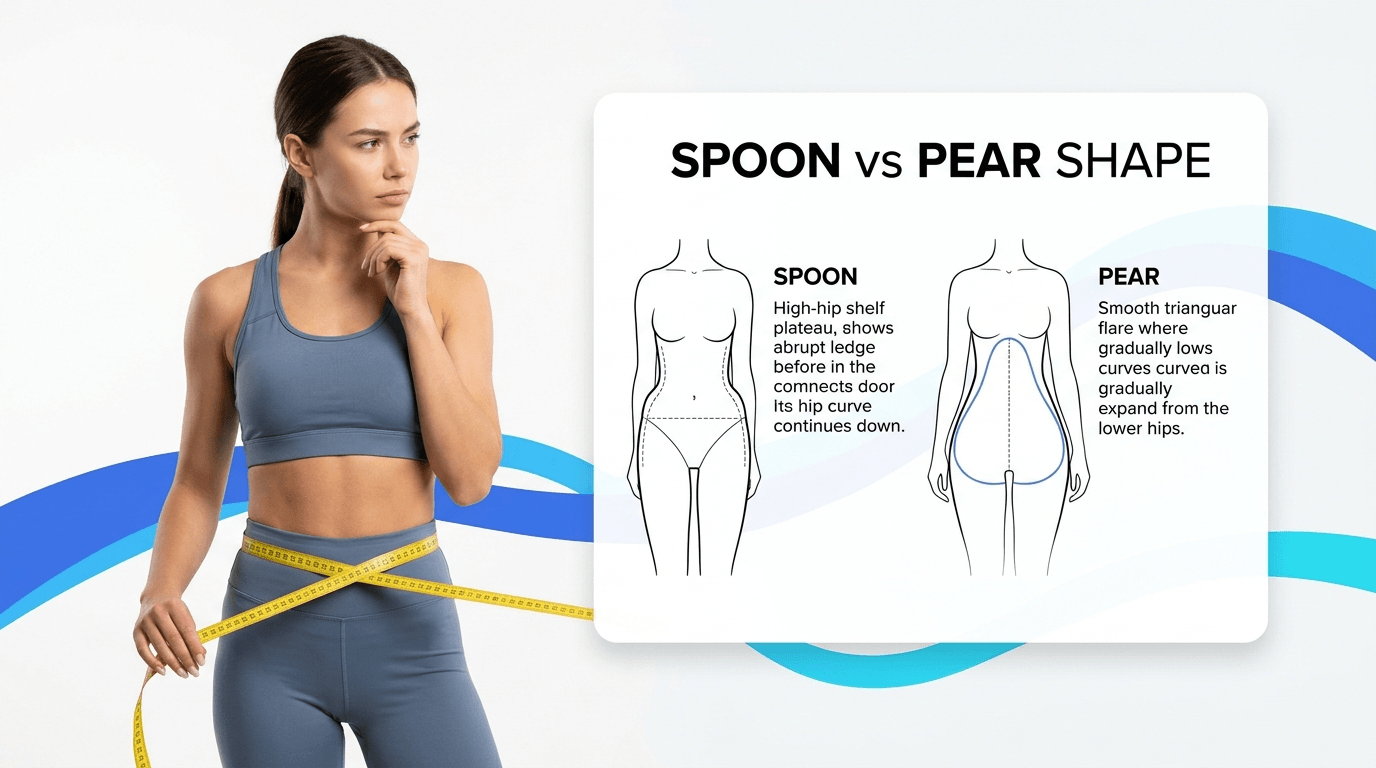
Derived from clinical gynoid adipose partitioning studies and 3D lower-torso surface scans. While both Pear and Spoon silhouettes exhibit hip circumferences exceeding the bust by 5% or more, they diverge in high-hip pelvic shelf projection, gluteofemoral adipose depth, and lower abdominal contouring.
Spoon vs. Pear Body Shape (Direct Answer)
The difference between a Spoon and a Pear (Triangle) body shape lies in the presence of an abrupt high-hip shelf and how adipose tissue is distributed across the lower stomach and hips.
A Classic Pear features a slender upper torso, a trim waist, and a gradual, smooth downward slope from the waist outward to the widest part of the lower hips and outer thighs (riding-breeches curve). In contrast, a Spoon Shape features an abrupt, shelf-like outward curve at the upper pelvis immediately below the waist—resembling the rounded bowl of a spoon—often paired with a localized lower abdominal softness even at low body weight.
You can verify whether you are a true Pear or a Spoon by testing your four-point numbers in our interactive Body Shape Calculator.
Anatomical Breakdown: Smooth Slope vs. Pelvic Bowl
Examine how skeletal framework and subcutaneous fat distribution dictate these two distinct lower-body profiles:
The Pear (Triangle) Silhouette
- • Transition: Gentle, continuous slope from the waist down to the lower hips.
- • Widest Point: Low hips across the greater trochanters and mid-thighs.
- • Abdominal Profile: Flat lower stomach; weight accumulates in outer thighs and gluteal fold.
- • Upper Body: Narrow shoulders, delicate clavicles, and smaller bust volume.
- • High-Hip Delta: High-hip measurement is modest (rarely >2.0 in wider than bust).
The Spoon (High-Shelf Pear)
- • Transition: Abrupt 90-degree step-out at the upper pelvic ridge (spoon bowl).
- • Widest Point: Upper hips and lower abdominal shelf.
- • Abdominal Profile: Natural lower tummy pouch resting immediately above the pelvic rim.
- • Upper Body: Small to medium bust with a well-defined waistline.
- • High-Hip Delta: High-hip exceeds natural waist by 3.0 to 5.0+ inches.
Styling Solutions: Pear vs. Spoon Wardrobe Rules
Standard Pear advice focuses almost entirely on drawing the eye upward with statement sleeves and A-line skirts. While this works well for Pears, Spoon silhouettes must also manage fabric tension across the high-hip shelf:
| Garment Type | Pear (Triangle) Recommendation | Spoon Recommendation |
|---|---|---|
| Denim Cuts | High-rise bootcut, wide-leg, flare trousers | Curvy-fit mid-rise with contour waistband |
| Dresses | A-line, wrap dresses, fit-and-flare | Empire waist, structured shift, wrap with tie at ribs |
| Tops & Necklines | Boatneck, bardot, puffed shoulders | Cowl neck, statement jewelry, structured shoulders |
| Fabric Choices | Medium-weight knits, structured denim | Draping crepes, fluid rayons, flat-front fabrics |
| What to Avoid | Skinny jeans paired with tight cropped tops | Front pockets with flap buttons or pleats over hips |
Case Study: How the High-Hip Ratio Distinguishes Spoon from Pear
Comparing two women with a 34-inch bust and 40-inch hips:
• Bust: 34.0 in (86.4 cm)
• Waist: 26.5 in (67.3 cm)
• High Hip: 33.0 in (83.8 cm) (Smooth +6.5 in delta)
• Full Hip: 40.0 in (101.6 cm)
Classification: True Pear. Low hip exceeds high hip by 7.0 inches. Flared skirts drape cleanly from the waist down.
• Bust: 34.0 in (86.4 cm)
• Waist: 26.5 in (67.3 cm)
• High Hip: 37.5 in (95.3 cm) (Abrupt +11.0 in shelf)
• Full Hip: 40.0 in (101.6 cm)
Classification: Spoon. High hip is nearly as wide as the low hip. Rigid denim waistbands pull tight across the pelvic shelf.
The Bottom Line: Tailor to Your Unique Curve Elevation
Both Pear and Spoon silhouettes are celebrated for their strong, feminine lower-body proportions. Once you recognize whether your hip curve starts at the upper pelvis (Spoon) or lower near the thighs (Pear), shopping transforms from a frustrating guessing game into a predictable styling victory.
Find Out If You Are a Pear or a Spoon
Enter your bust, waist, high-hip, and low-hip numbers into the ToolWingz calculator to verify whether your curves begin at the upper pelvis or lower thighs.
Educational Disclaimer: ToolWingz provides anthropometric ratio modeling for wardrobe styling and health awareness.