

What Body Shape Am I? The Definitive Guide to All 10 Female Body Types
Explore the 10 distinct female body silhouettes. Learn the clinical circumference ratio formulas, high-hip shelf dynamics, and diagnostic decision matrix.
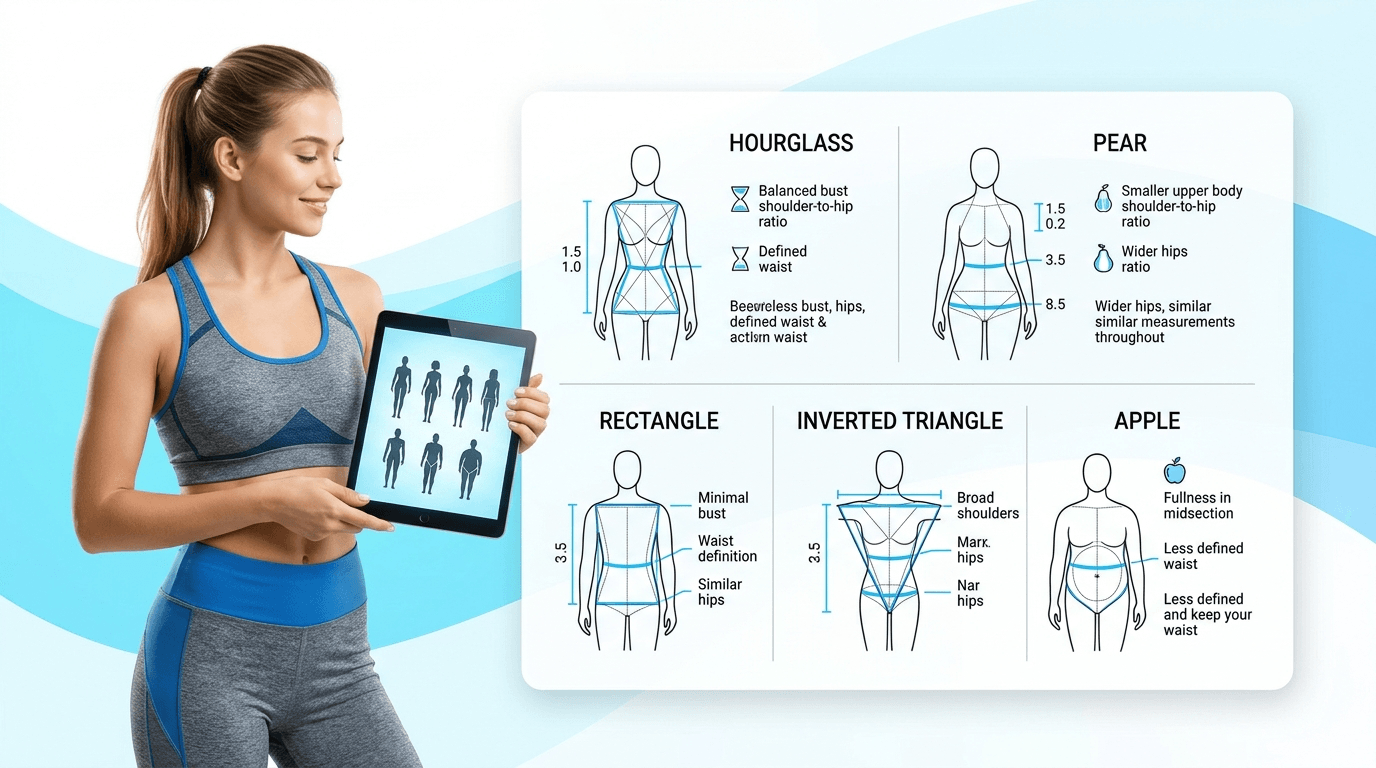
Formulated upon empirical 3D body anthropometry surveys (including the SizeUSA and CAESAR kinematic datasets) and clinical circumference ratio algorithms. Female silhouettes are determined strictly through geometric relationships between bust, natural waist, high-hip shelf, and fullest gluteal perimeter.
What Body Shape Am I? (The Direct Diagnostic Method)
Your body shape is determined by the mathematical proportional ratios between your bust, natural waist, and hips—not by your scale weight, height, or dress size.
While generic media frequently references only four or five rudimentary “fruit” categories, clinical kinanthropometry recognizes 10 distinct female silhouettes. These encompass critical structural nuances such as the high-hip pelvic shelf (which differentiates a Figure-8 from an Hourglass, or a Spoon from a Pear) and asymmetrical upper-versus-lower curve biases (Top Hourglass vs. Bottom Hourglass).
You can pinpoint your exact classification in seconds using our online Body Shape Calculator, or follow the diagnostic blueprint detailed below.
The 10 Female Body Silhouettes: Mathematical Definitions
Examine the clinical proportion thresholds that define each of the 10 structural silhouettes:
Classic Hourglass (X-Shape)
Bust and fullest hips are roughly equal in circumference (within 1 to 2 inches of each other), paired with a dramatically defined natural waist that is at least 25% smaller than the bust and hips (waist-to-hip ratio ≤ 0.75).
Top Hourglass
Maintains the dramatic defined waist indentation of an hourglass, but the bust measurement significantly exceeds the hip circumference by 2.0 to 4.0 inches due to a broader ribcage or fuller bust volume.
Bottom Hourglass
Maintains clear waist definition with pronounced curves, but hips exceed the bust circumference by 2.0 to 4.0 inches while retaining upper torso balance.
Figure 8 (Spanish Hourglass)
Frequently confused with the classic hourglass, the Figure-8 features an abrupt, high pelvic shelf immediately below the narrow waist. The hip curve flares out high on the iliac crest rather than sloping gently down toward the thighs.
Pear (Triangle)
The lower body circumference significantly dominates the silhouette. The hips and thighs are at least 5% to 15% larger than the bust, while shoulders remain delicate and the waist remains trim and well-defined.
Spoon Shape
A high-hip shelf variation of the pear shape. The hips are substantially wider than the bust (by 2.0+ inches), but the upper hip shelf curves out abruptly near the pelvis like the bowl of a spoon, often holding weight in the lower abdomen.
Rectangle (Banana / Ruler)
Bust, waist, and hips align in straight, uniform proportions. The waist measures within 20% of the bust and hip circumferences, producing a sleek, athletic, or linear silhouette without sharp indents.
Inverted Triangle (Strawberry)
Bust and broad shoulders clearly exceed the hip circumference by 5% or more. The hips and buttocks appear slender, compact, and taper down into athletic legs.
Apple (Round)
Weight and circumference are concentrated predominantly across the chest, ribcage, and midsection, resulting in a waist circumference equal to or greater than the hip measurement (WHR ≥ 0.85). Limbs and hips remain slender.
Diamond Shape
The stomach and high waistline represent the widest horizontal circumference of the entire torso, exceeding both narrower shoulders/bust and narrower pelvic hips. Arms and lower calves remain notably shapely.
Quick Diagnostic Decision Matrix: Find Your Shape by Ratio
Use your verified bust, natural waist, and hip numbers to navigate this definitive logic path:
| Primary Ratio Test | Waist Curve Characteristic | High-Hip Placement | Resulting Shape |
|---|---|---|---|
| Bust ≈ Hip (within 1 in) | Waist ≥ 9 in smaller than bust/hip | Gradual low-hip curve | Classic Hourglass |
| Bust ≈ Hip (within 1 in) | Waist ≥ 9 in smaller than bust/hip | Sharp high-hip shelf | Figure 8 |
| Hip > Bust by 2+ in | Waist clearly defined | Smooth taper to thighs | Pear (Triangle) |
| Hip > Bust by 2+ in | Waist clearly defined | Abrupt high-hip shelf | Spoon Shape |
| Bust, Waist & Hip within 5% | Waist indent < 20% | Linear, vertical alignment | Rectangle (Ruler) |
| Bust > Hip by 5%+ | Moderate waist definition | Narrow pelvis / flat hip | Inverted Triangle |
| Waist ≥ Hip (WHR > 0.85) | No natural waist indentation | Slender pelvic frame & legs | Apple / Round |
Common Misconceptions: What Body Shape Is NOT
1. Body Shape Is Not Body Mass Index (BMI): A woman with an athletic BMI of 21.0 and a woman with a BMI of 32.0 can share the exact same Hourglass, Pear, or Inverted Triangle silhouette. BMI reflects whole-body weight per square meter of height, whereas body shape reflects regional circumference ratios.
2. Body Shape Is Not a Clothing Size: Wearing a size 4 or size 16 does not indicate whether your hips exceed your bust or your shoulders dominate your torso. Clothing sizes reflect volume; body shape reflects proportion.
3. Body Shape Does Not Require 36-24-36: The historic mid-century “36-24-36” archetype is merely one arbitrary numerical expression of an hourglass ratio. A woman measuring 44-32-45 or 32-22-33 possesses the exact same mathematically validated hourglass geometry.
The Bottom Line: Understanding Your Blueprint Unlocks Confidence
Recognizing your true body shape is the foundation of intentional personal style and healthy body neutrality. Rather than fighting your biological skeletal framework with ill-fitting garments, understanding your proportions empowers you to choose cuts, waistbands, and necklines that celebrate your natural geometry.
Enter your tape measurements into the ToolWingz calculator above to discover your exact silhouette, access tailored styling blueprints, and evaluate your health ratios today.
Calculate Your Exact Female Body Shape
Input your bust, natural waist, high-hip shelf, and fullest hip circumferences into our interactive algorithm to instantly identify which of the 10 silhouettes matches your geometry.
Educational Disclaimer: ToolWingz Body Shape Calculator categorizes silhouettes according to mathematical ratio thresholds for educational and personal styling exploration.