

What Is the Rarest Body Shape? Global 3D Bodyscanning Statistics
Global demographic data reveals why the true hourglass represents under 9% of women, while the rectangle accounts for nearly half of the population.
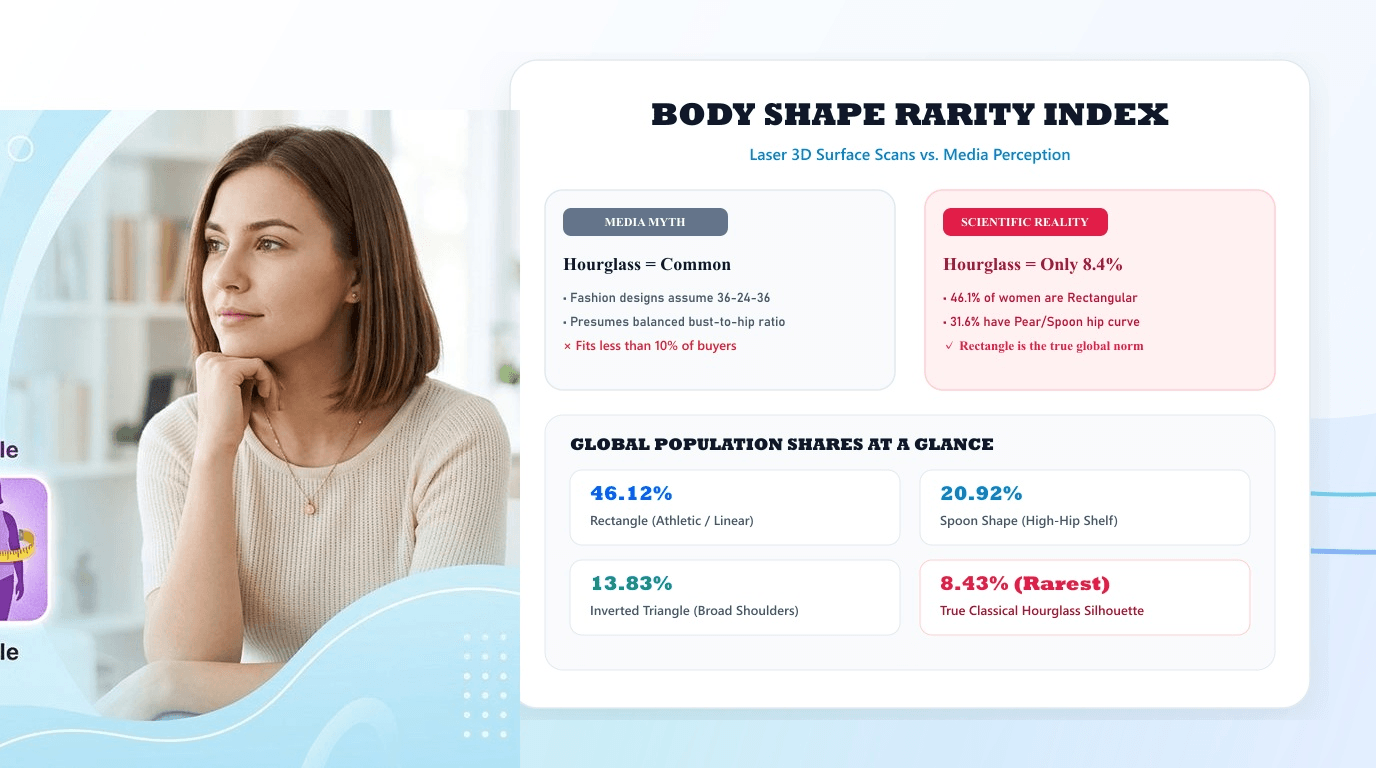
Derived from the landmark SizeUSA Anthropometric Survey conducted by [TC]² and North Carolina State University, analyzing 3D surface scans of over 10,000 adult women. Confirms why the classical hourglass silhouette represents less than 9% of the real-world female population.
What Is the Rarest Body Shape? (Direct Answer)
According to comprehensive 3D whole-body laser scanning data from the landmark SizeUSA study, the true Hourglass body shape is the rarest natural female silhouette in the world, representing only approximately 8.43% of women.
In contrast, the Rectangle (athletic linear) silhouette is the most common, accounting for nearly half of all adult women (46.12%) globally.
You can verify your statistical standing by checking your measurements in our interactive Body Shape Calculator.
Global Population Statistics: SizeUSA 3D Scanning Results
| Silhouette Type | Population Share | Mathematical Defining Ratio | Rarity Ranking |
|---|---|---|---|
| Rectangle (Banana) | 46.12% | Waist is less than 25% smaller than bust/hips. | #1 (Most Common) |
| Spoon (High-Shelf Pear) | 20.92% | Hips > 5% larger than bust; high-hip shelf > 2″. | #2 Common |
| Inverted Triangle | 13.83% | Shoulders/Bust ≥ 5% larger than hips. | #3 Common |
| Bottom Pear (Triangle) | 10.70% | Hips > 5% larger than bust; gentle slope without shelf. | #4 Common |
| Classical True Hourglass | 8.43% | Bust & hips within 1″; waist ≥ 25% narrower (WHR ≤ 0.75). | #5 (Rarest Overall) |
Why True Hourglass Proportions Are Statistically Rare
The rarity of the classical hourglass is driven by strict multi-variable mathematical criteria:
- Dual Symmetry: The horizontal breadth of the chest (bi-acromial span and breast tissue) must match the pelvic width (bi-trochanteric span) within a razor-thin 1-inch variance.
- Deep Genetic Waist Taper: The natural waistline must indent by at least 25% (or 8 to 12 inches narrower than bust and hips). This requires a genetically narrow ribcage paired with zero abdominal fat deposition.
- Weight Fluctuation Fragility: Most women who possess an hourglass in early adulthood transition into a bottom pear or apple as metabolic fat shifts during pregnancy or perimenopause.
Where Do Your Measurements Rank?
Plug your tape measurements into our algorithm to calculate your exact silhouette score and see how your ratios compare to global population norms.
Educational Disclaimer: ToolWingz provides body shape and ratio analysis for wellness and style awareness.