

Why Does a High BAC Cause Blackouts? The Neuroscience of Alcohol Amnesia
Learn the neurobiology behind alcohol blackouts: why high BAC shuts down long-term potentiation in the hippocampus and prevents memories from being recorded.
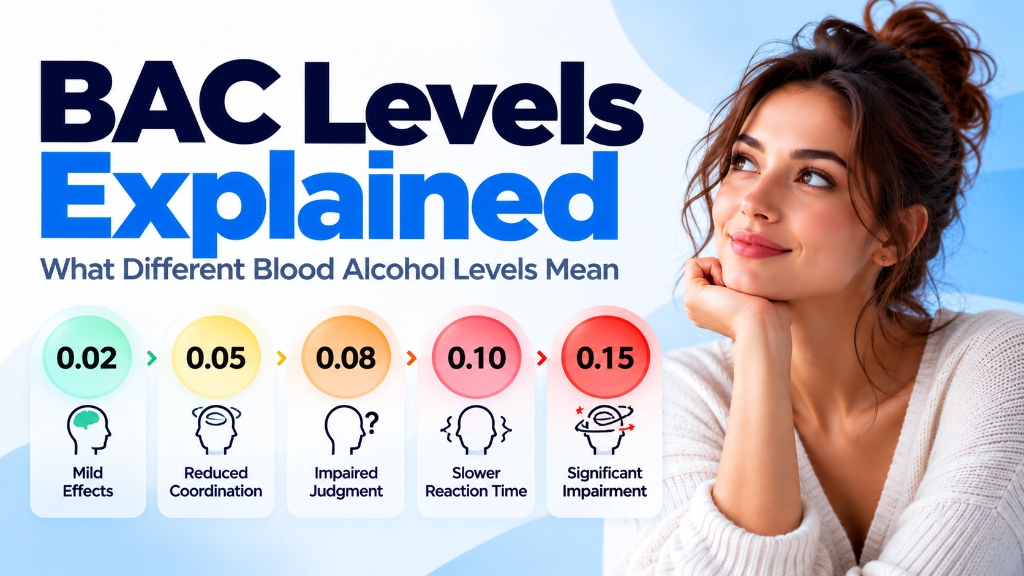
Derived from clinical neuroimaging research from the National Institute on Alcohol Abuse and Alcoholism (NIAAA) and peer-reviewed studies published in Nature Neuroscience and Alcoholism: Clinical and Experimental Research.
Why Does a High BAC Cause Memory Blackouts? (Direct Answer)
An alcohol-induced blackout is not passing out, falling asleep, or losing consciousness. During an alcohol blackout, a person is completely awake, carrying on complex conversations, dancing, ordering food, driving, or sending text messages—yet the following morning, they have zero recollection of what transpired.
Blackouts occur because rapidly rising blood alcohol concentrations (typically surging past 0.15% to 0.20% BAC) chemically paralyze the hippocampus—the brain's dual-lobed memory consolidation hub located deep in the temporal lobes. Alcohol blocks long-term potentiation (LTP), the electro-chemical process required to transfer immediate short-term events into permanent long-term memory storage.
During a blackout, your brain does not “forget” what happened; the memories were never recorded onto your biological neural circuits in the first place. To evaluate how quickly different beverages spike blood alcohol, explore our Toolwingz BAC Calculator.
The Neurochemical Mechanism: Hippocampal LTP Disruption
Human memory formation relies on a microsecond dialogue between two opposing neurotransmitter systems in the CA1 pyramidal cell layers of the hippocampus:
GABA Agonism & NMDA Glutamate Antagonism
When ethanol floods the brain, it acts as a dual neurochemical sabotuer:
- Inhibitory GABA-A Overdrive: Ethanol binds to allosteric sites on GABA-A receptors, forcing open chloride channels. This hyperpolarizes CA1 pyramidal neurons, creating an electrical barrier that prevents action potentials from firing.
- Excitatory NMDA Glutamate Blockade: Memory consolidation requires glutamate to bind to NMDA receptors, triggering a rush of calcium ions that physically alters synaptic dendritic spines (Long-Term Potentiation). Ethanol physically lodges in the NMDA channel pore, shutting off calcium flow and silencing synaptic plasticity.
Types of Blackouts: En Bloc vs. Fragmentary (“Brownouts”)
Cognitive neuroscientists divide alcohol-induced amnesia into two distinct clinical categories:
| Cognitive Dimension | Fragmentary Blackout (“Brownout”) | En Bloc Blackout (Total Amnesia) |
|---|---|---|
| Hippocampus State | Partially inhibited synaptic plasticity | Complete, total blockade of memory consolidation |
| Memory Recall Ability | Can be recalled when cued or prompted by friends | Permanent, irreversible amnesia (cannot be recovered) |
| Typical BAC Threshold | 0.14% to 0.19% BAC | 0.20% BAC and higher (or steep rate of ascent) |
| Time Horizon Lost | Fuzzy gaps (e.g., missing 20 minutes in a taxi) | Hours-long chronological void with sharp start/end points |
| Behavioral Function | Noticeably intoxicated, slurred speech | Appears surprisingly functional (eating, driving, texting) |
Real-World Scenarios: The Slope of Ascent in Action
Comparing how drinking speed dictates whether a blackout occurs in a 170 lb (77 kg) adult:
6 Tequila Shots in 45 Minutes (Empty Stomach)
- Ethanol Influx: 84g pure ethanol dumped rapidly into duodenum.
- Rate of BAC Rise: Surges from 0.00% to 0.16% in under 50 minutes.
- Hippocampal Response: Sudden neurochemical shock shuts down LTP instantly.
- Outcome: Total En Bloc Blackout starting at 10:30 PM. Next morning, zero recollection of paying the bill, taking an Uber, or arriving home.
6 Beers Over 6 Hours with Dinner & Water
- Ethanol Influx: 84g pure ethanol absorbed slowly across evening.
- Rate of BAC Rise: Never exceeds 0.07%–0.08% as liver metabolizes 0.015%/hr continuously.
- Hippocampal Response: Neurons maintain long-term potentiation throughout.
- Outcome: Complete Memory Recall. Wakes up remembering every conversation, joke, and detail of the evening.
Drink Quantities & Blackout Vulnerability
How standard drinks scale into memory disruption thresholds:
5 to 7 Beers (Rapid)
12 oz 5% beers consumed in under 2 hours pushes BAC past 0.15%, initiating fragmentary memory loss in most adults.
1+ Bottle of Wine
Drinking an entire 750ml bottle of 13% wine on an empty stomach triggers steep upward curves that disconnect hippocampal recording.
4+ Liquor Shots
Taking multiple 1.5 oz 40% shots in rapid succession is the single most common trigger for catastrophic en bloc blackouts.
Blackout Myths vs. Clinical Scientific Evidence
Separating popular cultural folklore from validated neurobiology:
| Common Cultural Myth | Scientific Reality | Neurochemical Mechanism |
|---|---|---|
| “A blackout means you passed out” | FALSE | Passing out is loss of consciousness; blackouts occur while awake and walking around. |
| “Only chronic alcoholics get blackouts” | FALSE | Infrequent social drinkers get blackouts more easily because they lack behavioral tolerance to rapid BAC spikes. |
| “Hypnosis can recover blackout memories” | IMPOSSIBLE | Because LTP was blocked, no synaptic traces or neural pathways were ever formed in the brain. |
| “Drinking water between drinks prevents blackouts” | TRUE (Indirectly) | Alternating water slows down consumption speed, flattening the upward slope of the BAC curve. |
Blackouts are chemical amnesia, not unconsciousness.
When you drink rapidly, your hippocampus temporarily loses the biological ability to create long-term memories. Pacing drinks, eating high-protein meals beforehand, and avoiding rapid liquor shots are the most effective ways to protect your brain's memory circuits.
Estimate Your BAC with the Toolwingz BAC Calculator
Calculate theoretical blood alcohol curves and explore how body weight, drink strength, and elapsed time influence clearance with 100% privacy.
Educational Disclaimer: Toolwingz BAC Calculator provides an estimate for informational purposes. It does not measure your actual BAC and cannot determine whether you are safe or legally permitted to drive.