

EtG Urine Test vs. BAC: Detection Window and Accuracy Comparison
An in-depth guide to Ethyl Glucuronide (EtG) urine testing vs. BAC. Understand the 80-hour myth, metabolic pathways, and court detection windows.
Reviewed against forensic testing parameters established by the Substance Abuse and Mental Health Services Administration (SAMHSA), clinical guidance from the American Association for Clinical Chemistry (AACC), and peer-reviewed studies published in Alcohol and Alcoholism.
EtG Urine Test vs. BAC: Detection Window Comparison (Direct Answer)
The fundamental difference between a standard Blood Alcohol Concentration (BAC) test and an Ethyl Glucuronide (EtG) urine test is what they measure and how long they can detect alcohol after drinking:
- Standard BAC (Breath / Blood): Measures active, unmetabolized ethanol circulating in your bloodstream. Because the liver eliminates ethanol at a fixed rate of ~0.015% BAC per hour, blood and breath tests can only detect alcohol for 6 to 24 hours at most. Once BAC reaches 0.00%, a breathalyzer detects nothing.
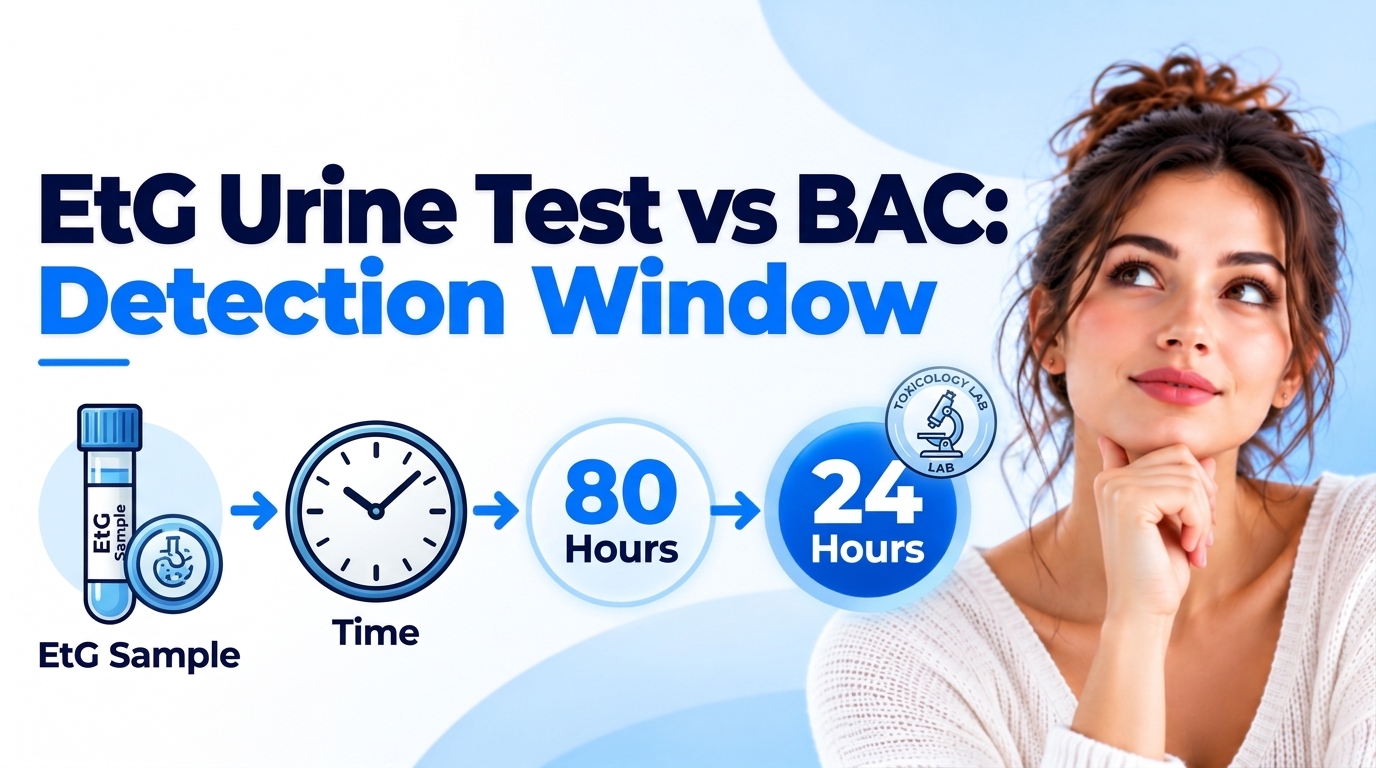
- EtG Urine Test (The “80-Hour Test”): Does not measure ethanol itself. Instead, it measures Ethyl Glucuronide—a non-oxidative direct metabolite created by the liver when ethanol conjugates with glucuronic acid. EtG remains detectable in urine for 24 to 48 hours after moderate drinking, and up to 70 to 80 hours following heavy binge drinking—long after active BAC has returned to absolute zero.
EtG tests are the gold standard for court probation, custody hearings, military compliance, and professional monitoring programs. To estimate how long active alcohol stays in your blood, use our BAC Calculator and read our guide on how long alcohol stays in your system.
How EtG and EtS Biomarkers Are Created
While 95% of ethanol is metabolized via hepatic oxidation (ADH to acetaldehyde to acetate), roughly 0.5% to 1.5% undergoes phase II conjugation:
The Glucuronidation Pathway
Enzymes known as UDP-glucuronosyltransferases (UGT) chemically link ethanol molecules with glucuronic acid in the liver to create Ethyl Glucuronide (EtG). Simultaneously, sulfotransferases create a companion metabolite, Ethyl Sulfate (EtS).
Because EtG is highly water-soluble and non-volatile, it is filtered by the kidneys into the bladder, accumulating in concentrated urine. While blood ethanol drops steadily every hour, EtG levels continue to rise in the bladder for hours after drinking stops, peaking approximately 4 to 8 hours after BAC reaches zero.
The 4 Phases of Alcohol Detection Over Time
Trace how different testing methods perform across the 80 hours following consumption:
Active Intoxication
Both BAC (blood/breath) and EtG are strongly positive. BAC reflects real-time impairment; EtG is rapidly conjugating in the liver.
BAC Drops to Zero
Blood ethanol clears entirely (0.00% BAC on breathalyzers). Meanwhile, EtG concentrations in urine hit their absolute maximum peak.
Moderate Drinking Window
Standard urine tests are negative. EtG remains easily detectable at standard 500 ng/mL cutoffs following 2–4 drinks.
Heavy Binge Window
Detectable only after heavy episodic binge drinking (6+ drinks) or in ultra-sensitive laboratory LC-MS/MS testing at 100 ng/mL cutoffs.
EtG Urine Test vs. Standard BAC: Side-by-Side Comparison
Compare the biological parameters, window of detection, and legal applications between these testing methodologies:
| Testing Parameter | Blood Alcohol Concentration (BAC) | EtG Urine Test |
|---|---|---|
| Target Molecule | Intact Ethanol (CH3CH2OH) | Ethyl Glucuronide (EtG) metabolite |
| Sample Specimen | Exhaled alveolar breath or whole blood | Urine (or hair for long-term 90-day testing) |
| Detection Window | Short (6 to 24 hours max) | Long (24 to 80 hours) |
| Measures Impairment? | YES (directly correlates with intoxication) | NO (only proves past consumption) |
| Primary Applications | Roadside DUI stops, crash investigations, workplace accidents | Court probation, alcohol rehab programs, pilot/physician monitoring |
The “80-Hour Myth”: How Long Does EtG Really Last?
EtG tests are marketed aggressively as the “80-Hour Alcohol Test,” but toxicologists caution that 80 hours represents an extreme statistical outlier:
12 to 24 Hours
After a couple of beers or glasses of wine, EtG clears below the standard 500 ng/mL court cutoff in under 24 hours.
36 to 48 Hours
Moderate social drinking typically remains detectable for approximately two days.
60 to 80 Hours
Only sustained heavy binge drinking or chronic alcohol abuse produces enough metabolite to trigger positives beyond day 3.
BAC measures current impairment; EtG reveals past drinking.
A zero BAC on a breathalyzer means you are legally sober right now, but it does not mean your urine is clear. If you are subject to court or professional EtG monitoring, drinking alcohol can result in a positive test for up to 2 to 3 days after sobriety has been restored.
Estimate Your BAC with the Toolwingz BAC Calculator
Calculate theoretical blood alcohol curves and explore how body weight, drink strength, and elapsed time influence clearance with 100% privacy.
Educational Disclaimer: Toolwingz BAC Calculator provides an estimate for informational purposes. It does not measure your actual BAC and cannot determine whether you are safe or legally permitted to drive.