

How Long Does Alcohol Stay in Your System? BAC & Alcohol Metabolism Explained
Learn how long alcohol stays in your body, how the liver metabolizes ethanol at a steady rate, and why BAC elimination cannot be rushed.
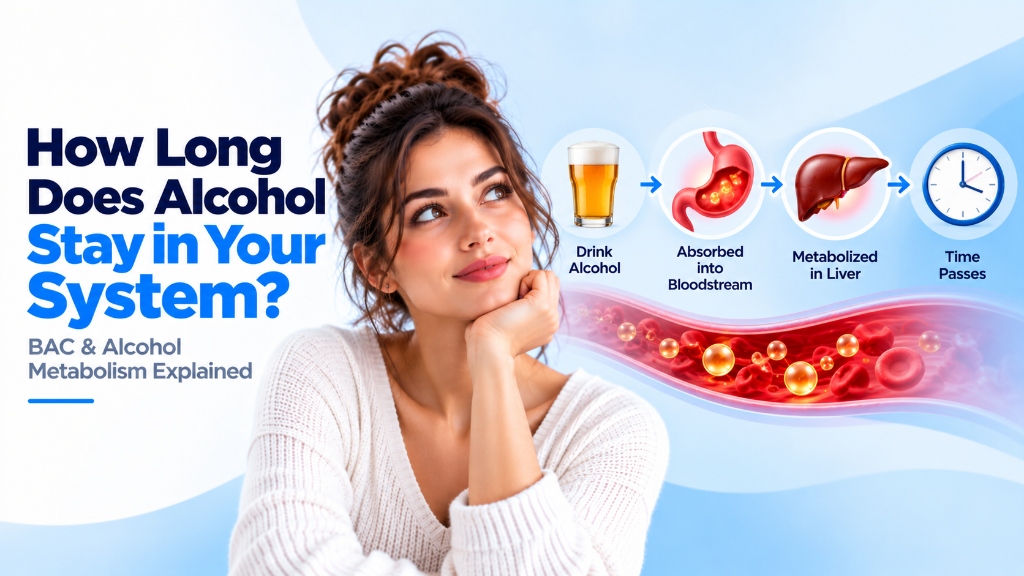
How Long Does Alcohol Stay in Your System? (Quick Answer)
On average, the human body metabolizes alcohol at a steady rate of approximately 0.015% BAC per hour—roughly equivalent to clearing one standard drink every 60 to 90 minutes. However, how long alcohol remains detectable depends heavily on the testing method used.
While active ethanol clears your bloodstream within 6 to 12 hours after moderate drinking, metabolic biomarkers such as ethyl glucuronide (EtG) remain detectable in urine for up to 72 hours, and in hair follicles for up to 90 days.
To model your personalized blood alcohol clearance timeline based on your body weight and drink tally, visit the Toolwingz BAC Calculator.
How the Body Metabolizes Alcohol: Zero-Order Kinetics
Most drugs and chemicals in the human body follow first-order elimination kinetics, meaning clearance speeds up as concentration rises. Alcohol is a notable exception: it follows zero-order kinetics.
The Liver Enzyme Toll Booth Analogy
The liver processes over 90% of circulating ethanol using a limited supply of the enzyme alcohol dehydrogenase (ADH). Once blood alcohol levels exceed tiny trace amounts (around 0.005% BAC), all available enzyme binding sites become fully saturated.
Imagine a busy highway bottlenecked at a toll booth with only two open lanes. Even if thousands of cars arrive at once, cars can only pass through at a constant, fixed rate. Any excess ethanol molecules must continuously recirculate through your heart, brain, and muscles until enzyme sites open up to break them down.
The Chemical Breakdown Pathway: Ethanol to Acetaldehyde to Acetate
The enzyme ADH converts ethanol into acetaldehyde. Acetaldehyde is a toxic compound responsible for facial flushing, nausea, rapid pulse, and hangover distress.
A second enzyme, ALDH, quickly transforms toxic acetaldehyde into acetate. Acetate is further converted into harmless water and carbon dioxide, which the body expels through exhalation and kidneys.
Theoretical Timeline for BAC Clearance
The table below illustrates hypothetical elimination times for various peak BAC levels in an average adult. These figures assume that absorption has finished and liver clearance proceeds steadily at 0.015% per hour. To learn how absorption timing shifts before this elimination phase begins, see our guide on when BAC peaks after drinking:
| Peak BAC Level | Typical Severity / Impairment | Estimated Time to 0.00% BAC |
|---|---|---|
| 0.020% | Mild relaxation, slight body warmth | ~1 hour 20 minutes |
| 0.050% | Exaggerated behavior, reduced alertness (Utah legal limit) | ~3 hours 20 minutes |
| 0.080% | Impaired perception, delayed braking reaction (U.S. legal limit) | ~5 hours 20 minutes |
| 0.120% | Significant motor control loss, slurred speech | ~8 hours |
| 0.160% | Severe sensory impairment, high blackout risk | ~10 hours 40 minutes |
| 0.200%+ | Acute toxicity, high risk of vomiting and unconsciousness | ~13 to 16+ hours |
Alcohol Detection Windows by Test Type
Breath (Breathalyzer)
Detects active ethanol vapors in alveolar breath. Window: 12 to 24 hours, directly corresponding to when ethanol remains in circulating blood.
Blood Testing
Laboratory gas chromatography directly quantifies parent ethanol molecules in blood serum. Window: 6 to 12 hours after moderate consumption.
Urine (EtG Biomarker)
Detects ethyl glucuronide (EtG), a metabolic byproduct formed by glucuronidation in the liver. Window: 24 to 72 hours (and up to 80 hours following heavy drinking).
Hair Follicle Tests
Metabolites incorporate into growing hair shafts from scalp capillaries. Window: up to 90 days, utilized to evaluate chronic drinking patterns rather than acute impairment.
Factors Influencing Elimination Speed
- Liver Health & Hepatic Function: Cirrhosis, fatty liver disease, or hepatitis significantly impairs enzyme availability, slowing clearance to below 0.010% per hour.
- Genetic Variants: Individuals with atypical ADH1B or ALDH2 alleles oxidize ethanol and intermediate metabolites at different biological speeds.
- Age: Natural reductions in liver blood flow, functional hepatocytes, and overall body water slow elimination in older adults.
Debunking Sobering-Up Myths
• Myth: "A cold shower sobers you up." Cold water activates shock and vasoconstriction, making you feel alert, but liver enzyme clearance remains exactly the same.
• Myth: "Black coffee speeds up alcohol breakdown." Caffeine is an adenosine antagonist stimulant. It masks feelings of fatigue but does not decrease blood alcohol concentration by a single milligram. Curious about the exact physiology? Read our guide on does coffee help lower BAC? to learn why caffeine cannot accelerate sobriety.
• Myth: "Drinking lots of water flushes alcohol out of your blood." Hydration relieves thirst and prevents dehydration headaches, but kidneys cannot dilute circulating ethanol or speed up liver enzymes. See our complete guide on does drinking water actually lower BAC? to learn what hydration can and cannot do.
• Myth: "You can sweat out alcohol with a hard workout or sauna." Perspiration eliminates under 1% of circulating ethanol; the remaining 95%+ must be metabolized in the liver. Explore our detailed guide on can you sweat alcohol out? to learn why exercise cannot speed up sobriety.
• Myth: "You can sleep it off in a couple of hours." Going to sleep does not accelerate hepatic metabolism. If you go to bed with a 0.14% BAC at 2:00 AM, you may still wake up with a legally impaired BAC of 0.065% to 0.08% at 7:00 AM. Read our full guide on does sleeping lower BAC? to understand what happens to alcohol levels while you sleep.
Frequently Asked Questions (FAQ)
How long does alcohol stay in your system?
How quickly does BAC go down?
Can you speed up alcohol metabolism?
Does drinking water lower BAC?
Does coffee help lower BAC?
Does eating food lower BAC?
Can a BAC calculator tell when I will reach 0.00?
Can I drive when a BAC calculator says 0.00?
Explore Your Estimated BAC Trajectory
While liver enzymes clear alcohol along a predictable biological curve, individual absorption rates, drink volumes, and body weights create unique outcomes. Use our interactive tool to visualize estimated blood alcohol changes over time.
Estimate Your BAC with the Toolwingz Calculator
Input your body weight, biological sex, standard drinks, and timeline to visualize estimated BAC degradation curves with 100% private in-browser calculations.
Educational Disclaimer: Toolwingz BAC estimates are designed for informational reference only. Calculations cannot measure real-time blood alcohol levels or clinical impairment and must never be used to evaluate driving ability.