

How Many Drinks Does It Take to Reach 0.08 BAC?
Learn why there is no universal number of drinks that equals 0.08 BAC, and how drink strength, body water, and pacing alter your level.
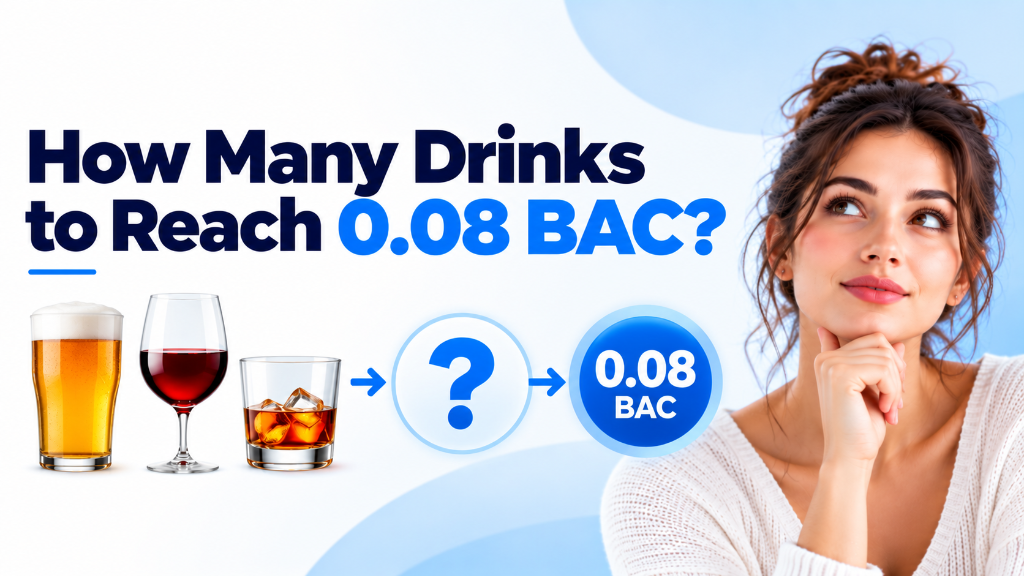
How Many Drinks Does It Take to Reach 0.08 BAC? (Direct Answer)
As a broad physiological rule of thumb, an average adult male weighing 160–180 lbs typically reaches or exceeds a 0.08% Blood Alcohol Concentration (BAC) after consuming approximately 3 to 4 standard drinks within one hour. For an average adult female weighing 120–140 lbs, it takes approximately 2 to 3 standard drinks in that same one-hour window.
However, there is no universal number of drinks that reliably applies to all people. Your exact blood alcohol level depends on your scale body weight, biological sex (total body water ratio), stomach food contents, drinking speed, and hepatic metabolism.
To test your personal variables and view theoretical degradation curves, visit the Toolwingz BAC Calculator.
Estimated Drinks to Reach 0.08% BAC in One Hour
The table below illustrates theoretical standard drink estimates (each containing 14g pure ethanol) consumed within one hour by individuals on an empty stomach:
| Body Weight | Biological Males | Biological Females |
|---|---|---|
| 100 lbs (45 kg) | ~2 drinks | ~1 to 2 drinks |
| 120 lbs (54 kg) | ~2 to 3 drinks | ~2 drinks |
| 140 lbs (64 kg) | ~3 drinks | ~2 to 3 drinks |
| 160 lbs (73 kg) | ~3 to 4 drinks | ~3 drinks |
| 180 lbs (82 kg) | ~4 drinks | ~3 to 4 drinks |
| 200 lbs (91 kg) | ~4 to 5 drinks | ~4 drinks |
| 220 lbs (100 kg) | ~5 drinks | ~4 to 5 drinks |
*Notice: These figures represent mathematical estimates using standard Widmark population coefficients. Real-time biological absorption varies significantly between individuals.
Why "Number of Drinks" Is an Unreliable Safety Metric
Counting glasses or drinks fails as a metric of sobriety for five distinct physiological reasons:
1. Serving Size Discrepancies
A 16-ounce craft pint of 8% ABV double IPA contains 1.28 oz of pure ethanol—equivalent to 2.1 standard drinks in a single glass. Two pints equal more than 4 standard drinks.
2. Body Water Composition
Because ethanol dissolves only in water, biological males average 60% to 68% total body water, whereas biological females average 50% to 55%. Less body water concentrates alcohol much faster.
3. Stomach Food & Pyloric Sphincter
Eating a full meal delays gastric emptying into the small intestine, slowing absorption and lowering peak BAC by 20% to 40% compared to drinking on an empty stomach.
The Decisive Role of Time and Liver Metabolism
The human liver metabolizes alcohol at a steady rate of roughly 0.015% BAC per hour. Spacing drinks over multiple hours fundamentally changes the resulting blood alcohol level:
• Scenario A: A 180 lb male drinks 4 standard beers in 1 hour. His liver only has time to clear ~0.015%, leaving his estimated peak BAC around 0.075% – 0.085%.
• Scenario B: The same 180 lb male drinks 4 standard beers over 4 hours. Over those 4 hours, his liver metabolizes approximately 0.060% BAC, keeping his estimated peak BAC around 0.025% – 0.035%.
Standard Drink Reference
Regular Beer
5.0% ABV (~14g pure ethanol)
Table Wine
12.0% ABV (~14g pure ethanol)
Distilled Spirits
40.0% ABV / 80-proof (~14g pure ethanol)
Impairment Begins Well Before 0.08% BAC
The 0.08% BAC limit is a legal dividing line for criminal prosecution, not a boundary of physiological safety. NHTSA crash studies demonstrate that emergency braking reaction times, divided attention, and tracking ability deteriorate at BAC levels as low as 0.02% to 0.05%.
Moreover, legal thresholds vary substantially by driver category and state jurisdiction—including Utah's 0.05% adult limit, federal 0.04% rules for commercial drivers, and strict zero-tolerance statutes for drivers under 21. For a detailed breakdown, explore our guide explaining legal BAC limits and driver category rules in the U.S..
Critical Driving Safety Warning
Never attempt to time drinks or calculate your BAC to decide whether you can safely drive. You can be arrested and convicted for DUI at any measurable BAC if driving impairment is observed. If you plan to drink, arrange a designated sober driver, rideshare, or taxi.
The Neurobiology Behind the 0.08% Legal Impairment Standard
The 0.08% BAC per se legal limit was established across all 50 US states following decades of epidemiological research conducted by the National Highway Traffic Safety Administration (NHTSA) and the American Medical Association:
• Divided Attention Impairment: At 0.05% BAC, laboratory driving simulators document statistically significant degradation in divided attention processing—the exact cognitive skill required to monitor road hazards while managing vehicular speed.
• Visual Tracking & Braking Response: At 0.08% BAC, muscle coordination becomes noticeably degraded, reaction times to unpredictable road obstacles lengthen by 15% to 25%, and peripheral optical perception narrows into visual tunnel effect.
• Exponential Crash Risk Multiplier: Epidemiological crash-reconstruction studies confirm that drivers operating vehicles at or above 0.08% BAC are roughly 4 to 11 times more likely to be involved in a fatal vehicular collision compared to zero-alcohol sober drivers.
• Cumulative Cognitive Fatigue: Alcohol acts as a central nervous system depressant that amplifies existing sleep debt. Even after BAC returns to 0.00% several hours later, vestibular recovery and executive function lag behind chemical clearance.
• Zero Tolerance for Commercial Drivers: In the United States and European Union, commercial vehicle operators face strict legal thresholds of 0.04% or 0.02% BAC, recognizing that large vehicular momentum demands unimpaired reflex latency.