

What Is the Legal BAC Limit in the U.S.? State and Driver Rules Explained
Understand the U.S. legal BAC limit (0.08%), Utah's 0.05% rule, underage zero-tolerance statutes, and federal 0.04% CDL standards.
Current as of October 2026. Statutory drinking-and-driving thresholds in the United States are established by individual state legislatures and federal transportation safety agencies. This guide is provided for educational purposes and does not constitute formal legal counsel. Always consult current state DMV codes and certified local statutes for jurisdiction-specific requirements.
What Is the Legal BAC Limit in the United States?
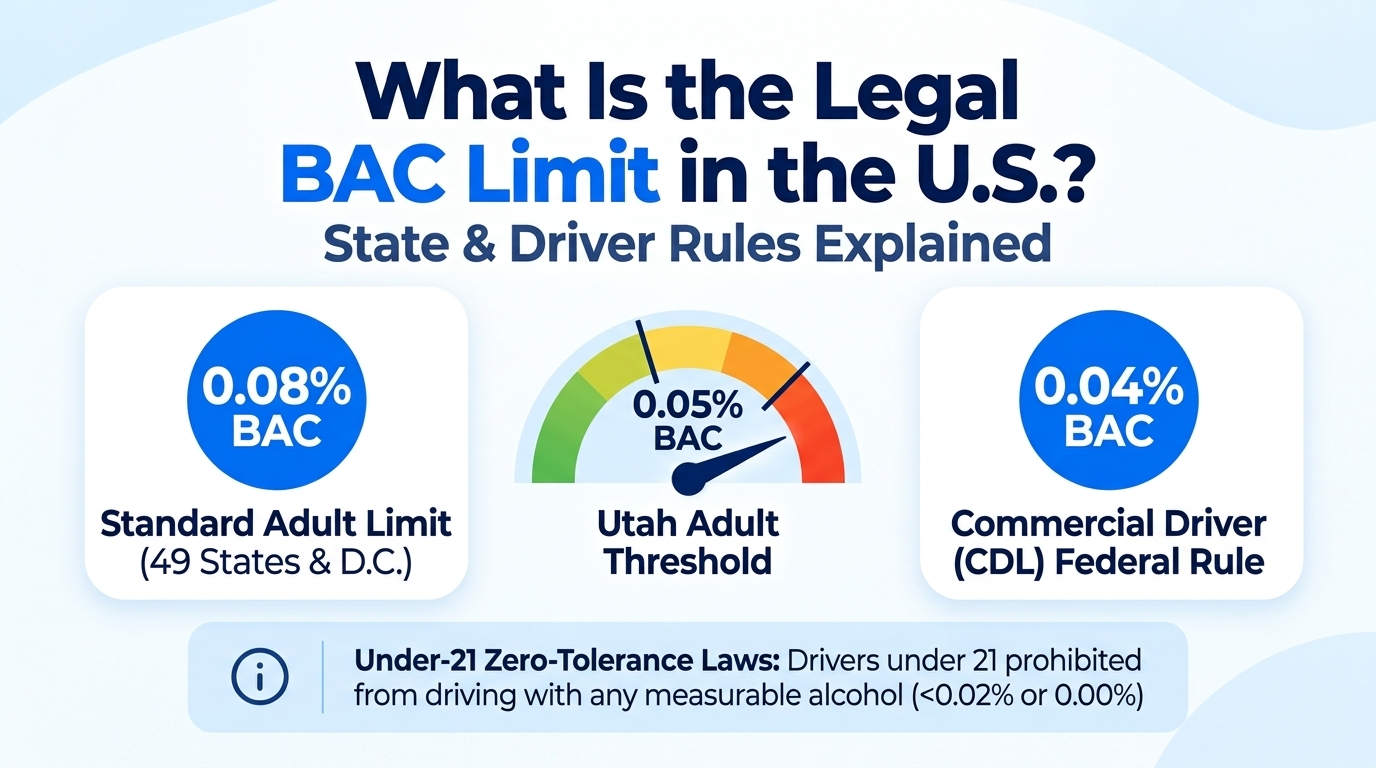
For standard adult noncommercial drivers aged 21 and older, the general legal blood alcohol concentration (BAC) limit is 0.08% (0.08 g/dL) in 49 states and the District of Columbia. Utah is the sole exception with a stricter 0.05% threshold.
However, describing 0.08% as the universal “U.S. legal limit” oversimplifies American motor vehicle jurisprudence. Under federal statutes and state traffic safety codes, substantially lower statutory limits apply to specific categories of motorists:
- Drivers under the age of 21: Governed by state zero-tolerance laws that set actionable thresholds between 0.00% and 0.02% BAC, making it illegal for underage motorists to operate a motor vehicle with any measurable alcohol.
- Commercial Motor Vehicle (CMV) operators: Governed by strict federal standards under the Federal Motor Carrier Safety Administration (FMCSA), which prohibit performing safety-sensitive functions at or above 0.04% BAC.
- Any driver displaying actual impairment: In all 50 states, an individual can be arrested and prosecuted for driving under the influence (DUI) or driving while intoxicated (DWI) at BAC levels well below 0.08% if observable physical or mental impairment affects their ability to operate a vehicle safely.
According to the National Highway Traffic Safety Administration (NHTSA), statutory per se limits provide an objective evidentiary baseline for criminal and administrative prosecution, but they do not represent a threshold below which driving is guaranteed to be safe (NHTSA Impaired Driving Legislation). Understanding how these legal thresholds operate requires separating statutory benchmarks from individual biological impairment and mathematical calculator estimates.
49 U.S. states & Washington, D.C. (Utah: 0.05%).
Federal rule under 49 CFR § 382.201 for safety-sensitive duty.
Zero-tolerance statutes across all 50 states and D.C.
What Does a Legal BAC Limit of 0.08% Mean?
A blood alcohol concentration of 0.08% is a volumetric concentration measurement, not a percentage of the drink or cocktail a person consumed. Specifically, 0.08% represents 0.08 grams of pure ethanol per 100 milliliters (or one deciliter) of whole blood. In forensic toxicology and state penal codes, this is alternately written as 0.08 g/dL or 0.080.
To understand the physiological mechanics behind how ingested liquor enters the bloodstream, read our foundational guide explaining what blood alcohol concentration means.
What Does “Per Se BAC Limit” Mean?
In legal terminology, per se is a Latin phrase meaning “by itself” or “in and of itself.” In the context of traffic safety laws, a per se BAC limit means that if a chemical test (such as an evidential breathalyzer or laboratory blood test) shows that a driver's BAC is at or above the statutory number, the state has legally established the intoxication element of the offense.
Under a per se law, prosecutors are not required to prove that the driver was swerving, slurring words, or failing physical agility tests. The scientific measurement of 0.08% or higher stands on its own as conclusive evidence of an illegal driving condition, subject to the standard rules of evidence and constitutional criminal procedure.
Does the Legal Limit Mean a Driver Is Unimpaired Below It?
No. This is one of the most dangerous and widespread misconceptions in public safety. A statutory per se limit is an arbitrary legislative line drawn for judicial enforceability—it is not a biological boundary separating sobriety from intoxication.
Extensive clinical and human performance research cited by NHTSA confirms that psychomotor degradation begins at much lower levels. Critical skills including divided attention, visual tracking, perceptual judgment, and emergency braking reactions suffer demonstrable decline at BAC levels between 0.02% and 0.05%. For a detailed breakdown of physiological stages and neurological impacts, explore our reference guide on how different BAC levels affect the body.
What Is the Legal BAC Limit for Adult Drivers?
For noncommercial motorists who have reached the legal drinking age of 21, the legal framework across the United States revolves around two primary statutory tiers: the nationwide 0.08% benchmark and Utah's lower 0.05% benchmark.
The Standard 0.08% Threshold (49 States & D.C.)
Between the late 1990s and mid-2000s, all 50 states transitioned from historical 0.10% BAC thresholds down to 0.08%. This national standardization was accelerated by federal transportation legislation passed in October 2000 (Department of Transportation Appropriations Act), which tied federal highway construction grants to state adoption of 0.08% per se statutes. By 2004, every state had enacted a 0.08% standard for adult noncommercial drivers.
While the number 0.08% is consistent across 49 states, penalties, administrative license suspensions, mandatory ignition interlock requirements, and enhanced sentencing for “aggravated BAC” (often set at 0.15% or 0.20%) vary significantly from state to state.
Utah's Lower 0.05% Threshold
On December 30, 2018, Utah became the first and only U.S. state to lower its adult per se driving limit from 0.08% to 0.05% BAC (Utah Code § 41-6a-502). Under Utah law, any adult operating or in physical control of a vehicle with a blood or breath alcohol concentration of 0.05 grams or greater can be arrested and convicted of a Class B misdemeanor DUI.
An official evaluation conducted by NHTSA and the Utah Highway Safety Office analyzed traffic safety outcomes following the policy shift (NHTSA Utah 0.05% Evaluation Report). The study documented an 8.9% reduction in fatal crashes in Utah during the law's first year of enforcement without causing measurable economic disruption to the hospitality or tourism sectors. While several other state legislatures (including Washington, New York, and Hawaii) have periodically debated similar legislation, Utah remains the sole state enforcing the 0.05% limit as of 2026.
What Is the BAC Limit for Drivers Under 21?
Motorists under the age of 21 are subject to substantially stricter legal restrictions than adult drivers. Because the federal National Minimum Drinking Age Act of 1984 established 21 as the legal age to purchase or publicly possess alcoholic beverages, driving with any alcohol in one's system is treated under specialized administrative and criminal statutes known as Zero-Tolerance Laws.
What Does Zero Tolerance Mean?
Zero-tolerance laws make it unlawful for anyone under 21 to drive after consuming alcohol. NHTSA provides detailed operational guidance on the enforcement of these countermeasures (NHTSA Zero-Tolerance Countermeasures Guidance). Rather than allowing young drivers to operate a vehicle up to 0.08%, these laws create immediate administrative penalties—most notably automatic driver's license revocation for six months to two years—upon chemical proof of alcohol consumption.
Is the Under-21 Limit Identical in Every State?
No. While all 50 states and the District of Columbia have enacted zero-tolerance statutes, the exact statutory number varies slightly by jurisdiction:
- Strict 0.00% or “Any Detectable Amount”: Some states (such as Arizona, North Carolina, and Oklahoma) enforce an absolute 0.00% zero-tolerance limit where any positive chemical reading triggers sanctions.
- 0.01% Threshold: Several states (such as California) use 0.01% as the administrative trigger point.
- 0.02% Threshold: The majority of states set their underage threshold at 0.02% BAC. This minimal buffer is intended to account for potential test instrument margin of error, endogenous ethanol, or trace alcohol absorbed from over-the-counter cough syrups, mouthwashes, or fermented food ingredients.
Why the 0.08% Adult Standard Does Not Apply to Underage Drivers
Young and novice drivers face an exponential increase in motor vehicle crash risk per drink compared to experienced adult drivers. Inexperience behind the wheel combined with unfamiliarity with alcohol's sedative effects produces severe crash hazards even at trace BAC levels. Underage motorists should never assume they have a “legal margin” up to 0.08%; in the eyes of state traffic law, driving after even half a standard drink violates zero-tolerance provisions.
What Is the Legal BAC Limit for Commercial Drivers?
Professional commercial drivers operating semi-trucks, tractor-trailers, passenger buses, hazmat transport vehicles, and school buses are governed by rigorous federal safety standards. Because commercial motor vehicles weigh up to 80,000 pounds and possess immense kinetic energy, the legal alcohol limit is half that of passenger car drivers.
How the 0.04% Federal Rule Works
Under federal transportation regulations codified in 49 CFR § 382.201, no commercial motor vehicle driver may report for duty or remain on duty requiring the performance of safety-sensitive functions with an alcohol concentration of 0.04 or greater (eCFR 49 CFR § 382.201 Regulatory Code).
Motor carriers and logistics employers who have actual knowledge that a commercial driver has tested at or above 0.04% are legally prohibited from permitting the driver to perform or continue performing safety-sensitive duties. Furthermore, under federal licensing standards (49 CFR § 383.51), a first conviction or chemical test refusal at 0.04% while operating a commercial motor vehicle results in a mandatory minimum one-year Commercial Driver's License (CDL) disqualification (three years if transporting hazardous materials).
The 24-Hour Out-of-Service Rule (0.02% to 0.039% BAC)
Federal safety regulations do not stop at 0.04%. Under 49 CFR § 392.5, a commercial driver found to have any measured alcohol concentration between 0.02% and 0.039% must be placed immediately out of service for a minimum of 24 hours. While an out-of-service order is not treated as a formal criminal DUI conviction, it prevents the driver from operating a vehicle, results in mandatory employer reporting, and can trigger employment termination under corporate safety policies.
Personal Vehicle Operations vs. Commercial Driving
A common point of confusion is whether the 0.04% limit applies when a CDL holder drives their personal passenger car on personal time. Generally, when operating a personal vehicle, the CDL holder is subject to the standard adult 0.08% state threshold. However, if a CDL driver is convicted of a standard 0.08% DUI in their personal vehicle, federal regulations require their commercial driving privileges to be suspended or revoked just as if the offense occurred in a commercial rig.
Can You Get a DUI Below 0.08% BAC?
Yes. You can be arrested, charged, and convicted of an alcohol-related driving offense at any BAC level below 0.08%, including at 0.02%, 0.04%, or 0.06%.
Every U.S. jurisdiction enforces two distinct statutory theories of drunk driving prosecution:
1. Per Se Offenses vs. 2. Impairment-Based Offenses
Per Se Violation (Chemical Limit)
Proven solely by proving the driver had a chemical BAC reading of 0.08% (or 0.05% in Utah) at the time of driving. Observable driving skill, tolerance, or perceived sobriety is legally irrelevant.
Impairment-Based Violation (Actual Ability)
Proven by demonstrating that the consumption of alcohol, drugs, or a combination impaired the driver's physical or mental ability to operate the vehicle with the caution characteristic of a sober driver.
If a law enforcement officer observes erratic lane changes, slow reaction times at traffic signals, or vehicle damage, and the driver exhibits signs of intoxication during Standardized Field Sobriety Tests (SFSTs), an arrest will proceed regardless of whether the preliminary breath test reads 0.04% or 0.07%.
State-Specific Lower-BAC Offenses (DWAI and OWI)
Several states maintain secondary statutory tiers specifically tailored for drivers who test below 0.08%:
- New York: Enforces Driving While Ability Impaired (DWAI) under NY Vehicle and Traffic Law § 1192(1) for drivers with BAC levels between 0.05% and 0.07%. DWAI carries mandatory fines, license suspension, and potential jail time.
- Colorado: Maintains a separate DWAI statute with a statutory inference threshold of 0.05% BAC.
- Maryland: Distinguishes between Driving Under the Influence (DUI, per se at 0.08%) and Driving While Impaired (DWI), which can be prosecuted starting at 0.07% BAC.
Furthermore, when alcohol is combined with prescription medications, over-the-counter antihistamines, or cannabis, synergistic drug interactions produce profound impairment at minuscule BAC readings that would normally be well below 0.08%.
Does the Legal BAC Limit Mean It Is Safe to Drive?
No. Being legally below 0.08% BAC does not mean you are safe to operate a motor vehicle.
The legal per se limit is not a safety target or a “free pass” to consume alcohol before getting behind the wheel. Human psychomotor coordination, peripheral vision, spatial depth perception, and cognitive hazard processing degrade steadily as soon as alcohol reaches brain tissue.
According to official drunk driving research from NHTSA, thousands of severe and fatal motor vehicle collisions occur annually involving drivers whose BAC was measured between 0.01% and 0.07% (NHTSA Drunk Driving Safety Resource). The table below illustrates the documented neuro-behavioral impairment that occurs well before reaching the general adult limit:
| BAC Level | Typical Physiological Effects | Direct Impact on Driving Skills |
|---|---|---|
| 0.02% | Mild body warmth, slight mood elevation, minor relaxation. | Decline in visual tracking of moving objects, subtle loss of divided attention. |
| 0.05% | Exaggerated behavior, reduced alertness, release of social inhibition. | Reduced steering coordination, delayed emergency braking reaction, difficulty tracking road cues. |
| 0.08% | Impaired muscle balance, speech slurring, dulled danger perception. | Short-term memory loss, severe speed control degradation, impaired hazard perception. |
⚠️Essential Public Safety Rule
Never use the legal BAC limit as a target for drinking. Even when a person believes their BAC is below the applicable legal threshold, impairment may still be present. If you've been drinking, choose a sober transportation option.
Personal feelings of sobriety are notoriously unreliable. As alcohol numbs the brain's frontal lobe, individuals systematically underestimate their degree of intoxication. Always designate a sober driver, utilize rideshare applications, or arrange public transit.
Can a BAC Calculator Tell You Whether You Are Below the Legal Limit?
With the widespread availability of digital health tools, many consumers ask whether an online calculator can verify if they are legally clear to drive home. To understand this relationship, you must clearly distinguish between a mathematical algorithm and a clinical biological measurement.
What a BAC Calculator Can Do
An online calculator uses established pharmacological models, such as the Widmark formula or the Forrest equation, to generate an educational estimate based on user-entered values: gender, body weight, standard drinks consumed, drink ABV, and elapsed time. To learn the underlying algebra and elimination curves, read our guide on how BAC is calculated.
These calculators are valuable educational instruments. They clearly demonstrate how quickly alcohol accumulates in the body, how biological sex influences water volume, and why liver enzymes require many hours to metabolize ethanol.
What a BAC Calculator Cannot Establish
A digital calculator cannot establish whether you are below a legal driving limit, safe to operate a vehicle, or protected from DUI prosecution. Why? Because algorithms rely on population averages and cannot account for real-world variables:
- Unmeasured serving sizes: Bartenders routinely pour heavy drinks. A cocktail ordered at a restaurant may contain 2.5 standard drinks rather than the single drink entered into a form.
- Food and gastric emptying: A full stomach delays alcohol absorption by 30 to 90 minutes. A calculator assuming immediate absorption may underestimate your future peak BAC while you are driving home.
- Individual enzyme kinetics: Genetic polymorphisms in alcohol dehydrogenase (ADH) and aldehyde dehydrogenase (ALDH) cause real metabolic clearance rates to vary between 0.010% and 0.025% per hour.
For a comprehensive review of these critical physiological variables, read our clinical analysis on the factors that affect BAC, as well as why there is no universal number of drinks that reaches 0.08 BAC.
Explore the ToolWingz BAC Calculator
Explore the ToolWingz BAC Calculator to understand how alcohol-related inputs—including beverage volume, proof, body mass, and time—contribute to an estimated blood alcohol concentration curve.
Disclaimer: ToolWingz BAC Calculator results are mathematical estimates for informational and educational purposes only. They do not measure actual real-time blood alcohol concentration and must never be used to determine whether someone is safe, unimpaired, or legally permitted to drive.
How Do U.S. BAC Limits Compare With Other Countries?
When examined on an international scale, the general U.S. adult limit of 0.08% is among the highest statutory thresholds in the developed world. Most industrialized nations enforce significantly lower limits to protect public safety on roadways.
The World Health Organization (WHO) tracks country-level traffic safety legislation across member states in its comprehensive legal indicator database (WHO Global Legal BAC Limits Database). An overview of international benchmarks reveals three predominant models:
- 0.05% BAC (Most Common Global Standard): Enforced across most of the European Union (such as France, Germany, Italy, and Spain), Australia, New Zealand, and South Africa. Drivers exceeding 0.05% face substantial fines and immediate administrative penalties.
- 0.02% BAC (High-Strictness Standard): Enforced in countries such as Norway, Sweden, Poland, and China, effectively creating near-zero tolerance for all motorists on public thoroughfares.
- 0.00% Absolute Prohibition: Enforced in countries including the Czech Republic, Hungary, Romania, Slovakia, and several Middle Eastern nations where any detectable alcohol concentration is strictly prohibited.
International travelers should never assume American 0.08% rules apply abroad. Always check the specific traffic authority statutes of any foreign country before driving.
The Bottom Line
Summary of Key Legal & Safety Takeaways:
- 1.General Adult Limit: Most U.S. states enforce a 0.08% per se BAC limit for noncommercial drivers aged 21 and older. Utah is the sole exception enforcing a 0.05% threshold.
- 2.Under-21 Zero Tolerance: Drivers under 21 face strict state zero-tolerance thresholds (0.00% to 0.02% BAC), with mandatory license suspensions for violations.
- 3.Commercial Drivers: Federal regulations (49 CFR § 382.201) prohibit commercial vehicle operation at or above 0.04% BAC, with an immediate 24-hour out-of-service order triggered at 0.02%.
- 4.DUI Below 0.08%: Law enforcement can arrest and prosecute drivers below 0.08% if observable physical or mental impairment affects driving safety.
- 5.Safety vs. Legal Compliance: A legal limit is not a target for drinking. Alcohol degrades reaction time and coordination well below statutory limits. Never use an estimated BAC calculator to decide whether you can safely drive.
Explore the ToolWingz BAC Calculator
Understand the science of blood alcohol pharmacokinetics. Test how drink proof, volume, body mass, and time influence mathematical BAC curves in an educational environment.
Educational Disclaimer: ToolWingz BAC Calculator results are mathematical estimates for informational purposes only. They cannot measure real-time blood alcohol levels and must never be used to evaluate driving fitness or legal compliance.