

BAC Levels Explained: What Different Blood Alcohol Levels Mean
A scientific guide to blood alcohol levels from 0.02 to 0.15+. Explore NHTSA impairment benchmarks and why BAC affects people differently.
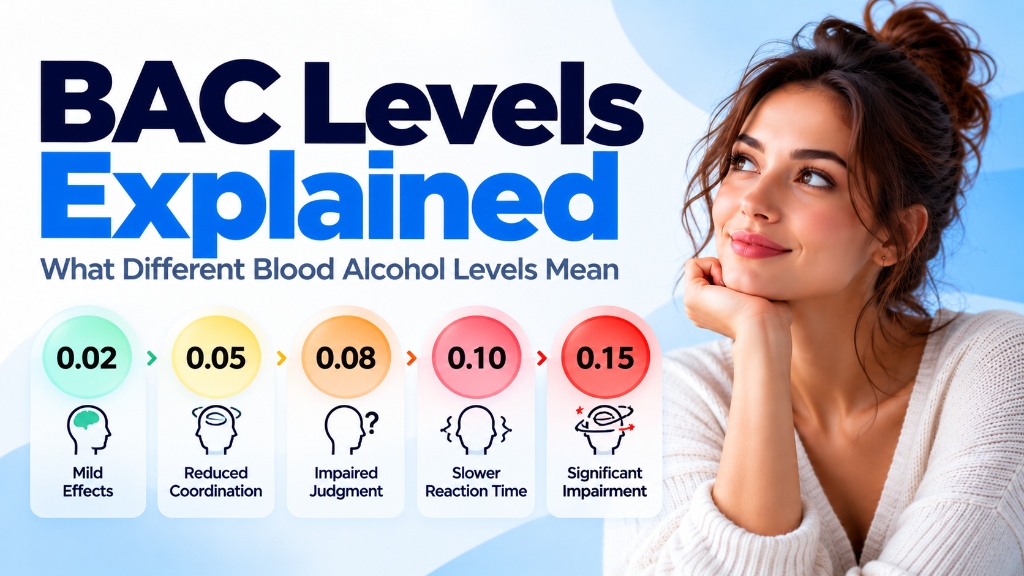
Blood Alcohol Concentration (BAC) Progression Overview
Blood Alcohol Concentration (BAC) measures the percentage of pure alcohol in your bloodstream by mass. Because ethanol is a potent central nervous system depressant that readily crosses the blood-brain barrier, higher blood alcohol concentrations systematically disrupt neurochemistry—modulating GABA and glutamate receptors to suppress cognitive control, sensory tracking, and motor coordination.
Understanding how physiological effects progress across specific BAC thresholds is critical for recognizing acute intoxication, preventing alcohol poisoning, and making informed safety decisions. To simulate where different drinks place your estimated blood alcohol curve, you can use the Toolwingz BAC Calculator.
Clinical Impairment Stages & Driving Effects at a Glance
The table below synthesizes physiological benchmarks established by the National Highway Traffic Safety Administration (NHTSA) and the National Institute on Alcohol Abuse and Alcoholism (NIAAA):
| BAC Level | Observable Physical & Mental Effects | Specific Driving & Motor Impairment |
|---|---|---|
| 0.02%Mild Warmth | Subtle relaxation, slight mood elevation, mild body warmth, and early minor loss of judgment. | Decline in rapid visual tracking of moving objects; measurable decline in divided-attention multi-tasking. |
| 0.05%Early Release of Inhibition | Exaggerated behavior, loss of small-muscle eye control, lowered alertness, and release of primary inhibitions. | Reduced coordination, difficulty tracking moving targets, impaired steering precision, and delayed hazard reaction. |
| 0.08%Statutory Legal Threshold | Marked muscle coordination deficit, compromised balance, slower reaction speed, degraded self-control and reasoning. | Substantial speed control degradation, impaired visual search and signal recognition, short-term memory deficit. |
| 0.10%Marked Deterioration | Clear deterioration of reaction time and muscular control. Slurred speech, unsteady gait, and slowed cognitive processing. | Reduced ability to maintain lane positioning, delayed emergency braking, failure to process roadside warnings. |
| 0.15%Substantial Impairment | Major loss of balance, confusion, severe sensory distortion, and nausea/vomiting. High risk of memory blackouts. | Severe loss of vehicle control, gross attention failure, and inability to process visual and auditory information. |
| 0.20% – 0.30%Severe Toxicity & Stupor | Profound mental confusion, inability to stand or walk unaided, loss of pain sensation, high vomiting and aspiration risk. | Complete incapacitation. Driving attempts result in catastrophic crashes. |
| 0.35%+Life-Threatening Emergency | Coma, loss of peripheral reflexes, respiratory arrest, severe hypothermia, cardiac failure, and imminent mortality. | Medical emergency requiring immediate intensive hospital resuscitation. |
In-Depth Breakdown of BAC Zones
0.00% – 0.02%: Baseline Sobriety & Early Elevation
At 0.02% (typically one standard drink for a healthy adult), outward intoxication is rarely noticeable. However, subtle alterations occur in visual processing: laboratory studies reveal measurable declines in the ability to track two rapid moving targets simultaneously.
0.02% – 0.05%: Euphoria & Divided-Attention Deficits
At 0.05%, mild euphoria and reduced anxiety emerge as ethanol enhances inhibitory GABA neurotransmission in the cerebral cortex. Crucially, fine motor coordination and emergency braking reactions degrade substantially. Several countries and Utah enforce 0.05% statutory driving limits because collision risks double at this stage.
0.05% – 0.08%: Psychomotor Deterioration
As BAC approaches the legal threshold, optical convergence weakens, causing blurred peripheral vision. Complex decision-making slows, speed perception is skewed, and drivers routinely drift across roadway lanes.
0.08%: The Statutory Per Se Impairment Threshold
Across 49 U.S. states and many global jurisdictions, 0.08% is the statutory threshold for per se driving under the influence charges. At 0.08%, NHTSA data demonstrates that a driver is approximately 4 to 6 times more likely to be involved in a fatal crash compared to a sober driver. For an in-depth breakdown of state statutes, under-21 zero-tolerance rules, and commercial driver standards, see our comprehensive guide on legal BAC limits in the United States. Roadside enforcement routinely relies on breath testing devices—learn how these compare in our guide on the difference between BAC and breath alcohol.
0.10% – 0.15%: Significant Impairment & Dysphoria
At this level, the initial euphoria is overtaken by depressant effects: slurred articulation, ataxia (unsteady stumbling gait), and delayed auditory processing. Gastrointestinal irritation frequently triggers vomiting.
0.16% – 0.25%: Blackouts & Acute Alcohol Poisoning
Ethanol completely suppresses hippocampal memory encoding, resulting in anterograde amnesia (blackouts). Individuals cannot form new memories despite walking and talking. Motor control collapses, and the risk of severe head trauma from falls escalates.
0.25% – 0.35%: Stupor & Medical Emergency
Sensory input fails to reach consciousness. The pharyngeal gag reflex diminishes or disappears entirely, creating an acute risk of asphyxiation on stomach vomit. Body temperature dysregulation causes life-threatening hypothermia.
0.35%+: Medullary Respiratory Arrest & Fatal Collapse
Ethanol suppresses vital autonomic centers in the brainstem medulla oblongata that control breathing and heartbeat. Respiration slows to fewer than 6 breaths per minute or ceases entirely, resulting in coma, cardiac arrest, and fatal alcohol overdose without immediate hospital intervention.
Physical vs. Cognitive Impairment: The Deceptive Gap
One of the greatest dangers of alcohol consumption is that cognitive faculties deteriorate long before physical motor symptoms appear:
Cognitive Impairment (Starts at 0.02%)
Risk assessment, emergency decision-making, visual attention, and hazard recognition begin deteriorating almost immediately after drinking begins.
Physical Symptoms (Visible at 0.08%+)
Obvious outward signs—such as slurred speech, stumbling, and dropping objects—generally only become conspicuous at elevated BAC levels.
The Myth of High Tolerance
Scientific Reality on Tolerance:
Frequent drinkers develop behavioral tolerance, learning to compensate for outward physical signs of drunkenness. However, behavioral tolerance does NOT lower biochemical blood alcohol concentration or protect brain synapses from degraded reaction times and visual tracking deficits. A driver with 0.08% BAC is equally impaired and legally culpable regardless of how sober they subjectively feel.