

BAC vs. BrAC: What's the Difference Between Blood and Breath Alcohol?
Explore the crucial differences between Blood Alcohol Concentration (BAC) and Breath Alcohol Concentration (BrAC), how breathalyzers detect alcohol, why ratios vary, and why calculators provide estimates.
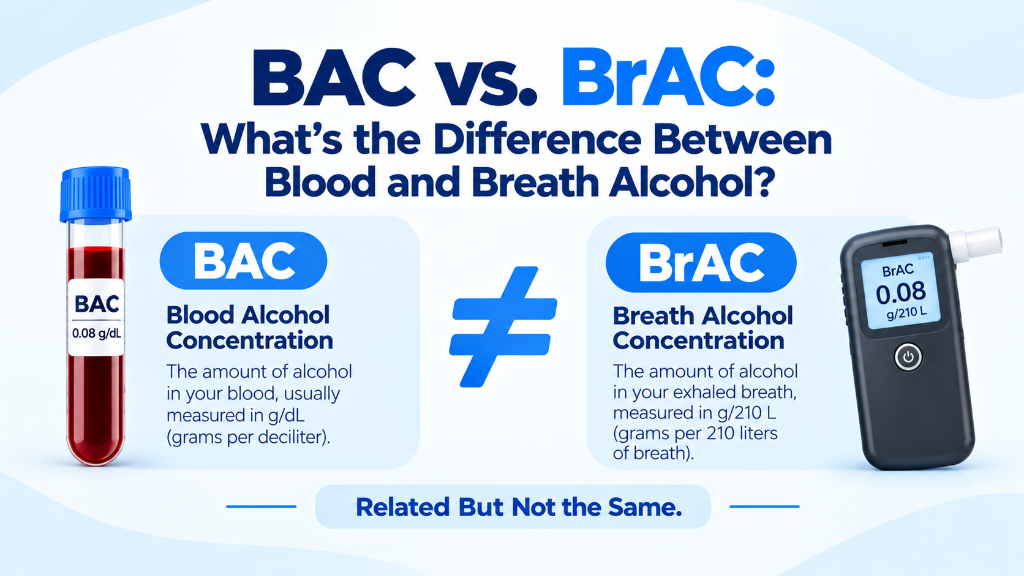
BAC vs. BrAC: What's the Difference?
The distinction between BAC and BrAC comes down to what is physically measured: blood alcohol concentration measures alcohol in your bloodstream, while breath alcohol concentration measures alcohol in your exhaled breath.
When discussing alcohol testing, people frequently use BAC (blood alcohol concentration) and BrAC (breath alcohol concentration) as if they were identical terms. However, they describe two distinct physiological measurements. The National Highway Traffic Safety Administration (NHTSA) defines BAC strictly in terms of the amount of alcohol present in a given volume of whole blood, while categorizing instrument readings gathered from exhaled air as BrAC (NHTSA SFST Manual).
When an individual blows into a roadside breathalyzer, the device does not draw a blood sample or directly chemically analyze whole blood. Instead, the breath-testing instrument samples the concentration of volatile ethanol vapors contained in exhaled alveolar air. It then uses calibrated mathematical software to report a result that law enforcement and clinical systems use as an evidential indicator of systemic alcohol concentration.
In consumer-facing educational resources, NHTSA notes that an individual's alcohol level can be evaluated using a breathalyzer or an evidentiary blood test (NHTSA Impaired Driving Guidance). While these two measurements correlate closely through pulmonary blood exchange, they rely on different biological matrices, specialized sampling protocols, and distinct reporting units.
Key Takeaway
BAC and BrAC are related measurements, but they are not the same measurement.
What Is BAC?
Blood Alcohol Concentration (BAC) represents the literal proportion of pure ethanol circulating within a person's bloodstream. Rather than evaluating symptoms or secondary biological byproducts, BAC measures the physical presence of alcohol in blood plasma and red blood cells. To explore the fundamental definitions and biological mechanics in depth, see our complete guide on what BAC means.
In the United States and several other countries, BAC is conventionally quantified in grams of alcohol per deciliter of whole blood (g/dL), which is equivalent to grams of alcohol per 100 milliliters of blood. As NHTSA explains in its forensic training curricula, a legal BAC of 0.08 means an individual has exactly 0.08 grams of ethanol circulating in every 100 mL (one deciliter) of their blood.
Why BAC Is Used
Because blood carries ethanol directly past the blood-brain barrier to the central nervous system, blood alcohol concentration serves as the primary scientific standard in biomedical toxicology, pharmacokinetic research, emergency medicine, and statutory traffic safety laws. However, a single BAC number does not mean that every person experiences the exact same subjective feelings or identical behavioral responses, because neurochemical tolerance and metabolic rates differ between individuals.
Is BAC the Same as “Blood Alcohol Level”?
In common conversation, news reporting, and casual medical settings, the terms “BAC” and “blood alcohol level” are frequently used interchangeably to describe the same general concept. Scientifically, however, blood alcohol concentration (BAC) is the precise toxicological phrase because it defines an exact mass-to-volume chemical concentration rather than an arbitrary scale or subjective rating.
What Is BrAC?
Breath Alcohol Concentration (BrAC) represents the concentration of alcohol molecules captured in an individual's exhaled breath. Because ethanol is a volatile liquid with a low boiling point, alcohol circulating through the pulmonary arteries naturally evaporates across microscopic alveolar capillary membranes into the microscopic air sacs of the lungs. When you breathe out, this vapor is expelled.
Under federal model standards established by NHTSA, BrAC is technically expressed in grams of alcohol per 210 liters of breath (g/210 L) (NHTSA Model Specifications for Evidential Breath Testers). In several international jurisdictions, breath readings are instead reported in micrograms of alcohol per 100 milliliters of breath (µg/100 mL) or milligrams per liter (mg/L).
What Does a Breathalyzer Actually Measure?
It is essential to understand that a breathalyzer measures alcohol in breath—not alcohol directly in blood. A breath-testing device captures an exhaled air sample, directs it into a specialized sensor chamber (typically using electrochemical fuel cells or infrared spectrophotometry), and calculates how much gaseous ethanol is present in that breath volume. The instrument then provides a breath alcohol reading that can be evaluated according to state or national legal standards.
Why Is Breath Testing Useful?
Drawing blood requires trained medical personnel, sanitary needles, biohazard controls, laboratory transport, and forensic gas chromatography analysis—a procedure that can take days or weeks. Breath testing provides a rapid, non-invasive, and practical method for roadside sobriety checkpoints, workplace safety monitoring, and police processing stations. As NHTSA outlines in its countermeasures documentation, law enforcement uses handheld preliminary breath test (PBT) screening devices alongside tabletop evidential breath-testing instruments to deter impaired driving efficiently.
How Does Breath Alcohol Relate to Blood Alcohol?
The physiological relationship connecting breath alcohol to blood alcohol is based on respiratory gas exchange governed by Henry's Law. Henry's Law dictates that when a volatile chemical is dissolved in a liquid at a constant temperature within a closed system, a predictable equilibrium forms between the concentration of the chemical in the liquid and the concentration of its vapor in the air directly above it.
The Pulmonary Exchange Chain:
Why the Two Measurements Are Connected
Because the lungs receive approximately 100% of cardiac blood output from the right side of the heart, alcohol in the blood continuously comes into close contact with alveolar air. For this reason, breath alcohol levels closely track circulating blood alcohol concentrations over time. As alcohol is metabolized by the liver, both blood and breath alcohol levels decline in tandem. To learn more about this biological clearance process, see our guide on how alcohol is metabolized.
Why They Aren't Interchangeable Numbers
In the United States, evidential breath-testing devices correlate breath to blood using a standardized partition ratio convention of 2,100:1. This means the legal testing system assumes that 2,100 milliliters of alveolar lung air contain approximately the same quantity of ethanol as 1 milliliter of whole blood (or 210 liters of breath to 100 milliliters of blood).
However, this partition ratio is an administrative and scientific standard—not a biological constant for every human being at every moment. In living individuals, actual biological partition ratios vary based on body temperature, hematocrit (red blood cell volume), breathing patterns, and whether an individual is in the active absorption phase versus the elimination phase. Therefore, BAC and BrAC are different measurement types, even when administrative legal systems link them by statutory definition.
Does a Breathalyzer Measure Your BAC?
The short answer is: not directly.
A breathalyzer samples exhaled breath; it does not draw blood and chemically analyze the fluid itself. However, approved breath-testing instruments are designed to assess systemic alcohol concentration through breath measurements, and the resulting measurement can be used for alcohol-impaired-driving enforcement.
In its consumer safety literature, NHTSA frequently states that BAC can be measured using a breathalyzer or blood test because statutory traffic codes have established legal definitions that treat evidential breath readings (expressed in g/210 L) as legally equivalent to blood alcohol values (expressed in g/dL). In an evidential context, many state laws define per se impairment by setting limits for both blood (e.g., 0.08 g/dL) and breath (e.g., 0.08 g/210 L) independently.
Why Can Breath Alcohol Results Vary?
Because breath alcohol measurement relies on capturing deep pulmonary air rather than drawing liquid directly from a vein, readings can be influenced by procedural, technological, and biological factors. Understanding these variables explains why two sequential tests or readings taken under different conditions might show variation.
Testing Device and Calibration
Not all breathalyzers operate with the same degree of precision. Consumer pocket breathalyzers often use low-cost semiconductor oxide sensors that can drift over time and cross-react with other volatile compounds. In contrast, evidential breath testers used in legal settings utilize fuel-cell or dual-wavelength infrared sensors subjected to strict calibration schedules. NHTSA maintains model specifications emphasizing that regular calibration, routine maintenance, and rigorous quality assurance protocols are vital to ensure the accuracy and evidential reliability of alcohol-testing instruments.
Testing Conditions and Mouth Alcohol
Standard forensic breath-testing protocols require a mandatory 15- to 20-minute pre-test observation period. This waiting period ensures that residual “mouth alcohol”—from taking a recent sip of an alcoholic beverage, using alcohol-containing mouthwash, or gastroesophageal reflux (burping)—has fully evaporated. If mouth alcohol is present, the sensor will register an artificially elevated reading that does not reflect actual alveolar air or systemic blood concentration.
Additionally, the depth and duration of the breath sample influence results. Evidential breathalyzers require a continuous, sustained blow to discard shallow dead-space air from the mouth and trachea, ensuring the instrument captures deep alveolar air from the lowest regions of the lungs.
The Measurement Isn't a Substitute for Understanding BAC Dynamics
Breath testing provides an observational snapshot of volatile ethanol at a single moment in time. It cannot reveal whether your blood alcohol level is still rising toward its crest or actively dropping on the downward elimination slope. Factors like drinking pace and food intake substantially affect these curves. For a detailed breakdown of how physiological factors influence your curve, explore our analysis of factors that affect BAC.
Can BAC and BrAC Numbers Look Different?
Yes. The numbers may be expressed differently because BAC and BrAC refer to different measurement mediums and units.
In the United States, forensic statutes purposefully set the breath reporting unit to grams per 210 liters of breath (g/210 L) so that an evidential breath reading displays a decimal number that matches the standard blood alcohol scale (such as “0.08”). However, the biological mediums are fundamentally different. Furthermore, in countries like the United Kingdom, Germany, or Australia, breath alcohol readings are reported in distinct units—such as 35 µg/100 mL or 0.25 mg/L—which appear completely different at first glance from a 0.05 or 0.08 blood percentage.
| Measurement | What is sampled? | Common concept |
|---|---|---|
| BAC | Blood | Alcohol concentration in blood |
| BrAC | Exhaled breath | Alcohol concentration in breath |
| Breathalyzer result | Breath | Instrument-based alcohol measurement |
| BAC calculator | No physical sample | Mathematical estimate |
Understanding these structural differences prevents confusion when reviewing medical records, legal documentation, or international travel guidelines regarding statutory impairment limits.
BAC vs. BrAC vs. a BAC Calculator
When evaluating alcohol in the body, confusion often arises when comparing physical clinical measurements with mathematical modeling tools. It is essential to distinguish between these three distinct concepts:
Direct Blood Measurement
A physical measurement of ethanol concentration in whole blood drawn via venipuncture and quantified using laboratory gas chromatography.
Exhaled Breath Reading
An instrument-based physical measurement of ethanol vapor expelled from pulmonary alveolar air, interpreted through calibrated sensor technology.
BAC Calculator Estimate
A theoretical mathematical estimate calculated using population demographic formulas based on alcohol consumed, timeframe, weight, and biological sex.
Make this distinction clear in your mind: a BAC calculator does not measure blood alcohol, and it does not perform a breath test. It takes inputs like your weight, gender, elapsed hours, and beverage count—relying on established definitions of what counts as a standard drink—to calculate an estimated blood alcohol concentration. To learn more about the scientific formulas used in these models, review our guide on how BAC is calculated.
Try the Toolwingz BAC Calculator to estimate BAC
Explore how personal variables shape theoretical alcohol absorption and metabolism curves in real time.
Can You Convert BrAC to BAC Yourself?
If you look online, you may encounter simplified arithmetic multipliers or conversion charts claiming that multiplying or dividing a breathalyzer reading by a fixed number (such as 2,100) will yield your exact blood alcohol concentration.
You should never treat a DIY conversion formula as a guaranteed method to determine your real-world blood alcohol level. While evidential testing instruments use standardized calibration benchmarks, an individual's actual biological partition ratio is dynamic. Studies in forensic toxicology show that individual blood-to-breath ratios can fluctuate significantly between roughly 1,800:1 and 2,400:1 depending on metabolic factors, body temperature, hematocrit levels, and respiratory dynamics.
Moreover, statutory rules vary across jurisdictions: NHTSA's technical specifications establish separate standard units for blood and breath, reinforcing that these measurements are distinct empirical observations rather than interchangeable values. Attempting to run personal math on a handheld breath reading to determine whether you are “safely below” a statutory driving limit is biologically flawed and legally perilous.
Which Is More Accurate: Blood Test or Breathalyzer?
In public discussions, people frequently ask which test is universally “more accurate.” In forensic toxicology, the answer is that blood and breath testing measure ethanol through entirely different biological samples, each with its own advantages and methodological requirements.
A properly collected and analyzed blood test is considered the definitive gold standard for direct chemical measurement because it extracts and quantifies ethanol molecules directly from the circulating blood matrix using headspace gas chromatography with flame ionization detection (GC-FID). There is no need to apply an assumed respiratory partition ratio. However, blood draws require rigorous chain of custody, proper preservatives (sodium fluoride) to stop post-collection fermentation, and sterile venipuncture protocols.
An evidential breath-testing device, when certified, regularly calibrated, and operated by a qualified technician following a strict observation window, provides a highly reliable, non-invasive assessment of alcohol concentration in the breath. The appropriate measurement depends on the purpose, testing method, equipment specifications, testing procedures, and applicable legal framework.
BAC, BrAC, and Driving Safety
Regardless of whether alcohol concentration is estimated with a digital tool or measured using an evidential device, public safety research is unequivocal: alcohol consumption impairs cognitive and motor functions long before a person realizes they are compromised. NHTSA emphasizes that even tiny amounts of alcohol—well below statutory thresholds—degrade divided attention, reaction speed, visual tracking, and steering control. For a comprehensive overview of physiological impairment milestones, review our guide on BAC levels explained.
Essential Rules on Impairment and Sobriety
- A calculated BAC is only a theoretical estimate: Mathematical curves cannot see your individual metabolism or digestive rate.
- Subjective feelings of sobriety are unreliable: Chronic tolerance masks outward signs of drunkenness without restoring degraded reflexes.
- A breath reading should never be treated as permission to drive: Your BAC could still be actively rising. Alcohol absorption can continue climbing for 30 to 90 minutes after your last drink—learn more about when BAC peaks after drinking.
- 0.08 is not a “safe limit”: In the U.S., 0.08 g/dL (and 0.08 g/210 L) is the statutory per se threshold in 49 states, while Utah enforces a stricter 0.05 limit. Stricter standards or zero tolerance apply to commercial drivers and drivers under 21. Drivers can be convicted of DUI at any measurable alcohol level if impairment is observed.
The Bottom Line: BAC vs. BrAC
Understanding the difference between blood and breath alcohol helps demystify forensic science, roadside testing procedures, and digital calculators:
- BAC refers to alcohol concentration in blood: It directly measures the mass of ethanol circulating in whole blood, typically expressed in grams per deciliter (g/dL).
- BrAC refers to alcohol concentration in breath: It quantifies ethanol vapors expelled from the alveolar air sacs of the lungs, typically expressed in grams per 210 liters of breath (g/210 L).
- A breathalyzer measures breath, not blood directly: It captures exhaled air and applies calibrated sensors to evaluate alcohol levels without taking a blood draw.
- Breath and blood measurements are related but not identical: While alveolar diffusion links the two through respiratory physiology, individual partition ratios and test conditions cause natural biological variability.
- A BAC calculator produces a mathematical estimate: It projects a statistical curve based on population averages rather than conducting a physical chemical test.
- None of these numbers should be used to rationalize driving: Never use a calculator, a personal breath test, or subjective feelings of alertness to justify getting behind the wheel after drinking.
Try the Toolwingz BAC Calculator to Estimate BAC
Explore how body weight, biological sex, standard drinks consumed, and elapsed time shape theoretical blood alcohol absorption models with complete privacy.
Toolwingz BAC Calculator results are estimates for informational purposes only. They do not measure your actual BAC or determine whether you are safe or legally permitted to drive.