Does Eating Before Drinking Affect BAC? How Food Changes Alcohol Absorption
Discover how food slows gastric emptying and alcohol absorption, how drinking on an empty stomach changes peak BAC, and why food cannot quickly sober you up.
1. Does Eating Before Drinking Affect BAC? (Direct Answer)
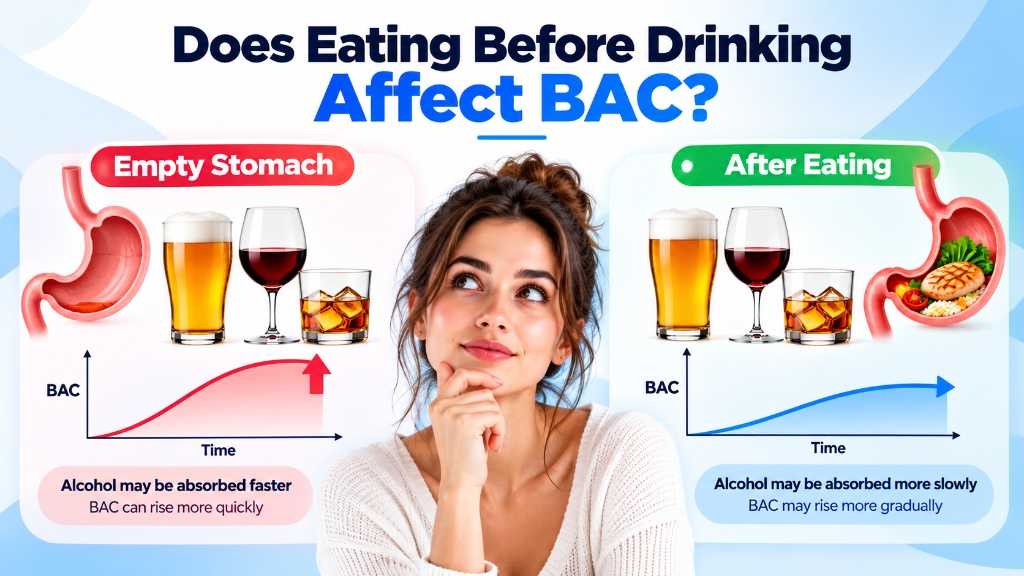
Yes. Eating before drinking significantly reduces your peak Blood Alcohol Concentration (BAC) and substantially slows down how rapidly alcohol enters your bloodstream. Consuming a balanced meal prior to drinking can lower peak BAC by 20% to 40% compared to drinking the identical amount on an empty stomach.
However, it is vital to understand the physiological boundary of this effect: food delays and moderates alcohol absorption—it does not eliminate alcohol, make you immune to intoxication, or restore sobriety once alcohol is circulating in your blood.
To explore how your drink choices, body weight, and timeline shape your estimated blood alcohol curve, you can test scenarios using the Toolwingz BAC Calculator.
2. How Alcohol Gets Into Your Bloodstream
Unlike proteins, carbohydrates, or fats, ethanol requires no preliminary enzymatic breakdown to enter human tissue. Instead, alcohol is absorbed directly into capillaries across two primary gastrointestinal sites:
~20% of Ingested Alcohol
Roughly one-fifth of ingested alcohol is absorbed directly through the gastric mucosal lining into local blood vessels. The stomach wall has a relatively small surface area and thick mucus protective layer, making absorption comparatively slow.
~80% of Ingested Alcohol
The remaining four-fifths passes through the pyloric valve into the duodenum and upper jejunum. Covered in millions of microscopic villi with vast vascular surface area, the small intestine absorbs alcohol almost instantaneously into circulating blood.
3. Why Does Food Slow Alcohol Absorption?
The core physiological reason food slows alcohol absorption lies in gastric emptying governed by the pyloric sphincter:
The Physiological Absorption Chain
When solid food enters the stomach, sensory receptors prompt the pyloric sphincter to close tightly. Stomach muscles churn the mixture with gastric acids and enzymes until food is broken into a semi-liquid state (chyme). Because alcohol mixes thoroughly with food, it remains trapped in the stomach for a prolonged period.
Food in Stomach
Pyloric Valve Closes
Metered Intestinal Release
Flatter, Lower BAC Peak
- Paced Absorption: Ethanol enters the small intestine only in small, metered pulses, allowing the liver time to clear alcohol gradually rather than facing a massive initial surge.
- Enhanced First-Pass Gastric Metabolism: The stomach lining contains gastric alcohol dehydrogenase (ADH) enzymes. Prolonged retention gives these enzymes additional time to oxidize a modest fraction before it ever reaches circulating blood.
4. Drinking on an Empty Stomach vs. After Eating
The practical difference between drinking on an empty stomach and drinking after a substantial meal is dramatic. To understand the broader timeline implications, explore our dedicated analysis on how food can affect the timing of peak BAC:
| Physiological Dimension | Drinking on an Empty Stomach | Drinking After a Substantial Meal |
|---|---|---|
| Pyloric Valve Status | Open; rapid pass-through to intestine | Closed for digestive churning |
| Time to Peak BAC | 20 to 45 minutes | 60 to 120+ minutes |
| Peak BAC Magnitude | Highest possible spike (100% baseline) | Flattened curve (20% – 40% lower peak) |
| First-Pass Metabolism | Minimal; bypasses gastric ADH enzymes | Maximized; extended gastric enzyme contact |
| Hangover & Gastric Distress | High risk of nausea, reflux, severe hangover | Buffer against acid irritation, gentler recovery |
5. Does Food Lower Your BAC?
Food does not neutralize or erase alcohol. What food does is flatten the peak BAC curve by stretching absorption across several hours, allowing liver metabolism (~0.015% BAC/hr) to chip away at circulating alcohol continuously as it enters. The total area under the curve changes modestly due to first-pass metabolism, but food cannot destroy ethanol already absorbed.
6. Can Eating After Drinking Sober You Up Faster?
No. Consuming late-night meals after drinking cannot retrieve alcohol that has already passed into your bloodstream and brain. While food provides glucose and eases morning stomach irritation, it does not accelerate hepatic liver enzymes or decrease your BAC faster.
7. What About Coffee, Water or a Cold Shower?
• Coffee & Energy Drinks: Caffeine stimulates central alertness, creating a deceptive state known as “wide-awake drunkenness,” but BAC remains unchanged. Learn more about the neurological differences in our guide on does coffee actually lower BAC? to see why caffeine cannot speed up sobriety.
• Water & Electrolytes: Prevent dehydration and mitigate headache symptoms, but cannot extract ethanol from blood plasma.
• Cold Showers: Trigger sensory shock and adrenaline, but do not speed up liver enzyme breakdown.
8. Does the Type of Food Matter?
Meals high in protein, healthy dietary fats, and complex fibrous carbohydrates take longest to digest, providing the most sustained gastric delay. Simple sugars and fast snacks pass through the stomach rapidly, offering far less protection.
9. Food Doesn't Make the Number of Drinks Predictable
Because meal composition, stomach acidity, and digestion speed vary unpredictably from day to day, you cannot rely on eating to guarantee a specific BAC level. Counting on food to keep you under legal driving limits is unreliable and dangerous.
10. How Food Fits Into a BAC Estimate
Standard mathematical formulas like the Widmark equation assume instantaneous complete absorption. Digital calculators often incorporate an absorption factor or allow users to model food intake, shifting the curve to reflect delayed, moderated peaks.
11. Why You Shouldn't Use Food to Decide Driving Safety
Never assume having a meal makes it safe or legal to drive after drinking. Even with delayed absorption, cognitive impairment begins at BAC levels as low as 0.02%, and alcohol will continue entering your bloodstream while you drive. Always choose a designated sober driver or rideshare.
Estimate Your BAC with the Toolwingz BAC Calculator
Explore how body weight, biological sex, drink strength, and timing influence your theoretical blood alcohol curve with 100% client-side privacy.
Educational Disclaimer: Toolwingz BAC Calculator results are estimates for informational purposes. They cannot measure your actual BAC or determine whether you are safe or legally permitted to drive.