Does Coffee Lower BAC? Why Caffeine Doesn't Sober You Up
Explore why coffee and caffeine cannot lower your blood alcohol concentration (BAC) or accelerate liver metabolism, why feeling alert is not the same as being sober, and the risks of caffeine-alcohol combinations.
Does Coffee Lower Your BAC? (Direct Answer)
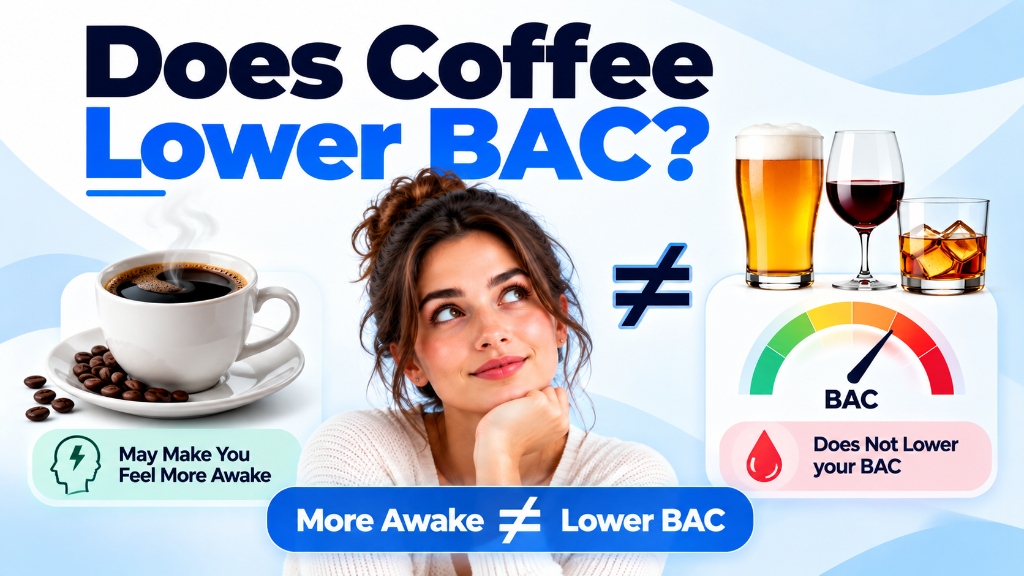
No. Drinking coffee does not lower your Blood Alcohol Concentration (BAC), nor does it remove alcohol from your bloodstream or make your body metabolize ethanol significantly faster.
While the caffeine in coffee is a central nervous system stimulant that can temporarily make you feel more alert and less drowsy, increased wakefulness is fundamentally different from physiological sobriety. The alcohol circulating in your brain, vascular system, and vital organs remains at the exact same concentration regardless of how many cups of coffee you drink.
Public health authorities, including the Centers for Disease Control and Prevention (CDC), warn that caffeine does not reduce alcohol's intoxicating effects or reverse cognitive and motor impairment. To understand where your theoretical blood alcohol levels stand after drinking, you can estimate your BAC using interactive mathematical models based on your body weight, drink count, and elapsed time.
Why Coffee Can Make You Feel Awake Without Lowering BAC
The persistent cultural belief that coffee “sobers you up” stems from a profound neurological misunderstanding. When someone who has been drinking drinks a hot cup of black coffee, they often feel an immediate shift in their subjective state. However, this sensation is entirely cosmetic:
Alcohol and Caffeine Have Fundamentally Opposite Mechanisms
Ethanol is a potent central nervous system depressant. It binds to gamma-aminobutyric acid (GABA) receptors in the brain to amplify inhibitory neurochemical signals, while simultaneously suppressing excitatory glutamate transmission. This chemical combination produces sedation, slowed neural communication, diminished motor reflexes, and pronounced sleepiness.
Caffeine, on the other hand, is a central nervous system stimulant. Its molecular structure closely resembles adenosine—a neuromodulator that accumulates in the brain throughout waking hours to signal fatigue and sleep pressure. By binding to and temporarily blocking adenosine receptors (specifically A1 and A2A receptors), caffeine prevents the brain from detecting its own tiredness.
Feeling Alert Isn't the Same as Being Sober
Sobriety is defined by the physiological absence of ethanol and the restoration of uncompromised cognitive and neuromuscular functioning. Alertness is merely a subjective perception of wakefulness.
When caffeine masks the heavy eyelids and sluggishness associated with intoxication, people frequently misinterpret their reduced drowsiness as proof of recovered competence. Laboratory experiments repeatedly demonstrate that caffeinated intoxicated participants consistently rate themselves as less impaired than non-caffeinated intoxicated participants, even while failing computerized driving simulations, visual tracking tests, and hazard reaction drills at the exact same rate.
Coffee never “cancels out” alcohol. It merely silences your body's natural warning signals that you are intoxicated. For a foundational physiological breakdown, see our guide on what BAC means.
What Actually Happens to Alcohol in Your Body?
To see why coffee is completely ineffective at lowering blood alcohol, it helps to review the biological pathway ethanol follows after you take a drink:
Ingestion & Absorption
Roughly 20% of alcohol absorbs directly through the stomach lining, while the remaining 80% absorbs rapidly across the microvilli of the small intestine.
Vascular Distribution
Ethanol diffuses freely into blood plasma and body water, circulating to the brain, heart, and lungs in minutes.
Hepatic Metabolism
Over 90% to 95% of circulating alcohol must be broken down by liver enzymes: alcohol dehydrogenase (ADH) and aldehyde dehydrogenase (ALDH).
Elimination
Only a tiny fraction (2%–5%) leaves unchanged via breath, urine, and sweat. The rest must wait for hepatic oxidation.
Once ethanol molecules enter your systemic circulation, they cannot be filtered out by your kidneys or neutralized in your stomach. Your body relies almost exclusively on the liver to chemically convert ethanol into acetaldehyde and eventually into harmless acetate. Learn more in our clinical review on how alcohol is metabolized over time.
Can Coffee Speed Up Alcohol Metabolism?
Coffee is not a biological shortcut for alcohol metabolism.
The enzymes responsible for oxidizing alcohol in hepatocytes operate under zero-order kinetics. This means that unlike many other metabolic pathways that speed up as chemical concentrations increase, alcohol dehydrogenase enzymes work at a fixed, saturated maximum capacity regardless of how much alcohol or coffee is present.
Caffeine does not stimulate the transcription or catalytic speed of alcohol dehydrogenase enzymes. It does not open up additional metabolic pathways, increase blood flow to the liver in a manner that meaningfully clears ethanol, or alter the biochemical rate of alcohol degradation.
Popular culture frequently claims that the body clears “one drink per hour.” While average population clearance is modeled at approximately 0.015% BAC per hour, individual metabolic clearance rates actually vary between 0.010% and 0.020% per hour due to genetic enzyme polymorphisms (such as ADH1B and ALDH2 alleles), liver health, biological sex, and age. Drinking coffee does not change your personal enzymatic rate by a single microgram.
Understanding these biological variables is key to evaluating theoretical blood alcohol curves. For an in-depth breakdown of how formulas model these dynamics, read our guide on how BAC is calculated and explore the major factors that affect BAC.
Coffee vs. BAC: What Changes and What Doesn't?
To clearly see what coffee can and cannot accomplish after drinking, consider the physiological side-by-side comparison below:
| After Drinking Coffee | What Actually Happens? | Scientific Explanation |
|---|---|---|
| Alertness | May increase temporarily | Caffeine stimulates central neural activity and temporarily elevates perceived energy. |
| Sleepiness | May decrease temporarily | Caffeine temporarily blocks adenosine receptors, masking signals of physiological fatigue. |
| Alcohol Already in Blood | Still present | Ethanol remains circulating freely throughout blood plasma and bodily fluids. |
| Blood Alcohol Concentration (BAC) | Not lowered by coffee | Coffee does not chemically neutralize ethanol or dilute blood volume significantly. |
| Alcohol Metabolism Rate | Not accelerated | Hepatic ADH and ALDH enzyme clearance rates proceed at their standard fixed biological pace. |
| Neurological Impairment | Can remain severe | Visual tracking, divided attention, fine motor control, and reaction times remain degraded. |
Note: Individual physiological responses vary based on caffeine tolerance, genetic enzyme rates, body weight, and hydration status. Under no circumstances does caffeine reverse alcohol intoxication.
Can Coffee Sober You Up Enough to Drive?
No. Absolutely not.
Coffee should never be used as a method to “sober up” for driving or operating machinery. Relying on coffee to drive after drinking is one of the most hazardous mistakes a person can make, because feeling awake creates an illusion of competence that actively encourages dangerous behavior.
Extensive crash research published by the National Highway Traffic Safety Administration (NHTSA) confirms that alcohol-induced driving impairment begins at blood alcohol concentrations as low as 0.02% to 0.05%—levels reached after just one or two standard drinks. Specific driving faculties compromised by alcohol include:
- Emergency Braking Reaction Time: Slower synaptic transmission delays foot-to-brake response by hundreds of milliseconds—translating to dozens of additional feet of travel distance at highway speeds.
- Divided Attention: Drivers cannot simultaneously track speed, maintain lane positioning, and scan crosswalks for pedestrians.
- Visual Tracking & Optical Convergence: Alcohol impairs eye muscle coordination, narrowing peripheral awareness and degrading nighttime hazard detection.
- Judgment and Risk Assessment: Ethanol suppresses prefrontal cortex inhibition, leading caffeinated drivers to take aggressive risks because they falsely believe they are alert.
Never use coffee, energy drinks, cold air, or subjective feelings of alertness to decide whether you are safe to drive. If you have been drinking alcohol, always use a designated sober driver, rideshare service, public transit, or taxi. For a detailed review of impairment milestones, read our guide on BAC levels and their effects.
What About Energy Drinks and Alcohol?
The popularity of combining alcohol with high-caffeine energy drinks (or consuming pre-mixed caffeinated alcoholic beverages) shares the exact same physiological flaw as drinking coffee—with even greater public health risks.
The CDC explicitly warns that combining caffeine with alcohol produces a phenomenon called “wide-awake drunkenness.” Caffeine masks the sedative cues that normally prompt an individual to stop drinking or go to sleep. Consequently, drinkers who mix alcohol with energy drinks are:
More Binge Drinking
Three times more likely to engage in heavy episodic binge drinking.
More Alcohol Harm
Twice as likely to experience alcohol-related physical injury or emergency trauma.
DUI Vulnerability
Significantly more likely to attempt driving under the false belief that they are sober.
Energy drinks do not metabolize alcohol faster, protect your liver, or decrease your blood alcohol concentration. They simply mask fatigue while impairment continues unchecked.
What About Cold Showers, Exercise or Fresh Air?
Alongside coffee, folklore is rich with other supposed “rapid sobering” methods. In human physiology, none of them work:
Cold Showers
Cold water provokes an adrenaline release and peripheral vasoconstriction. While this shock can make you gasp and feel awake, it does not alter hepatic enzymatic clearance. Read our clinical guide on does a cold shower actually sober you up? to see why cold water cannot reduce blood alcohol.
Intense Exercise & Sweating
Less than 1% of circulating alcohol is eliminated through sweat glands. Vigorous exercise merely exhausts an already dehydrated system and increases heart strain without measurably reducing BAC.
Walking in Fresh Air
Cool outdoor air stimulates sensory receptors on facial skin, increasing alertness. However, alcohol elimination continues at the exact same fixed liver pace of ~0.015% per hour.
Wondering about hydration? Read our detailed physiological analysis on does drinking water actually lower BAC? to see what fluids can and cannot do for alcohol clearance.
What About Eating After Drinking?
Another common belief is that heading to a diner for greasy food, pizza, or carbs late at night will “soak up” the alcohol and sober you up.
While food in the stomach before drinking delays alcohol absorption by closing the pyloric sphincter, eating after drinking is completely ineffective for lowering current BAC. By the time you eat a late-night meal, the alcohol you consumed hours earlier has already passed through the stomach and small intestine into your circulating bloodstream. Food cannot reach into your vascular system to extract ethanol.
To explore the precise differences between eating before versus after alcohol, see our detailed guide on how eating before drinking affects BAC.
Can a BAC Calculator Tell Whether Coffee Lowered Your BAC?
Online tools such as the Toolwingz BAC Calculator provide theoretical estimates of your estimated blood alcohol concentration using standardized mathematical formulas (such as the Widmark equation).
These calculators model alcohol clearance strictly as a function of body weight, biological sex, standard drink ounces, and elapsed time. Digital tools do not include coffee or caffeine inputs because caffeine has zero physiological impact on blood alcohol levels or clearance rates.
Toolwingz BAC Calculator results and articles are provided for informational and educational purposes only. Mathematical calculations cannot measure actual real-time blood chemistry, cannot predict biological absorption with laboratory accuracy, and should never be used to evaluate legal driving ability or fitness to operate motor vehicles.
The Key Difference: Feeling Sober vs. Being Sober
Coffee may change how awake you feel. It doesn't remove alcohol from your blood.
Sobriety requires the biological passage of time. Your liver must physically convert ethanol molecules into acetate, one standard drink at a time, hour after hour. Neither hot coffee, espresso shots, cold showers, nor perceived willpower can accelerate this enzymatic timeline.
Whenever you consume alcohol, never trust subjective feelings of alertness, self-assessed tolerance, or digital estimates as evidence that you are sober. When in doubt, prioritize safety: arrange a designated driver, call a rideshare, and give your body the time it needs to recover naturally.
Estimate Your BAC with the Toolwingz BAC Calculator
Explore how body weight, biological sex, drink strength, and drinking timeline influence your theoretical blood alcohol curve with 100% client-side privacy.
Educational Disclaimer: Toolwingz BAC Calculator results are estimates for informational purposes. They cannot measure your actual BAC or determine whether you are safe or legally permitted to drive.