When Does BAC Peak After Drinking? Understanding Your BAC Timeline
Discover when blood alcohol concentration peaks after drinking, why BAC continues to rise after your last drink, and how drinking speed, food, and biology shift the curve.
When Does BAC Peak After Drinking?
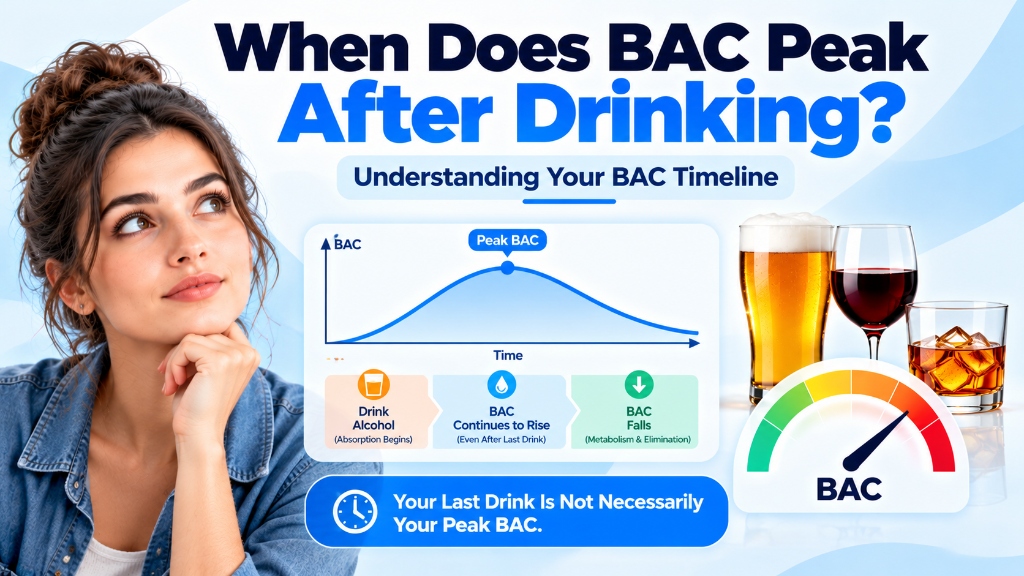
Blood alcohol concentration (BAC) does not peak immediately after you take your last sip.
One of the most dangerous and widespread assumptions about alcohol is that a person reaches their maximum level of intoxication the moment they put their glass down. In human physiology, however, ethanol requires time to move through the digestive tract, pass into the bloodstream, and distribute throughout body water. Consequently, your blood alcohol concentration can continue climbing for a substantial period after you have stopped drinking.
There is no universal, one-size-fits-all rule such as “BAC always peaks exactly 60 minutes after drinking.” The National Highway Traffic Safety Administration (NHTSA) emphasizes that the rate at which BAC rises and peaks varies based on several interdependent factors—including the total number of drinks consumed, the speed of consumption, biological sex, body weight, and whether food was present in the stomach.
The Essential Takeaway
Your last drink is not necessarily your peak BAC.
Alcohol sitting in your stomach and upper intestines when you finish your final drink continues entering your bloodstream. An individual who feels mildly buzzed when leaving a social gathering may reach a dangerously higher, peak level of impairment 30 to 60 minutes later while traveling home.
What Does “Peak BAC” Mean?
In pharmacokinetic terms, Peak BAC (often denoted as Cmax) represents the absolute highest concentration of ethanol reached in an individual's bloodstream during a drinking episode. It marks the physiological transition point where the rate of alcohol absorption no longer exceeds the rate of elimination.
1. BAC Rises During the Absorption Phase
When you consume alcohol, ethanol molecules enter the digestive system. A small portion (approximately 20%) diffuses across the gastric mucosa in the stomach, while the overwhelming majority (roughly 80%) is rapidly absorbed through the vast, vascular surface of the upper small intestine (duodenum and jejunum). As ethanol pours into the portal circulation and disperses throughout blood plasma, your BAC curve slopes steeply upward.
2. BAC Reaches Its Crest (The Peak)
Throughout the drinking session, your liver works continuously to oxidize alcohol. Initially, however, the digestive tract absorbs ethanol far faster than hepatic enzymes can process it. Eventually, the pool of unabsorbed alcohol in the digestive tract dwindles, and the rate of new alcohol entering the blood matches the rate at which the liver removes it. At this precise equilibrium, your BAC hits its crest—the peak.
3. BAC Enters the Elimination Phase
Once absorption slows past the liver's processing capacity, elimination becomes the dominant driver. At this point, blood alcohol levels begin their gradual, downward trajectory. To understand the hepatic enzyme pathways responsible for this clearance phase, explore our guide on how alcohol is metabolized.
Can BAC Keep Rising After Your Last Drink?
Yes, absolutely. In fact, in real-world drinking scenarios, it almost always does.
Consider a typical social scenario: a person finishes their third drink at 11:00 PM, puts the glass down, and prepares to leave. Because they stopped consuming alcohol, they assume their body has entered recovery mode and their blood alcohol level must already be dropping.
This assumption is biologically incorrect. While active swallowing has stopped, a substantial reservoir of ethanol remains sitting in the stomach and upper small intestine. Over the subsequent 30 to 60 minutes, that remaining alcohol continues to diffuse across intestinal membranes into the bloodstream. As NHTSA explains, alcohol must pass through the gastrointestinal tract and circulate through total body water before the liver can metabolize it. This phenomenon also explains why blood alcohol can continue spiking while an intoxicated individual is asleep in bed—explore our guide on whether sleeping lowers your BAC.
The Delayed Peak Danger
A driver might leave a venue with a self-assessed BAC of 0.05% feeling completely in control. By 11:45 PM—while driving on the highway—their BAC may continue climbing to a peak of 0.09%, plunging them into severe legal and physical impairment without them realizing the shift occurred.
How Long Does It Take for BAC to Peak?
Clinical pharmacokinetic literature frequently notes that blood alcohol concentration typically peaks somewhere between 30 and 90 minutes after the completion of drinking. However, it is essential to treat this range as a descriptive scientific observation rather than a personal guarantee or countdown.
There is no universal timeline that applies to every individual or every drinking session. The time required to reach peak BAC varies dramatically depending on:
- Total Ethanol Dose: Larger quantities of alcohol take longer to fully empty from the stomach and absorb.
- Drinking Tempo: Rapidly gulping drinks causes a steeper, earlier surge compared to leisurely sipping.
- Gastric Food Contents: Meals in the stomach can delay peak timing by well over an hour.
- Biological Sex & Body Composition: Differences in gastric enzyme activity and body water distribution influence concentration dynamics.
- Beverage Concentration & Carbonation: Effervescent drinks often accelerate gastric emptying, altering the timeline.
NHTSA specifically emphasizes that because the rate of BAC rise differs across people and circumstances, attempting to calculate or guess your exact minute of peak BAC is virtually impossible.
Why Does Drinking Speed Affect Peak BAC?
Drinking speed is one of the single most influential determinants of both how high your BAC peaks and how fast it gets there.
The human liver processes alcohol at a relatively fixed biological rate—averaging approximately 0.015% BAC per hour. It cannot speed up clearance to match rapid consumption. When you consume several drinks in rapid succession (such as taking multiple shots within 30 minutes), you overwhelm the liver's processing capacity.
Same Amount of Alcohol, Entirely Different BAC Curves
Consider two people of identical weight and biological sex consuming four standard drinks:
Rapid Binge Pattern (4 Drinks in 45 Min)
Alcohol floods the small intestine all at once. Absorption dramatically outpaces liver elimination, creating a steep spike. Peak BAC may rapidly crest at 0.09% to 0.11%, causing acute behavioral and physical impairment.
Paced Pattern (4 Drinks over 4 Hours)
The liver continuously metabolizes roughly one standard drink each hour while new alcohol is gradually absorbed. The BAC curve remains flatter and lower, peaking at approximately 0.03% to 0.04%.
NHTSA explicitly states that consuming alcohol quickly results in a substantially higher peak BAC than spreading the exact same dose over an extended timeframe.
Does Eating Change When BAC Peaks?
Having food in your stomach prior to or during drinking fundamentally reshapes your BAC curve—both in height and in timing.
When food enters the stomach, the muscular valve at the bottom of the stomach—the pyloric sphincter—contracts to hold stomach contents in place for digestion. Because alcohol cannot pass freely into the small intestine (where 80% of absorption occurs), it is forced to linger in the stomach. Gastric alcohol dehydrogenase enzymes begin breaking down a small portion of the ethanol locally, while the rest trickles slowly into the intestine.
As a result, eating before drinking delays the time it takes for BAC to peak—often shifting the peak from 30 minutes to 60–120 minutes after drinking—while also lowering the overall peak BAC by up to 20% to 50% compared to an empty stomach.
To explore the precise physiology of gastric emptying and macronutrients, see our dedicated guide on how eating before drinking affects BAC.
Does the Type of Alcohol Change When BAC Peaks?
A persistent myth claims that beer produces a different physiological peak than hard liquor or wine. However, the beverage category itself does not dictate your BAC curve.
According to the National Institute on Alcohol Abuse and Alcoholism (NIAAA), a standard U.S. drink contains approximately 14 grams (0.6 fluid ounces) of pure ethanol, regardless of the container:
What does change the absorption rate is concentration and carbonation:
- High-Proof Liquors: Very concentrated spirits (over 20–30% ABV) can irritate gastric mucosa and cause a temporary spasm of the pyloric valve (pylorospasm), temporarily delaying absorption until diluted.
- Carbonated Beverages: Effervescent drinks (such as champagne, sparkling wine, or cocktails mixed with soda) can accelerate gastric emptying, speeding up alcohol delivery to the intestine and prompting an earlier peak.
Before calculating intake, learn what counts as a standard drink and explore our analysis on why drink strength matters for BAC across modern high-ABV craft beers, oversized wine pours, and mixed cocktails.
What Happens to BAC After It Peaks?
Once all consumed alcohol has been absorbed from the digestive tract, your BAC reaches its summit and enters the post-absorptive (elimination) phase.
During this phase, hepatic metabolism is the primary driving force. Enzymes in your liver—principally alcohol dehydrogenase (ADH) and aldehyde dehydrogenase (ALDH)—oxidize ethanol molecules into acetaldehyde and then into acetate at a steady rate.
Unlike the absorption phase (which can fluctuate wildly based on food, carbonation, and drink strength), the elimination phase follows predictable zero-order kinetics in healthy individuals. The average rate of decline is roughly 0.015% to 0.020% BAC per hour. However, this is an average, not a guaranteed countdown.
Learn more about the full biological clearance sequence in our guide on alcohol metabolism and clearance timelines.
Why You Shouldn’t Assume You’re Past Your Peak
One of the most dangerous cognitive traps when consuming alcohol is relying on subjective physical sensations to determine whether your BAC is rising or falling.
Human beings cannot accurately feel their BAC. An individual might:
- Feel completely alert and coherent while alcohol is still vigorously absorbing into their bloodstream.
- Misjudge the sheer number of standard drinks contained in large glassware or strong craft beers.
- Experience the “Mellanby effect”—a clinical phenomenon where cognitive and motor impairment feels subjectively less severe during the declining phase of BAC than during the rising phase at the exact same numeric BAC level.
NHTSA specifically warns that the intricate interplay of biological variables makes it virtually impossible for an individual to accurately assess their own BAC or impairment level. Never assume that feeling “fine” or “normal” means you have passed your peak.
Can a BAC Calculator Predict Your Peak BAC?
Digital tools like the Toolwingz BAC Calculator allow users to explore theoretical alcohol curves. By entering your body weight, biological sex, standard drinks consumed, and drinking timeframe, you can estimate your BAC and visualize your theoretical blood alcohol concentration timeline.
However, there is a fundamental difference between a mathematical projection and a clinical biological measurement. Digital calculators rely on statistical population distribution factors (such as the Widmark formula). They cannot measure real-time pyloric valve contractions, individual stomach acidity, or personal enzyme saturation. For an in-depth look at chemical blood testing versus breathalyzers, read our complete guide on how BAC is measured.
Toolwingz BAC Calculator results are estimates provided strictly for informational and educational purposes. They do not measure your actual blood chemistry and cannot determine whether you are past your peak, unimpaired, or legally permitted to drive.
Can Peak BAC Be Used to Decide Whether You Can Drive?
No. Under no circumstances should estimated peak timing be used to decide driving fitness.
Attempting to calculate when your BAC peaked so you can guess when it drops below the legal limit is exceptionally dangerous. NHTSA notes that even tiny amounts of alcohol measurably compromise driving performance:
- At 0.02% BAC: Loss of subtle visual tracking and divided attention begins.
- At 0.05% BAC: Reduced coordination, difficulty steering, and delayed emergency braking responses emerge.
- At 0.08% BAC: Severe degradation in speed control, short-term memory, information processing, and hazard perception occurs.
In the United States, driving with a BAC of 0.08 g/dL or higher is illegal per se across 49 states, while in Utah the statutory threshold is 0.05 g/dL. Furthermore, drivers can be arrested and convicted of Driving Under the Influence (DUI) at any BAC level if physical impairment is documented.
Never use the time elapsed since your last drink, an estimated peak calculation, or subjective feelings of sobriety to get behind the wheel. For a complete review of impairment stages, read our guide on BAC levels and their effects.
BAC Peak Timeline: A Simple Example
To visualize how blood alcohol dynamics unfold in real life, consider this conceptual progression during a standard social drinking occasion:
First Drink Ingested
Ethanol enters the stomach and begins mucosal absorption into the portal blood supply.
Additional Drinks Consumed
Rate of gastrointestinal absorption vastly outpaces liver clearance; BAC curve rises sharply.
Last Drink Finished
Drinking stops, but unabsorbed ethanol remains in the gut. BAC continues to rise.
Peak BAC Reached
Absorption rate equals elimination rate. Blood alcohol concentration hits its highest crest.
Hepatic Elimination Phase
Liver enzymes systematically clear alcohol from the blood until BAC returns to 0.00%.
Note: This sequence illustrates the conceptual curve shape. Exact elapsed time for each stage varies substantially based on individual biology, food intake, and drinking pattern.
The Bottom Line
- Your last drink is not your peak BAC: Blood alcohol concentration frequently continues climbing for 30 to 90 minutes after your final sip.
- Peak timing is individual: Drinking speed, stomach contents, beverage strength, and personal biology shift the peak timing and height.
- Subjective feelings are deceptive: Feeling alert or sober does not mean your BAC has peaked or that impairment has cleared.
- Calculators provide theoretical models: They estimate statistical curves but cannot measure living human blood chemistry.
- Safety first: Never rely on estimated peak timing to drive. If you have been drinking, always arrange a designated driver or rideshare.
Estimate Your BAC with the Toolwingz BAC Calculator
Explore how body weight, biological sex, standard drinks, and timeline shape your theoretical blood alcohol curve with 100% client-side privacy.
Educational Disclaimer: Toolwingz BAC Calculator results are estimates for informational purposes. They do not measure your actual BAC and cannot determine whether you are safe or legally permitted to drive.