How Accurate Are BAC Calculators? The Limits of Online BAC Estimates
Discover whether online BAC calculators produce reliable estimates, why calculation results differ, and why estimates cannot confirm actual BAC or driving safety.
Reviewed against peer-reviewed forensic literature, research published in the International Journal of Occupational Medicine and Environmental Health, and public safety data from the National Highway Traffic Safety Administration (NHTSA). This analysis explores mathematical modeling limitations and does not constitute legal or clinical evaluation.
How Accurate Are BAC Calculators?
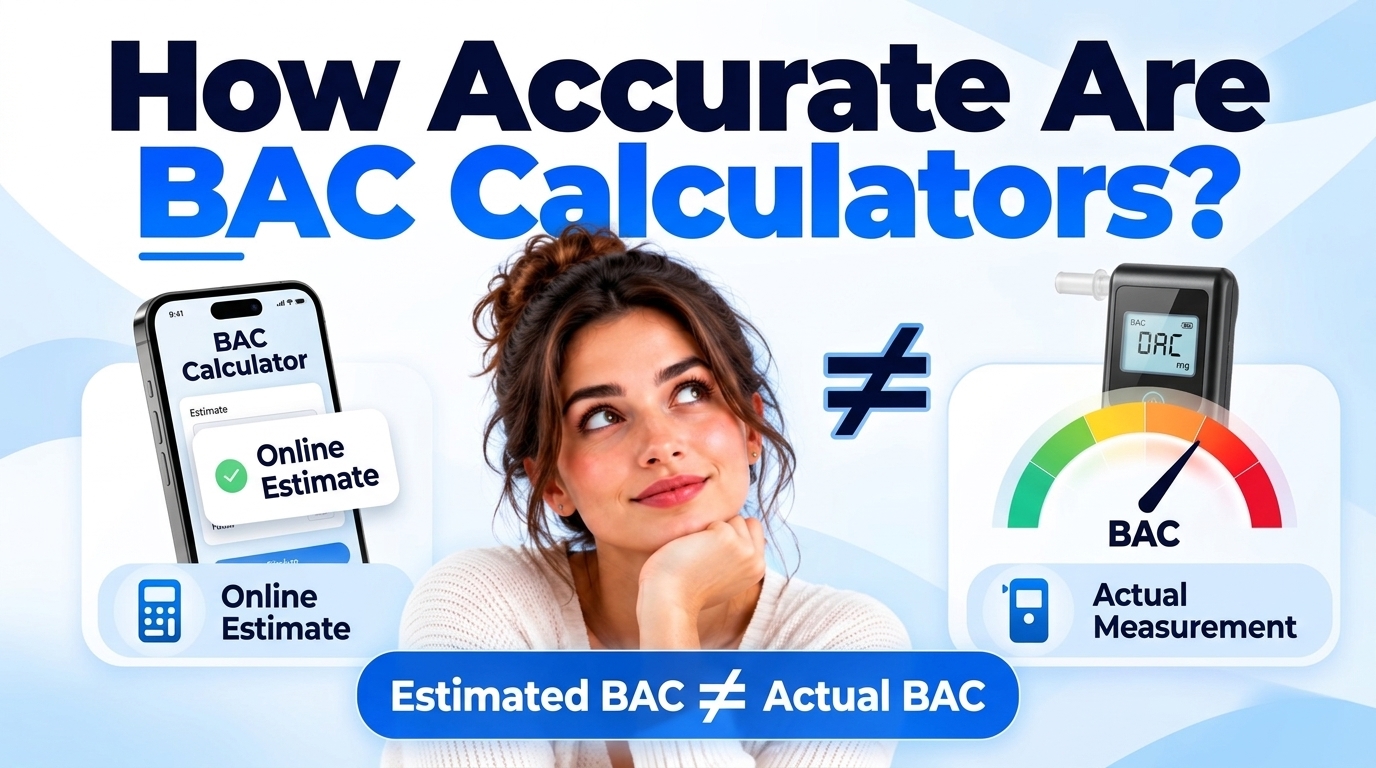
Online blood alcohol concentration (BAC) calculators provide mathematical estimates, not guaranteed or laboratory-grade measurements of an individual's actual blood alcohol concentration.
The numerical accuracy of an online BAC estimate depends entirely on the mathematical model used, the biological assumptions programmed into its formulas, the precision of the user inputs entered, and how closely those generalized assumptions mirror an individual's unique physiology under real-world drinking conditions. While an online tool is extraordinarily helpful for understanding how alcohol dosage, beverage strength, and elapsed time influence physiological clearance, a calculated number should never be treated as an exact physical measurement.
To understand the fundamental nature of alcohol calculation, one must distinguish between two fundamentally different concepts:
- Estimated BAC: A theoretical statistical figure derived from mathematical equations (such as the Widmark formula or Watson total body water models) using self-reported drinking parameters, standard alcohol distribution factors, and population-average metabolic rates.
- Measured BAC: A physical diagnostic value obtained by directly analyzing a biological sample—such as venous whole blood gas chromatography or an evidential electrochemical/infrared breath-alcohol instrument operated by certified technicians.
As emphasized by the National Highway Traffic Safety Administration (NHTSA), blood alcohol concentration is exceptionally difficult to judge personally because cognitive impairment, delayed absorption, and biological variables create substantial discrepancies between subjective sensations, mathematical calculations, and physical circulating alcohol levels.
Calculated from general formulas and average rates. Subject to input error and biological variance.
Obtained directly from biological fluids (venous blood or certified breathalyzers) with forensic accuracy.
Calculators can never establish fitness to drive or guarantee legal compliance under state laws.
How Do Online BAC Calculators Estimate Blood Alcohol Concentration?
Online calculators estimate blood alcohol concentration by applying simplified mathematical algorithms designed to simulate human pharmacokinetics. Rather than measuring chemical reactions in real time, these digital algorithms simulate the distribution of consumed ethanol throughout an assumed volume of body water, and then subtract estimated metabolic degradation over the elapsed timeframe.
Depending on how sophisticated a calculator is, the software prompts users for several core physiological and behavioral inputs:
- Total Body Weight: Determines the general volume of mass available to dilute incoming alcohol.
- Biological Sex: Dictates the assumed ratio of total body water (TBW) to body mass, reflecting normative differences in average adipose tissue versus lean muscle mass.
- Drink Counts and Serving Sizes: Establishes the gross fluid volume consumed.
- Alcohol by Volume (ABV): Determines the true mass of pure ethanol ingested (typically around 14 grams per standard U.S. drink).
- Drinking Duration / Elapsed Time: Indicates how many hours have passed since the first drink commenced.
- Assumed Elimination Constant: A programmed constant (frequently 0.015% BAC per hour) that deducts alcohol degraded by hepatic enzymes.
As forensic alcohol researcher John Searle demonstrated in his seminal review of alcohol calculations (Searle, 2015), every alcohol calculation depends on multiple interconnected variables: total dose, beverage strength, stomach absorption dynamics, individual distribution volume, and hepatic clearance rate. Any variance or uncertainty in any single parameter propagates directly into the final estimated outcome.
What Is the Widmark Formula?
Pioneered by Swedish physician Erik Widmark in 1932, the Widmark formula remains the foundational equation in forensic science for estimating alcohol concentration. It calculates theoretical peak BAC by dividing the mass of consumed ethanol by the product of body weight and an average biological water distribution ratio (r = 0.68 for average males, 0.55 for average females), then subtracting an hourly metabolic loss rate (β). To explore the full mathematical formulation, variable derivations, and step-by-step worked examples, see our dedicated guide on how BAC is calculated.
Why Do Calculators Use Assumptions?
A free digital tool cannot perform clinical diagnostic tests on your body through a web browser. It cannot measure your exact liver enzyme volume (such as alcohol dehydrogenase and CYP2E1 activity), verify your exact body fat percentage, measure your instantaneous gastric emptying speed, or examine your pyloric sphincter tone. Because measuring these internal biological variables in real time is clinically impossible without hospital equipment, calculators must substitute generalized population medians. When your individual biology deviates from those statistical medians, the calculated estimate deviates from your true physiological reality.
Why Can BAC Calculators Produce Different Results?
If you input the exact same details—such as a 175-pound male who drank three beers over two hours—into five different online calculators, you may receive five noticeably different BAC outputs. This discrepancy occurs because online tools are built on distinct computational frameworks, rely on different scientific equations, and apply conflicting assumptions.
Different Calculation Formulas
Some tools strictly utilize Erik Widmark's classical 1932 linear model. Others employ the more modern Watson formula, the Forrest equation, or the Seidl modification, which incorporate age and height to refine total body water estimations. Two tools requesting identical inputs can compute distinct distribution volumes because their underlying formulas calculate hydration differently.
Different Elimination Rate Constants
Forensic research demonstrates that human alcohol clearance ranges from 0.010% to 0.025% per hour across the population. Some calculators subtract an aggressive 0.018% per hour, others use the standard forensic median of 0.015%, and conservative safety tools subtract only 0.012% or 0.010%. Over a four-hour timeline, that difference alone shifts the estimated result by 0.032% BAC.
Varying Definitions of a "Drink"
In the United States, a standard drink is defined as 14.0 grams (0.6 fluid ounces) of pure ethanol. However, tools programmed in the UK or Europe may calculate drinks based on British units (8 grams of pure ethanol) or international standard units (10 to 12 grams). If a tool simply asks for "number of drinks" without clarifying alcohol grams, calculations skew dramatically. Learn more in our detailed analysis of what counts as a standard drink.
Treatment of Food and Timing
Consuming meals rich in fats, proteins, and complex carbohydrates delays gastric emptying, flattening peak BAC curves by 20% to 50%. Most basic calculators assume instant gastric absorption or ignore food altogether, whereas sophisticated models attempt to modulate absorption curves. Explore this phenomenon in our guide on how food affects BAC absorption.
*Note: When two calculators deliver divergent outputs, it does not prove that one tool is "flawless" and the other is "broken." Rather, it reveals that mathematical models are sensitive to their internal assumptions, mathematical constants, and input parameter structures.
What Factors Limit BAC Calculator Accuracy?
The uncertainty inherent in online alcohol estimation originates from two distinct categories: user input inaccuracy (human error and knowledge gaps) and biological algorithmic limitation (unmodeled physiological variation).
1. Inaccurate Drink Quantities and Pour Sizes
Most social drinkers do not carry graduated cylinders or refractometers to bars and social gatherings. A craft IPA poured into a pint glass may contain 7.5% ABV rather than the 5.0% assumed for standard beer, delivering 50% more alcohol than recorded. Cocktails, mixed drinks, and generous home wine pours regularly contain two to three standard drinks disguised in a single glass. When user estimates of alcohol mass are inaccurate, the calculated BAC output is proportionally distorted.
2. Individual Biological Differences & Body Composition
Two individuals with the identical biological sex and total scale weight can experience markedly different BAC levels from the same drink. Ethanol is hydrophilic (water-soluble) and does not dissolve into fatty adipose tissue. An athletic individual with 12% body fat possesses a considerably larger volume of body water—and therefore achieves lower circulating blood alcohol—than an individual of identical weight with 30% body fat. Standard calculators cannot gauge individual body composition.
3. Uncertain Drinking Timelines & Absorption Lag
Linear calculation models assume that alcohol absorbs instantly and eliminates steadily from minute zero. In clinical reality, alcohol absorption follows a non-linear curve. BAC often continues rising for 30 to 90 minutes after the final drink has been finished. A calculation performed 20 minutes after finishing drinks might reflect an elimination phase, while the human body is still actively in an escalating absorption surge.
4. Missing Critical Biological Variables
Online calculators generally omit prescription medication interactions, liver health status, genetic enzyme variants (such as atypical ALDH2 or ADH alleles common in specific populations), hormonal fluctuations, recent illness, and dehydration levels. All of these physiological factors significantly alter the body's ability to process and eliminate ethanol.
What Does Research Say About Online BAC Calculator Accuracy?
Scientific scrutiny of consumer-facing digital health tools has expanded significantly in recent years. Rather than accepting software claims at face value, independent forensic researchers have begun benchmarking online alcohol estimators against controlled laboratory and field measurements.
A notable 2026 peer-reviewed study published in the International Journal of Occupational Medicine and Environmental Health (evaluated via PubMed) systematically analyzed 36 online BAC calculators operating in English and Polish. Researchers compared the outputs generated by these 36 web algorithms against physical reference measurements recorded from 16 human participants under varying controlled drinking scenarios.
What the 2026 Study Discovered
The researchers observed substantial variability across the evaluated tools. Many calculators either substantially underestimated or significantly overestimated participant blood alcohol levels compared to measured biological values. This was especially pronounced among simplistic tools that requested minimal user inputs or implemented rigid, uncalibrated elimination formulas. The authors concluded that relying on casual online calculators for personal legal reassurance or safety determinations poses significant hazards.
What the Study Does Not Establish
While the study offers critical scientific insights into consumer estimation pitfalls, it is equally important to maintain academic restraint and recognize its methodological limitations:
- Limited Reference Sample: The clinical study utilized a reference sample of 16 individuals. A 16-person cohort provides a useful illustrative benchmark, but cannot represent the full distribution of global human metabolic diversity.
- Specific Evaluated Toolset: The investigation tested a specific sample of 36 web tools active during their research period. It does not establish a universal error percentage applicable across every calculator in existence.
- No Validation of ToolWingz: The study did not test or evaluate the ToolWingz calculator specifically. The findings serve as a broad scientific caution regarding the nature of digital estimation rather than a specific assessment of our software.
Why Scientific Transparency Matters
These findings reinforce why digital health calculators must operate with complete transparency. Platforms that promise "guaranteed 100% precision" or claim to certify driving sobriety mislead the public. Responsible estimation platforms must clearly publish their underlying equations, explain their scientific assumptions, state their limits, and actively caution users against dangerous reliance.
Can You Trust a BAC Calculator for Personal Decisions?
Whether an online BAC calculator can be "trusted" depends entirely on the purpose for which you are using the calculation:
When an Estimate Is Highly Educational:
- Demonstrating how biological sex and body weight influence alcohol dilution.
- Visualizing how craft beer ABV creates higher ethanol concentrations than standard lager.
- Understanding why consuming three drinks over one hour yields dramatically higher peak concentrations than over five hours.
- Gaining conceptual awareness of how slowly the human liver metabolizes alcohol.
When an Estimate Must NEVER Be Relied On:
- Deciding whether you are legally capable or safe to operate a motor vehicle.
- Attempting to calibrate drinking to stay just below the statutory 0.08% limit.
- Determining whether alcohol has completely cleared before operating machinery.
- Evaluating probation, commercial driving (CDL), or zero-tolerance compliance.
The NHTSA emphasizes that individuals routinely underestimate their degree of physical and cognitive impairment. Alcohol impairs reaction time, peripheral vision, divided attention, and risk assessment long before reaching the 0.08% statutory threshold. If you have been consuming alcoholic beverages, do not consult a website to see if you can drive—always arrange a designated driver, rideshare, or public transit.
How Does the ToolWingz BAC Calculator Fit In?
At ToolWingz, our engineering philosophy is built on scientific transparency, complete data privacy, and objective education. We do not market our tool as a breathalyzer substitute, a legal defense instrument, or an assurance of physical sobriety.
The ToolWingz BAC Calculator is designed as an educational simulation platform. It implements established pharmacokinetic models (including Widmark principles and standard metabolic constants) to help users visualize and understand:
- How different beverage strengths (beer, wine, spirits) contribute discrete grams of ethanol.
- How body weight and biological water factors scale alcohol distribution.
- The mathematical timeline required for natural metabolic oxidation over multi-hour intervals.
- Real-time degradation curves that demonstrate the gradual slope of alcohol clearance.
Mandatory ToolWingz Educational Notice
Official Disclaimer: ToolWingz BAC Calculator results are mathematical estimates for informational and educational purposes only. They do not measure actual biological blood alcohol concentration, do not predict individual clinical impairment, and cannot determine whether someone is safe or legally permitted to operate a vehicle under state or federal law.
How Can You Evaluate an Online BAC Calculator?
When navigating online health and alcohol estimators, use this four-point evaluation checklist to distinguish credible scientific platforms from irresponsible software:
Check Which Inputs Are Requested
A tool that only asks for "number of drinks" without asking for beverage volume, ABV percentage, body weight, or elapsed drinking duration cannot provide a meaningful estimate. Reliable calculators require granular dosage and timeline inputs.
Look for Formula & Method Transparency
Does the website explain what mathematical equations it uses (e.g., Widmark, Watson)? Does it state its assumed hourly elimination rate? Platforms that conceal their formulas behind opaque "black-box" interfaces should be viewed with skepticism.
Evaluate Claims vs. Scientific Reality
Be wary of websites that claim "police-grade accuracy" or "100% verified legal results." No digital algorithm operating without physical biological fluid testing can guarantee forensic accuracy. Slick design does not equal scientific validation.
Verify Prominent Safety Disclaimers
Ethical digital health platforms prominently display safety disclaimers reminding users that estimates must never guide driving decisions. The absence of a clear disclaimer is an immediate indicator of an unvetted or irresponsible web tool.
The Bottom Line
Online BAC calculators estimate rather than directly measure blood alcohol concentration. Different mathematical models, unmeasured biological factors, drink pour discrepancies, and variable elimination rates naturally cause different calculators to produce differing results.
While independent 2026 research highlights the variability of uncalibrated web estimators, digital tools remain powerful educational resources for understanding alcohol pharmacokinetics. Transparent methodology and strict personal restraint are essential: never use an online estimate to determine whether you or someone else is safe to drive. When alcohol has been consumed, always choose sober transportation.
Explore the ToolWingz BAC Calculator
Simulate how biological sex, body weight, drink details, and elapsed timelines influence theoretical blood alcohol curves with complete client-side privacy.
Educational Disclaimer: ToolWingz BAC Calculator results are mathematical estimates for informational purposes only. They do not measure actual blood alcohol levels and must never be used to evaluate driving fitness or legal compliance.