What Is a Standard Drink? Beer, Wine & Liquor Explained
Learn what counts as a standard drink in the U.S. across beer, wine, and liquor, how ABV alters pure alcohol, and why serving size matters.
What Is a Standard Drink? (Direct Answer)
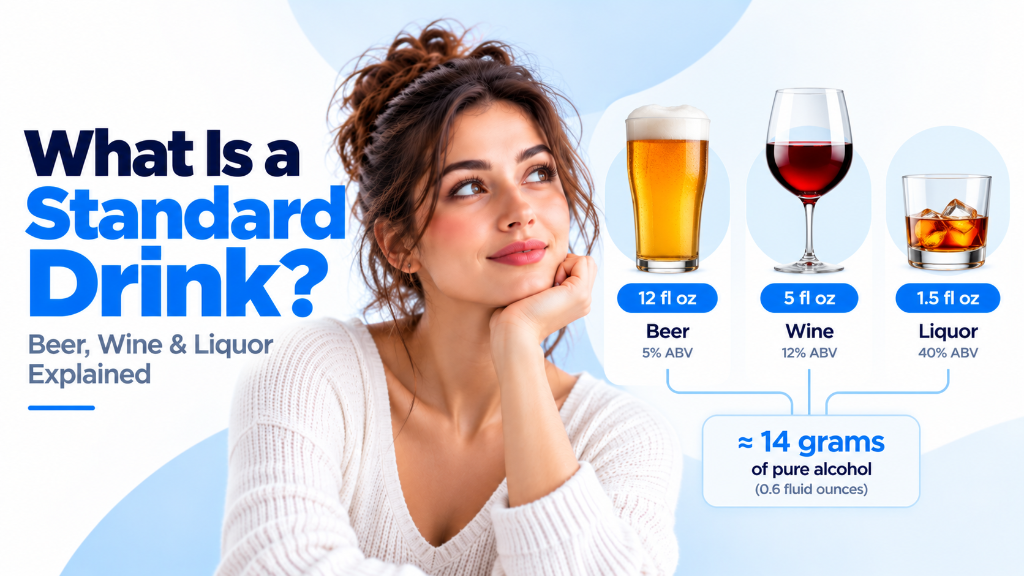
In the United States, a standard drink is defined by the National Institute on Alcohol Abuse and Alcoholism (NIAAA) and the Centers for Disease Control and Prevention (CDC) as any beverage that contains approximately 14.0 grams (0.60 fluid ounces, or 1.2 tablespoons) of pure ethanol.
Because alcoholic beverages vary dramatically in alcohol concentration (ABV), serving sizes differ markedly across beer, wine, and distilled spirits. Understanding standard drink units is essential for accurately tracking intake and calculating biological alcohol exposure. To explore how drink strength changes your alcohol load in detail, see our guide on how alcohol percentage affects BAC.
To calculate your estimated blood alcohol concentration based on your specific drink types and timelines, use the Toolwingz BAC Calculator.
Standard Drink Definitions Across Major Beverage Categories
Regular Beer
A standard domestic can or bottle of regular lager or ale. Light beers (~4.2% ABV) contain slightly less alcohol, while craft ales frequently contain substantially more.
Table Wine
A modest wine glass pour. A standard 750 mL bottle of wine contains approximately 25.4 fluid ounces, which equals about 5 standard drinks.
Distilled Spirits
One standard shot of whiskey, vodka, gin, rum, or tequila. A standard 750 mL bottle contains slightly over 16.9 standard drinks.
Other Common Alcoholic Beverages (NIAAA Reference Values)
| Beverage Type | Standard Serving Volume | Average ABV | Standard Drinks Contained |
|---|---|---|---|
| Malt Liquor / High-Gravity Beer | 8–9 fl oz | ~7.0% ABV | 1.0 standard drink |
| Fortified Wine (Port, Sherry) | 3–4 fl oz | ~17.0% ABV | 1.0 standard drink |
| Cordial / Liqueur / Aperitif | 2–3 fl oz | ~24.0% ABV | 1.0 standard drink |
| Cider & Hard Kombucha | 12 fl oz | ~5.0% ABV | 1.0 standard drink |
Why Drink Size and Glassware Mislead
The single most widespread misunderstanding about alcohol intake is assuming that ordering “one glass,” “one pint,” or “one cocktail” equals one standard drink:
Craft Beer Pints
A 16 oz pint of a 7.5% ABV IPA contains 1.20 oz of pure ethanol—exactly 2.0 standard drinks in a single glass. Ordering two pints introduces four standard drinks into your system.
Generous Wine Pours
Most restaurant wine glasses hold 12 to 16 ounces. A typical generous pour fills 8 to 9 ounces (rather than the 5 oz standard), turning a single glass of wine into 1.6 to 1.8 standard drinks.
Cocktails & Mixed Drinks
Cocktails like Martinis, Margaritas, and Long Island Iced Teas combine multiple spirits. A Long Island contains gin, rum, vodka, tequila, and triple sec, routinely equaling 3.0 to 4.0 standard drinks. To learn how recipe variations change alcohol content, explore our complete guide on how many standard drinks are in a cocktail.
How Standard Drinks Impact BAC Calculations
The Widmark equation calculates peak blood alcohol concentration based on the mass of pure ethanol, not the liquid volume of the beverage. Underestimating drink counts throws off mathematical predictions immediately:
• If a 170 lb male drinks two 16 oz craft IPAs (8% ABV) over two hours, he has consumed 4.2 standard drinks, reaching an estimated peak BAC around 0.065%.
• If he assumes he only had “two beers,” he might incorrectly project his BAC at under 0.02%, completely misjudging his neurological impairment.
Formula for Calculating Standard Drinks
You can determine the exact standard drink count of any container using this straightforward arithmetic:
Example 1: A 19.2 oz stovepipe can of 9.0% ABV craft beer:
(19.2 × 0.09) / 0.60 = 1.728 / 0.60 = 2.88 standard drinks.
Example 2: A 750 mL bottle of 14% ABV red wine (25.36 oz):
(25.36 × 0.14) / 0.60 = 3.55 / 0.60 = 5.92 standard drinks.
Common Misconceptions About Alcoholic Drinks
• Myth: "Beer is weaker than hard liquor." A 12 oz can of 5% beer contains the exact same 14 grams of pure ethanol as a 1.5 oz shot of 80-proof whiskey. To your liver and bloodstream, pure alcohol is chemically identical regardless of the beverage source.
• Myth: "Mixing drinks gets you drunker." The total mass of ethanol consumed determines your BAC, not whether you switched from beer to wine or liquor.
• Myth: "Dark liquor has higher alcohol content than clear liquor." Vodka, gin, white rum, bourbon, and Scotch all typically measure 40% ABV (80 proof). Dark spirits contain congeners that affect hangover severity, but not raw alcohol content.
International Standards: How Other Countries Define a "Unit"
The definition of a standard drink varies globally depending on national public health authorities:
• United States: 14.0 grams (0.6 fluid ounces) of pure ethanol, established by the National Institute on Alcohol Abuse and Alcoholism (NIAAA).
• United Kingdom: Defined as 1 "unit," which equals 8.0 grams (10 mL) of pure ethanol. A standard US drink equals 1.75 UK alcohol units.
• Australia & New Zealand: 10.0 grams (12.7 mL) of pure ethanol, established by the National Health and Medical Research Council (NHMRC). A standard US drink equals 1.4 Australian standard drinks.
• European Union & WHO: The World Health Organization typically uses 10.0 grams of ethanol as the benchmark unit for international comparative epidemiological surveys.
• Canada: Health Canada benchmarks 1 standard drink at 13.45 grams (17.05 mL) of pure alcohol, representing approximately 12 oz of 5% beer or 5 oz of 12% wine.
• Japan: The Ministry of Health, Labour and Welfare defines 1 "unit" (ichigo) as approximately 19.75 grams of pure alcohol, traditionally based on 180 mL of sake at 15% ABV.
• Practical Consumer Guidance: Because beverage serving sizes and alcohol by volume percentages fluctuate widely across international borders, always inspect the container label for total liquid volume (fluid ounces or milliliters) and stated ABV before estimating your alcohol intake or calculating personal blood alcohol concentration.
Frequently Asked Questions About Standard Drinks
How much alcohol is in one standard drink?
Is one beer one standard drink?
Is a glass of wine one standard drink?
Is one shot a standard drink?
Can a cocktail contain more than one standard drink?
Does a higher ABV mean more standard drinks?
Is a standard drink the same worldwide?
Can standard drinks tell you your BAC?
Estimate Your BAC With Toolwingz
Counting drinks alone cannot reflect your real-world impairment or blood alcohol level. Enter your precise drink amounts, alcohol strength, and timeline to visualize educational BAC trends.
Explore the Toolwingz BAC Calculator
Input your weight, gender, drink details, and drinking timeline to calculate hypothetical blood alcohol concentration curves with 100% client-side privacy.
Educational Disclaimer: The Toolwingz BAC Calculator produces mathematical estimates, not biological measurements. Results should never be used to evaluate fitness to drive or legal compliance.