

How Many Standard Drinks Are in a Cocktail? A Simple Guide
Learn how to calculate standard drinks in mixed drinks, why popular cocktails often contain 2 to 3+ standard drinks, and how cocktail recipes impact BAC estimates.
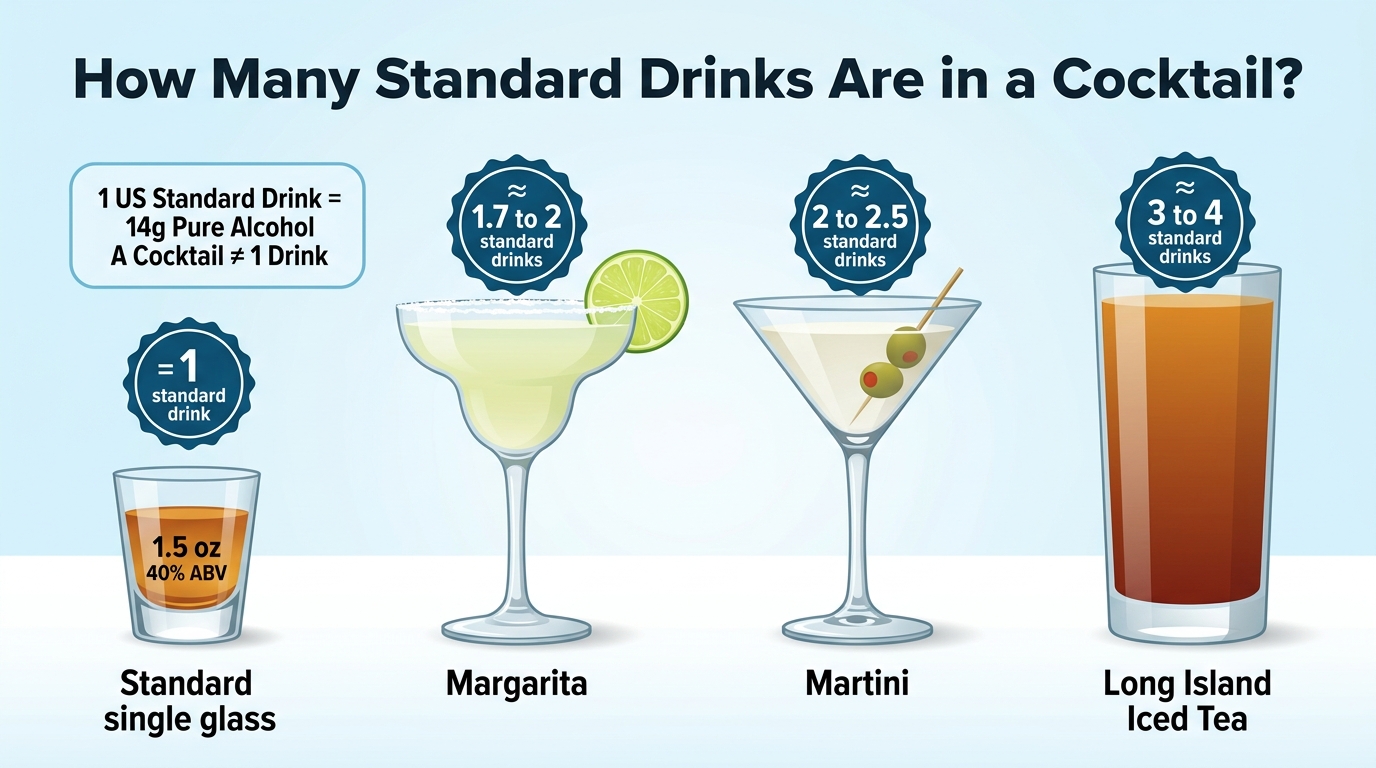
How Many Standard Drinks Are in a Cocktail?
A single cocktail can contain anywhere from one to more than three U.S. standard drinks, depending entirely on the recipe, the number of distilled spirits included, and the bartender's pour size.
When ordering mixed drinks in social or dining settings, many people assume that “one glass equals one drink.” In reality, cocktail recipes frequently combine multiple shots of liquor, high-proof liqueurs, and generous pours into a single serving. According to the National Institute on Alcohol Abuse and Alcoholism (NIAAA), cocktail recipes often contain substantially more alcohol than a single standard serving, with the exact amount varying widely based on how the beverage is crafted (NIAAA Alcohol Core Resource).
A cocktail's physical glassware, colorful garnish, or sweet flavor gives no reliable indication of how much pure ethanol is inside. In the United States, official public health agencies benchmark alcohol consumption against a standardized metric:
- 12 fluid ounces of regular beer at roughly 5% alcohol by volume (ABV).
- 5 fluid ounces of table wine at roughly 12% ABV.
- 1.5 fluid ounces of distilled spirits (80-proof liquor) at 40% ABV.
According to the Centers for Disease Control and Prevention (CDC), each of these reference benchmarks contains approximately 14 grams (0.60 fluid ounces) of pure ethanol (CDC Standard Drink Guidelines). Because many popular cocktails incorporate 2 to 3 ounces—or more—of 80-proof spirits, drinking one cocktail often equals consuming two or more standard drinks at once.
Core Rule of Thumb
One cocktail is not automatically one standard drink.
Never track alcohol intake simply by counting glasses. A patron who finishes two Margaritas and a Long Island Iced Tea may believe they have consumed three drinks, when they have actually ingested the pure alcohol equivalent of six or seven standard servings.
What Is a U.S. Standard Drink?
A standard drink is a scientific unit of measurement representing an exact quantity of pure ethanol, rather than a particular container, can, or glass size. In clinical toxicology and epidemiology, this standardized unit allows researchers and consumers to compare alcohol exposure across radically different beverage types.
What Counts as One Standard Drink?
In the United States, one standard drink consistently contains 0.6 fluid ounces (14 grams) of pure alcohol. Because distilled spirits contain a high concentration of ethanol (typically 40% ABV or 80 proof), a standard single serving of liquor is quite small—just 1.5 fluid ounces (44 mL), often described as a single jigger or standard shot glass. For a complete review of serving sizes and beverage categories, review our detailed guide on what counts as a standard drink.
Why a Cocktail Isn't Automatically One Drink
Unlike a commercial 12-ounce can of domestic beer that comes pre-packaged with a fixed ABV and volume, cocktails are handcrafted mixtures. A standard cocktail recipe rarely calls for exactly 1.5 ounces of a single spirit and nothing else.
Instead, classic recipes routinely call for 2.0 to 2.5 ounces of a base spirit (such as gin or bourbon), accompanied by secondary alcoholic modifiers like vermouth, orange liqueur, bitters, or amaro. Even though the finished mixture is served in a single glass, the total pure ethanol content can easily equal 1.5 to 2.5 standard drinks before a single drop of mixer is added.
How Do You Calculate the Number of Standard Drinks in a Cocktail?
Calculating the alcohol content of any mixed beverage requires breaking the drink down into its individual alcoholic components and applying a straightforward mathematical formula:
Once you determine the pure alcohol volume for each alcoholic ingredient, add them together. Dividing that total by 0.60 fluid ounces (the pure alcohol in one U.S. standard drink) gives you the exact standard-drink equivalent.
Step 1: Identify All Alcoholic Ingredients
List every spirit, liqueur, fortified wine, or beer included in the recipe. Non-alcoholic components (soda, tonic, fruit juice, simple syrup) can be ignored for pure ethanol math.
Step 2: Check the Precise Pour Volume of Each Ingredient
Measure or look up exact fluid ounces. Precision matters: a bartender using a “heavy free-pour” of 2.5 ounces creates a vastly different alcohol load than a standard 1.5-ounce jigger pour.
Step 3: Check Each Ingredient's Alcohol Percentage (ABV)
Check the bottle label for ABV. Base liquors like vodka or bourbon are commonly 40% ABV (80 proof), while triple sec is typically 15% to 40% ABV, and dry vermouth is roughly 15% to 18% ABV.
Step 4: Sum the Pure Alcohol and Divide by 0.60
Sum the resulting ounces of pure ethanol from all alcoholic ingredients, then divide by 0.60 to obtain the total standard-drink value.
The NIAAA provides an interactive Mixed Drink and Cocktail Content Calculator that demonstrates this exact methodology, allowing consumers to test recipe combinations and see how small adjustments in pour volumes shift total alcohol consumption.
Why Some Cocktails Contain More Than One Standard Drink
Several common factors explain why cocktails so frequently exceed the single-drink baseline:
- Multiple Distilled Spirits: Many cocktails call for more than one base liquor. A classic Long Island Iced Tea, for instance, blends five distinct distilled spirits—vodka, rum, gin, tequila, and triple sec—multiplying the total ethanol load.
- Base Pours Exceeding 1.5 Ounces: Most modern cocktail lounges pour 2.0 or 2.5 ounces of spirit for a standard Martini, Manhattan, or Old Fashioned. That base pour alone represents 1.33 to 1.67 standard drinks.
- Alcoholic Modifiers and Liqueurs: Ingredients like sweet vermouth, orange curaçao, coffee liqueurs, or chartreuse contribute significant ethanol on top of the primary base spirit.
- Overproof Spirits: Using navy-strength gin (57% ABV), cask-strength bourbon (55–65% ABV), or overproof rum (69–75% ABV) dramatically increases the pure alcohol content without changing the liquid volume poured.
- Bartender Free-Pouring: When bartenders “free-pour” without calibrated jiggers, over-pouring by just half an ounce per ingredient substantially inflates the total alcohol content.
Crucially, adding non-alcoholic mixers—such as club soda, cola, ginger beer, cranberry juice, or sour mix—dilutes the flavor and lowers the drink's overall percentage concentration, but it does not remove a single milligram of the pure ethanol already poured into the glass.
How Many Standard Drinks Are in Popular Cocktails?
Because cocktail recipes and bar preparations vary widely, there is no single universal drink count that applies to every drink of the same name. However, analyzing typical balanced recipes illustrates the dramatic differences between common favorites:
| Cocktail | Typical Alcoholic Ingredients | What Determines Its Alcohol Content? | Estimated Standard Drinks |
|---|---|---|---|
| Margarita | 1.5–2 oz Tequila (40%) + 0.75–1 oz Triple Sec (30–40%) | Tequila volume and the proof of the orange liqueur | ~1.4 – 1.8 Drinks |
| Martini | 2.5 oz Gin or Vodka (40–47%) + 0.5 oz Dry Vermouth (15%) | Base spirit pour size and high-proof gin selection | ~1.8 – 2.2 Drinks |
| Mojito | 1.5–2 oz White Rum (40%) + Mint, Lime, Sugar, Club Soda | Total rum poured before soda and crushed ice | ~1.0 – 1.3 Drinks |
| Piña Colada | 2 oz Light Rum (40%) + Optional 0.5 oz Dark Rum float (40%) | Rum volume added alongside heavy cream/pineapple | ~1.5 – 2.0+ Drinks |
| Cosmopolitan | 1.5 oz Citrus Vodka (40%) + 0.75 oz Cointreau (40%) | Vodka volume and high-proof Cointreau liqueur | ~1.5 Drinks |
| Gin & Tonic | 1.5–2 oz Gin (40%) + Tonic Water | Ounces of gin measured into the highball glass | ~1.0 – 1.3 Drinks |
| Vodka Tonic / Screwdriver | 1.5–2 oz Vodka (40%) + Mixer (Tonic or Orange Juice) | Volume of vodka added before non-alcoholic juice/tonic | ~1.0 – 1.3 Drinks |
| Long Island Iced Tea | 0.5 oz Vodka, 0.5 oz Rum, 0.5 oz Gin, 0.5 oz Tequila, 0.5 oz Triple Sec (2.5 oz spirits) | Combining five spirits (2.5–3.0 oz total liquor) | ~2.5 – 3.2 Drinks |
As emphasized by the NIAAA, these figures are estimates. A small bar pouring with 1-ounce jiggers will yield a much lighter drink than an upscale steakhouse serving a 3-ounce “jumbo” Martini.
Does the Size of a Cocktail Glass Tell You How Much Alcohol It Contains?
No. The physical volume of a glass is completely separate from the amount of alcohol it contains.
Understanding cocktail strength requires distinguishing between three separate concepts:
- Total Beverage Volume: The total liquid filling the glass (alcohol, mixers, melted ice water).
- Pure Ethanol Volume: The exact ounces of undiluted alcohol dissolved within the drink.
- Standard Drink Count: Total pure alcohol divided by 0.60 fluid ounces.
A massive 16-ounce hurricane glass may be packed with crushed ice, pineapple juice, and coconut milk, holding just 1.5 ounces of rum (1.0 standard drink). In contrast, a modest 4-ounce chilled martini coupe containing 2.5 ounces of 94-proof gin holds well over 2 standard drinks of pure ethanol. For a deeper look at how liquid concentration and serving size interact, see our analysis on how alcohol percentage affects BAC.
How Do Restaurant and Homemade Cocktails Differ?
Cocktails made at home and cocktails served in hospitality venues often differ substantially, even when they follow the same named recipe:
- Free-Pouring vs. Measuring: Home bartenders rarely use precision jiggers, frequently pouring “by eye” into oversized glassware, which can easily double the intended spirit portion.
- Commercial House Specifications: High-volume venues may use strict 1.25 or 1.5-ounce spirit specifications to control liquor costs, while craft cocktail bars intentionally design drinks around 2.0- to 2.5-ounce base spirit ratios.
- Spirit Brand & Proof Differences: A home recipe calling for bourbon might use an 80-proof (40% ABV) bottle, whereas a craft bar might use a 100-proof (50% ABV) bottled-in-bond whiskey, increasing pure alcohol content by 25% with the exact same pour volume.
- Ice Dilution: Commercial shake and stir techniques incorporate consistent amounts of water from melting ice, modifying drink temperature and flavor profile without altering the gross ethanol delivered.
NIAAA cautions that because preparation techniques vary so greatly among bartenders and establishments, no consumer should assume a cocktail served at a bar matches a published recipe found online.
How Does Cocktail Alcohol Content Affect an Estimated BAC?
In mathematical pharmacokinetics, estimating your Blood Alcohol Concentration (BAC) depends on the gross grams of ethanol introduced into your body water reservoir over time. To learn how mathematical models project this curve, read our guide on how BAC is calculated.
Why Counting Cocktails Distorts BAC Estimates
When entering consumption data into a BAC calculator, inputting the number of physical glasses rather than true standard drinks leads to massive errors. If an individual drinks three high-gravity Margaritas containing 1.8 standard drinks each, they have consumed 5.4 standard drinks (approx. 75 grams of pure ethanol). Entering “3 drinks” into a calculator would underestimate their alcohol intake by nearly 45%, projecting a falsely low BAC curve.
Other Biological Factors That Shape BAC
While standard drink calculations accurately reflect alcohol ingestion, your resulting blood alcohol level also depends on individual physiological dynamics. Biological sex and body weight govern your dilution volume, stomach food delays gastric absorption, and liver enzymes metabolize ethanol at a steady hourly pace. To understand how these variables interact, explore our analyses of factors that affect BAC and how alcohol is metabolized. Furthermore, drinking speed directly dictates when BAC peaks after drinking.
Explore the ToolWingz BAC Calculator
Input your standard drinks, timeline, biological sex, and weight to model theoretical blood alcohol curves with complete privacy.
Can You Tell Whether a Cocktail Contains Alcohol Just by Tasting It?
Taste, sweetness, and perceived burn are exceptionally poor indicators of alcohol content.
Cocktail mixology relies on culinary balance: acidic juices (lemon, lime, grapefruit), high-sugar syrups, carbonated sodas, and aromatic bitters effectively mask the sensory burn of ethanol on the tongue and throat. A sweet frozen Daiquiri or Tiki punch can contain 3 ounces of rum while tasting like fruit juice, whereas a dry Gibson or bone-dry Martini with equal alcohol content tastes intensely alcoholic.
Never assume a cocktail is “light” or “weak” simply because it tastes smooth, fruity, or refreshing. Checking the recipe or asking the bartender what spirits were poured is the only reliable way to know what you are drinking.
Can a Cocktail's Standard-Drink Count Tell You Whether You Can Drive?
No. A standard-drink count can never tell you whether you are safe or legally permitted to drive.
While calculating standard drinks helps you estimate alcohol consumption, it cannot measure your actual blood alcohol concentration, neurological reaction time, or psychomotor coordination. Clinical safety research from NHTSA and NIAAA proves that driving-related skills—such as divided visual attention, steering tracking, and emergency braking reactions—decline significantly at low BAC levels well below the statutory 0.08 per se limit (and Utah's 0.05 limit).
Crucial Road Safety Directive
Never use a drink recipe formula, a standard-drink tally, or an online BAC calculator to determine if you can drive. If you have been drinking cocktails, always choose a designated driver, taxi, or rideshare service.
The Bottom Line
- A cocktail often contains multiple standard drinks: Many popular recipes contain 1.5 to 3.0+ U.S. standard drinks in a single glass.
- Ingredients and pour sizes govern alcohol content: The volume of spirits and their ABV dictate pure ethanol, regardless of non-alcoholic mixers added.
- Glass size is deceptive: A large glass filled with ice and juice does not guarantee a stronger or weaker drink than a small, spirit-forward cocktail.
- Recipes vary widely between bars and home: Heavy pours and spirit proof differences cause substantial variations in identical cocktails.
- Standard drink math improves BAC estimates: Knowing true standard drink equivalents helps calculators model theoretical alcohol load more accurately.
- Calculators provide estimates, not tests: Digital tools calculate theoretical population models—they cannot measure living biological blood chemistry.
- Never use drink math to rationalize driving: No cocktail calculation or estimated BAC guarantees fitness to operate a motor vehicle.
Explore the ToolWingz BAC Calculator
Calculate how total standard drinks from cocktails, beer, or wine translate into theoretical blood alcohol concentration curves over time.
ToolWingz BAC Calculator results are estimates for informational purposes only. They do not measure actual blood alcohol concentration and cannot determine whether someone is safe or legally permitted to drive.