

How Does Alcohol Percentage Affect BAC? ABV, Drink Strength & Blood Alcohol
Discover how Alcohol By Volume (ABV) changes the pure ethanol dose in your drink, why serving sizes matter, and how beverage strength shapes BAC calculator estimates.
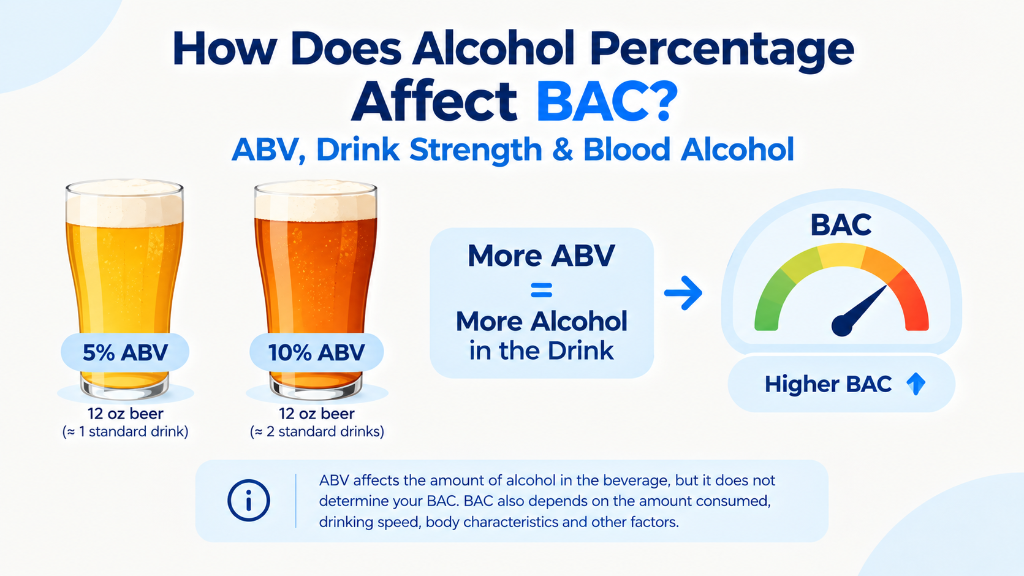
Does Alcohol Percentage Affect BAC?
Yes, alcohol percentage directly affects BAC because a beverage with a higher percentage delivers more pure ethanol into your body for any given liquid volume.
When you consume an alcoholic beverage, your Blood Alcohol Concentration (BAC) is governed primarily by the total mass of pure ethanol that enters your bloodstream relative to your total body water. Alcohol percentage—formally labeled as Alcohol By Volume (ABV)—indicates the exact concentration of ethanol in that container. Consequently, drinking a beverage with a higher ABV introduces more pure alcohol into your digestive tract than drinking the exact same volume of a lower-strength drink.
Consider a straightforward real-world comparison:
- A 12-ounce regular beer at 5% ABV contains approximately 0.6 fluid ounces (14 grams) of pure ethanol.
- A 12-ounce craft double IPA or imperial stout at 10% ABV contains approximately 1.2 fluid ounces (28 grams) of pure ethanol.
The second 12-ounce glass contains approximately twice as much pure alcohol as the first. According to clinical guidance from the National Institute on Alcohol Abuse and Alcoholism (NIAAA), a 12-ounce beer at 5% ABV represents about one standard drink, whereas a 12-ounce beer at 10% ABV equals approximately two standard drinks (NIAAA Standard Drink Guidance). Consuming that higher-ABV beer doubles your alcohol exposure, which can result in a substantially higher peak BAC.
Critical Distinction
ABV determines how much alcohol is in the beverage—ABV alone does not determine your BAC.
While drink strength dictates the dose of alcohol ingested, your resulting blood alcohol concentration depends on the total volume consumed, drinking pace, biological sex, body weight, and digestive factors.
What Does ABV Mean?
ABV stands for Alcohol By Volume. It is the worldwide scientific and legal standard used to express what percentage of a liquid's total volume consists of pure ethanol at a standardized temperature of 20°C (68°F).
If a beverage is labeled as 5% ABV, exactly 5% of the liquid in that bottle is pure ethanol, while the remaining 95% consists of water, sugars, flavorings, and other ingredients. Across commercial beverage types, typical ABV ranges include:
- Standard Beers and Ciders: Typically range from 4.0% to 6.0% ABV (with craft beers frequently reaching 7.0% to 12.0%+).
- Table Wine: Typically ranges between 11.5% and 14.5% ABV (with fortified dessert wines reaching 16.0% to 20.0%).
- Distilled Spirits: Typically 40% ABV (80 proof) for commercial vodka, gin, rum, and whiskey, though overproof spirits can exceed 50% to 75% ABV.
The Centers for Disease Control and Prevention (CDC) notes that the amount of pure alcohol in any drink depends directly on its alcohol content, or ABV (CDC Standard Drink Sizes).
ABV Is Not the Same as BAC
Consumers often confuse these two acronyms because both are expressed in percentage formats. However, they describe completely different entities:
- ABV measures alcohol concentration inside the bottle or glass.
- BAC measures alcohol concentration inside your bloodstream (grams of ethanol per deciliter of blood).
A beverage labeled 10% ABV does not produce a 0.10% BAC. To understand how chemical blood measurements relate to breathalyzer sensors, explore our guide on BAC vs. BrAC: what's the difference?.
Why Two Drinks of the Same Size Can Contain Different Amounts of Alcohol
One of the most frequent misconceptions in social drinking is assuming that liquid volume equals alcohol load. Looking at the height of a glass or the size of a can does not reveal how much ethanol is being consumed.
Two identical 12-ounce pint glasses can contain drastically different quantities of pure alcohol depending strictly on their ABV:
| Beverage | Serving Size | ABV | Approx. Pure Alcohol | Standard Drink Equivalent |
|---|---|---|---|---|
| Beer A (Standard Lager) | 12 oz | 5% | 0.60 fl oz (~14 g) | ~1.0 Standard Drink |
| Beer B (High-Gravity IPA) | 12 oz | 10% | 1.20 fl oz (~28 g) | ~2.0 Standard Drinks |
| Table Wine | 5 oz | 12% | 0.60 fl oz (~14 g) | ~1.0 Standard Drink |
| Distilled Spirits (80 Proof) | 1.5 oz | 40% | 0.60 fl oz (~14 g) | ~1.0 Standard Drink |
As NIAAA documentation affirms, different beverages can possess widely differing alcohol percentages while delivering comparable amounts of pure ethanol when their customary serving sizes differ appropriately.
Does Higher ABV Always Mean a Higher BAC?
Not by itself.
A higher-ABV beverage will only cause a higher BAC if the total quantity of pure ethanol you ingest ends up being higher. To see why, examine what happens when serving size is adjusted to match drink strength:
12 oz × 0.05 = 0.60 oz pure alcohol (approx. 14 grams).
6 oz × 0.10 = 0.60 oz pure alcohol (approx. 14 grams).
Because both options deliver virtually the identical dose of pure ethanol, neither drink inherently creates a higher blood alcohol level if consumed at the same speed by the same person.
This comparison proves why ABV cannot be evaluated in isolation. NIAAA standard-drink guidance emphasizes that beverage size and alcohol percentage must always be evaluated together to establish your actual alcohol intake.
How ABV and Serving Size Work Together
To understand how alcohol enters your system, scientists and public health agencies use a fundamental conceptual equation:
In the United States, pure alcohol volume is converted to grams of ethanol (using the specific density of pure ethanol, approximately 0.789 g/mL). A standard drink contains approximately 14 grams (0.60 fluid ounces) of pure ethanol, as defined by the CDC.
1. Same ABV, Different Serving Sizes
If the alcohol percentage remains unchanged, doubling the serving size doubles your pure alcohol intake. For example, drinking a 6-ounce half-pint of 5% beer delivers 0.30 ounces of pure alcohol, while drinking a 12-ounce pint delivers 0.60 ounces—doubling your exposure.
2. Different ABV, Same Serving Size
If the serving size remains fixed at 12 ounces, but the ABV increases from 5% to 10%, the quantity of pure ethanol doubles from 0.60 ounces to 1.20 ounces. Holding the glass size constant while increasing drink strength is the most common reason people accidentally consume far more alcohol than intended.
3. Different ABV and Different Serving Sizes
When both variables change simultaneously—such as ordering an 8-ounce pour of an 8.5% Belgian ale versus a 16-ounce pint of a 4.2% light lager—standard drink conversions level the playing field, allowing you to compare true alcohol intake accurately. This principle is especially important when calculating alcohol content in cocktails, where multiple liqueurs and spirits of varying strengths are combined into a single glass.
How Alcohol Percentage Changes the Number of Standard Drinks
In everyday conversation, people frequently tally their consumption by saying “I only had two drinks.” However, one physical container or glass rarely equals one standard drink.
Public health research supported by NIAAA and the CDC highlights standard benchmarks:
- 12 oz beer at 5% ABV: ≈ 1.0 standard drink.
- 12 oz beer at 7% ABV: ≈ 1.4 standard drinks.
- 12 oz beer at 10% ABV: ≈ 2.0 standard drinks.
- 5 oz wine at 12% ABV: ≈ 1.0 standard drink.
- 1.5 oz spirits at 40% ABV: ≈ 1.0 standard drink.
If you consume two 12-ounce craft beers with a 10% ABV, you have consumed the ethanol equivalent of four standard drinks. For a complete review of serving sizes and beverage categories, review our detailed guide on what counts as a standard drink.
Does Beer ABV Affect BAC?
Yes. Beer is not a uniform beverage category where every can is “one drink.” Modern brewing produces an immense spectrum of alcohol percentages across different styles:
- Light Lagers (3.8% – 4.2% ABV): Deliver roughly 0.46 to 0.50 ounces of pure alcohol per 12 oz can (about 0.8 standard drinks).
- Standard Lagers & Pilsners (4.5% – 5.0% ABV): Deliver roughly 0.60 ounces of pure alcohol (1.0 standard drink).
- Craft IPAs & Ales (6.5% – 7.5% ABV): Deliver roughly 0.78 to 0.90 ounces of pure alcohol (1.3 to 1.5 standard drinks).
- Double IPAs & Imperial Stouts (8.5% – 11.0%+ ABV): Deliver 1.0 to 1.3+ ounces of pure alcohol (1.7 to 2.2 standard drinks).
NIAAA emphasizes that alcohol concentration varies substantially among commercial beer products. Drinking two high-gravity craft beers can produce the physiological impact of four or more conventional domestic beers, pushing your BAC far higher than anticipated.
Does Wine ABV Affect BAC?
Wine alcohol percentages also vary markedly by grape variety, climate, and fermentation technique. While a standard U.S. wine serving is defined as 5 fluid ounces at 12% ABV, many popular red wines (such as California Zinfandels or Cabernet Sauvignons) reach 14.5% to 15.5% ABV.
Why Wine Pours Can Be Misleading
In restaurants and home environments, customary wine pours typically measure between 6 and 8 fluid ounces rather than the strict 5-ounce standard benchmark. When a generous 8-ounce pour is combined with a 14.5% ABV wine:
8 oz × 0.145 = 1.16 oz pure ethanol (≈ 1.93 standard drinks in a single glass)
Two generous glasses of a bold red wine can easily deliver nearly four standard drinks of pure ethanol, elevating BAC significantly faster than expected.
Do High-ABV Drinks Raise BAC Faster?
It is critical to be scientifically precise: high ABV does not automatically guarantee a faster rise in blood alcohol, but it often does so in practice because of how ethanol is ingested.
The National Highway Traffic Safety Administration (NHTSA) explains that the rate at which BAC rises is determined by the total amount of alcohol consumed and the speed at which it enters the digestive tract (NHTSA Alcohol Guidance). Because higher-ABV drinks deliver a much larger dose of ethanol per ounce, consuming them delivers a concentrated payload of alcohol into the stomach and small intestine in fewer sips and less time.
When a large amount of ethanol floods the upper gastrointestinal tract rapidly, passive diffusion across the intestinal wall outpaces hepatic enzyme clearance, creating a steep spike toward peak intoxication. To learn more about absorption timelines and crest dynamics, read our guide on when BAC peaks after drinking.
How ABV Affects a BAC Calculator
A digital BAC calculator requires an accurate estimate of total ethanol consumed to generate a reliable mathematical model. The underlying pharmacokinetic sequence operates directly on drink strength:
If a calculator simply assumes every beer is 5% ABV, a user logging three 12-ounce craft beers at 8.5% ABV will receive an estimate based on 42 grams of alcohol instead of the 71.4 grams actually ingested. This produces a massive underestimation of theoretical blood alcohol levels.
Why the Label Matters
Checking the printed label on your bottle, can, or tap handle for the exact ABV is the single most effective way to ensure that calculator inputs reflect real-world alcohol exposure.
Why the Calculator Is Still Only an Estimate
Even with perfect container size and ABV inputs, an online calculator uses statistical population formulas (such as the Widmark equation). It cannot measure your real-time liver enzyme kinetics, stomach contents, or individual biological clearance.
Try the Toolwingz BAC Calculator
Explore how beverage volume, drink strength, weight, and timeline interact to shape theoretical alcohol curves.
Does a Higher ABV Mean You Will Have a Higher BAC?
A higher ABV can contribute to a higher BAC when it leads to more pure ethanol being ingested, but ABV alone never dictates your physiological blood alcohol concentration.
Your ultimate BAC is governed by a complex physiological interplay of multiple independent factors:
- Total pure alcohol consumed: The gross mass of ethanol delivered into the gut.
- Beverage volume & ABV: The concentration and physical liquid quantity.
- Drinking speed: How rapidly drinks are finished over time.
- Body composition & biological sex: Total body water volume available to dilute alcohol.
- Food intake: Presence of food in the stomach delaying gastric emptying.
- Individual metabolic clearance: Hepatic alcohol dehydrogenase (ADH) enzyme activity.
To understand how these individual biological traits interact, review our comprehensive analysis of factors that affect BAC.
ABV vs. BAC: Don't Confuse These Numbers
Keeping forensic and mathematical terms distinct prevents dangerous assumptions about sobriety and legal limits. Use this quick reference matrix:
| Term | What It Tells You |
|---|---|
| ABV (Alcohol By Volume) | Alcohol concentration inside the beverage liquid (e.g., 5% or 40%). |
| Standard Drink | Approximate mass of pure ethanol (~14 grams in the U.S.). |
| BAC (Blood Alcohol Concentration) | Alcohol concentration inside circulating blood (e.g., 0.08 g/dL). |
| BrAC (Breath Alcohol Concentration) | Alcohol concentration inside exhaled pulmonary breath (e.g., 0.08 g/210 L). |
| BAC Calculator | Mathematical estimate of theoretical BAC based on demographic formulas. |
To understand the critical physiological differences between blood draws and breathalyzers, read our complete guide on BAC vs. BrAC.
Can ABV Tell You Whether You're Safe to Drive?
No. ABV cannot tell you whether you are safe or legally permitted to drive.
ABV describes only the concentration of alcohol inside a beverage. It cannot measure how much ethanol has absorbed into your vascular system, how rapidly your brain function is declining, or how impaired your visual tracking and reaction speeds are.
NHTSA emphasizes that alcohol impairs psychomotor driving performance even at low concentrations, long before a driver reaches the statutory 0.08 per se threshold (or Utah's 0.05 limit). Divided attention, peripheral vision, emergency braking reaction, and lane-tracking skills begin deteriorating at minimal BAC levels.
Crucial Safety Rule
Never use the ABV on a can, an estimated drink calculation, or a digital BAC tool to decide whether you can drive. If you have consumed alcohol in any amount, always arrange a designated driver or use rideshare services.
The Bottom Line
- ABV measures beverage strength: It represents the percentage of a beverage's total liquid volume that consists of pure ethanol.
- Higher ABV means more alcohol per ounce: A 10% craft beer contains twice the ethanol of a standard 5% domestic beer of the same size.
- Serving size matters equally: A small pour of a high-ABV drink can deliver the same alcohol load as a large pour of a low-ABV drink.
- Two identical-looking drinks can vary drastically: Never assume two glasses or cans contain the same amount of alcohol without checking the label.
- Standard drinks equalize different ABVs: Converting beverage size and ABV into standard drinks (~14g pure ethanol) allows accurate intake tracking.
- Accurate ABV improves BAC estimates: Knowing your drink strength helps a BAC calculator model theoretical exposure more realistically.
- A BAC calculator is an estimate, not a test: Digital tools model mathematical population curves—they cannot measure live biological blood chemistry.
- Never use ABV to rationalize driving: Drink strength cannot tell you whether you are safe or legally permitted to drive after drinking.
Try the Toolwingz BAC Calculator
Estimate theoretical blood alcohol curves based on your drink size, ABV, elapsed hours, biological sex, and body weight.
Toolwingz BAC Calculator results are estimates for informational purposes only. They do not measure your actual BAC and cannot determine whether you are safe or legally permitted to drive.