

Can You Get a DUI Below 0.08? Impaired Driving Laws & 0.05 BAC Risks
Discover how state impairment statutes allow law enforcement to arrest and convict drivers for DUI or DWAI at 0.05% BAC or lower.
Researched against the motor vehicle codes of all 50 U.S. states, forensic impairment research from the National Highway Traffic Safety Administration (NHTSA), and peer-reviewed studies published in Accident Analysis & Prevention. This educational analysis explores statutory arrest thresholds and does not constitute formal legal counsel.
Can You Get a DUI Below 0.08 BAC? (Direct Answer)
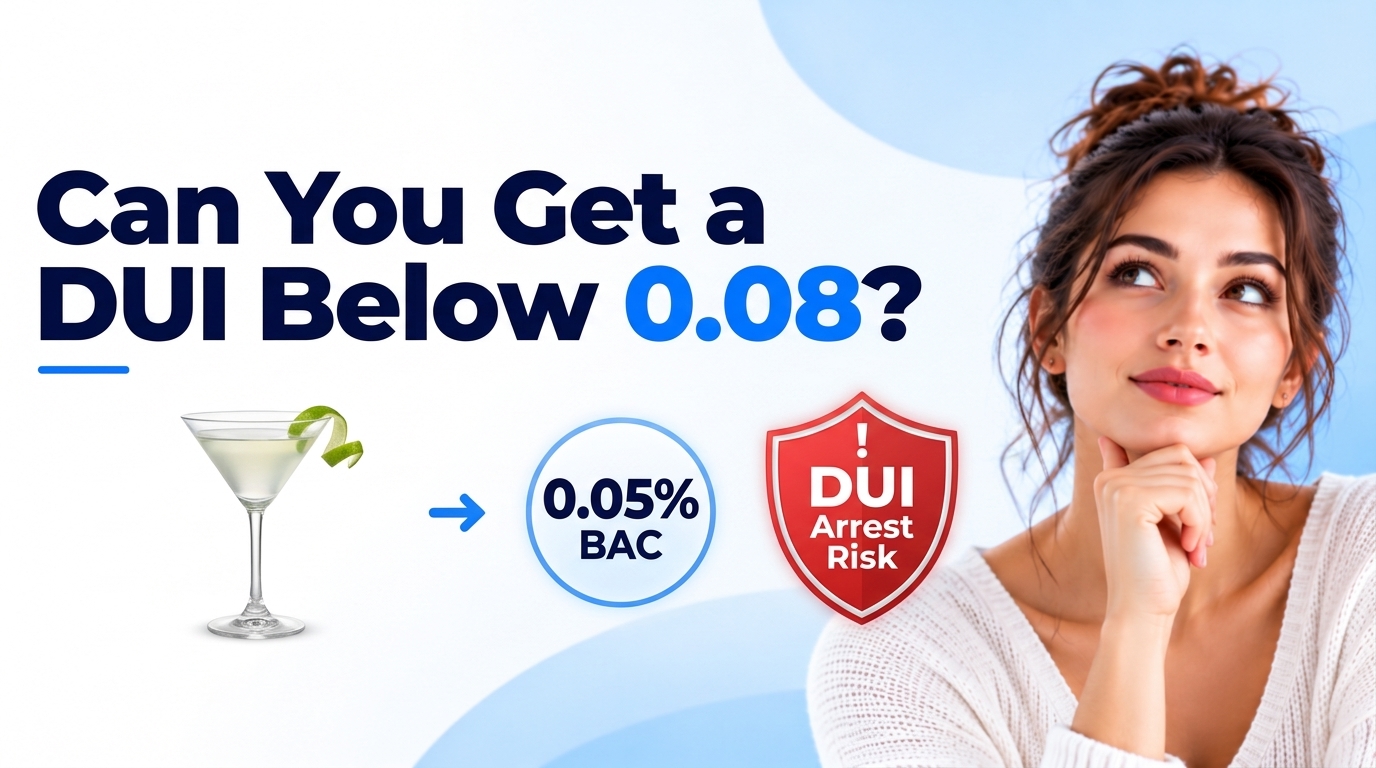
Yes, absolutely. You can be arrested, charged, and convicted of driving under the influence (DUI) or driving while ability impaired (DWAI) with a blood alcohol concentration (BAC) well below 0.08%.
One of the most dangerous and costly legal misconceptions among motorists is the belief that 0.08% is a “safe harbor” or legal entitlement below which driving is automatically protected by law. In every U.S. state and federal territory, 0.08% is merely the per se statutory limit—meaning that driving at or above 0.08% is illegal automatically, without prosecutors needing to prove that your driving skills were visibly impaired.
However, all 50 states maintain parallel impairment-based statutes. If a law enforcement officer observes erratic lane tracking, delayed braking, or signs of intoxication during roadside testing, you can be lawfully arrested and prosecuted for driving under the influence at 0.05%, 0.04%, or even 0.02% BAC. To understand how drinks translate to theoretical blood levels, you can calculate your estimated BAC using scientific formulas based on body weight, drink count, and elapsed time.
Per Se DUI vs. Impairment-Based DUI: Understanding the Dual Legal Standard
State criminal justice systems evaluate drunk driving through two separate legal pathways. Understanding the difference between these two theories of prosecution is critical:
1. The “Per Se” Standard (0.08% Chemical Threshold)
Under “per se” DUI laws, the prosecution does not have to demonstrate that your driving was hazardous, that you swerved across lanes, or that you failed a physical sobriety balance test. The only fact the state must prove beyond a reasonable doubt is that you were operating a motor vehicle and had a chemical test (breath or blood) registering 0.08 grams per deciliter (g/dL) or higher at the time of driving.
2. The “Impairment-Based” Standard (Common Law DUI / DWAI)
Below 0.08%, police and prosecutors rely on common law impairment statutes—often categorized as Driving Under the Influence (DUI), Driving While Intoxicated (DWI), or Driving While Ability Impaired (DWAI).
In these cases, a driver whose breathalyzer reads 0.04% or 0.06% can still be convicted if the arresting officer documents clear physical and behavioral evidence showing that alcohol compromised their ability to operate a vehicle safely. Convictions are built on cruiser dashcam footage, officer testimony regarding slurred speech and odor of alcohol, and roadside performance on standardized physical drills.
Learn more about how legal blood limits are structured in our deep dive on the legal BAC limit in the United States.
How Officers Build a DUI Case Below 0.08% BAC
When blood alcohol falls below the automatic per se number, an arrest relies on four sequential investigative phases standardized by the NHTSA:
Vehicle in Motion
The officer observes initial visual cues: weaving within the lane, straddling lane lines, late braking at red lights, wide turns, or driving 10+ mph below speed limits.
Personal Contact
At the car window, the officer notes sensory evidence: the odor of alcoholic beverages, bloodshot watery eyes, slurred diction, or difficulty retrieving driver registration.
Field Sobriety Drills
Standardized drills (Horizontal Gaze Nystagmus, Walk-and-Turn, One-Leg Stand) test optical tracking, divided attention, and vestibular equilibrium.
Chemical Testing
A preliminary breath test (PBT) or evidentiary station breathalyzer confirms the presence of alcohol, linking observed physical impairment directly to ethanol consumption.
Because breathalyzer readings confirm that alcohol was consumed, prosecutors can argue that even a small dose of alcohol was the proximate cause of the driver's observed physical shortcomings. Read our guide on BAC vs BrAC breathalyzer testing to see how chemical concentrations correlate with breath samples.
Utah's 0.05% Law and State-by-State Statutory Differences
In 2018, Utah became the first state in modern American history to lower its general per se driving limit from 0.08% to 0.05% BAC. In Utah, any non-commercial adult operating a vehicle at 0.05% is automatically guilty of a Class B misdemeanor DUI, facing mandatory jail time, license revocation, and ignition interlock requirements—with zero proof of bad driving required.
Other states have established formal intermediate tiers specifically designed to prosecute drivers between 0.05% and 0.079%:
DWAI Statute (0.05%)
Under C.R.S. § 42-4-1301, a BAC between 0.05% and 0.079% triggers a permissible statutory inference of Driving While Ability Impaired (DWAI), carrying up to 180 days jail and 8 DMV license points.
DWAI Violation (0.05%–0.07%)
NY VTL § 1192(1) creates a distinct DWAI traffic infraction for blood alcohol between 0.05% and 0.07%, leading to a mandatory 90-day driver license suspension and substantial fines.
OWVI (Operating While Visibly Impaired)
Allows conviction at any detectable alcohol level if an officer can prove the driver operated with less ability than an ordinary careful driver.
Forensic Driving Impairment at BAC Levels Below 0.08%
Decades of controlled driving simulator experiments and emergency trauma data analyzed by the NHTSA confirm that critical driving faculties deteriorate significantly before reaching 0.08%:
| BAC Level | Physiological Effects | Impact on Driving Ability | Typical Legal Risk |
|---|---|---|---|
| 0.02% | Slight body warmth, mild mood elevation, subtle relaxation of neural inhibitions. | Decline in visual tracking; reduced ability to perform divided-attention tasks. | Illegal for Under-21 drivers (Zero Tolerance) and CDL operators. |
| 0.04% | Minor relaxation, lowered self-restraint, slight reduction in auditory processing speed. | Degraded emergency braking response; reduced steering coordination and lane positioning. | Federal Per Se CDL limit; actionable DWAI for non-commercial drivers. |
| 0.05% | Exaggerated behavior, release of inhibition, impaired fine muscle control, mild euphoria. | Reduced optical convergence; slowed response to sudden road hazards; difficulty steering. | Per Se DUI in Utah; statutory DWAI in NY/CO; widespread European legal limit. |
| 0.07% | Significant loss of balance, slurred speech, blunted self-critique and judgment. | Severe reaction time delays; erratic speed modulation; high crash risk. | High conviction rate under common law impairment statutes in all 50 states. |
Data synthesized from NHTSA DOT HS 809 028 and the American College of Emergency Physicians clinical trauma registry.
Real-World Scenarios: How Drivers Get Convicted Below 0.08%
Consider these two concrete scenarios demonstrating how mathematical blood estimates contrast with real-world legal outcomes:
The “Just Two Craft IPAs” Dinner
A 160-lb driver consumes two 12-oz high-gravity IPAs (8% ABV) with appetizers over 90 minutes. In standard drink calculations, two 8% beers equal nearly 3.2 standard drinks. At the end of dinner, his theoretical BAC is approximately 0.055%.
Driving home, his slowed reaction time causes him to brake late at a yellow light, entering the intersection crosswalk. An officer pulls him over, smells alcohol, and conducts a Walk-and-Turn test. The driver steps off the line twice due to altered equilibrium. Despite blowing 0.05% on the chemical breath test, dashcam footage provides sufficient evidence to secure a DWAI conviction.
Alcohol Plus Allergy Medication Synergy
A 130-lb driver takes an over-the-counter antihistamine (diphenhydramine) in the afternoon and consumes a single 5-oz glass of wine (0.028% BAC) at a work reception.
The sedative properties of the antihistamine amplify the central nervous system depression of the ethanol (synergistic compounding). The driver drifts across the fog line. When tested, she exhibits horizontal gaze nystagmus and extreme drowsiness. Even with a chemical test reading only 0.03% BAC, she is prosecuted and convicted under the state's “combination of alcohol and drugs” impaired driving statute.
Curious how cocktail alcohol percentages alter standard drink counts? See our guide on how many standard drinks are in typical cocktails.
Never assume you are legally “safe” to drive simply because you estimate your BAC is below 0.08%. Under United States law, there is no constitutional right to drive with any amount of alcohol in your system if that alcohol diminishes your mental or physical capabilities to the slightest degree.
If you have been drinking, arrange a designated sober driver, call a rideshare, or use public transportation. The average cost of a first-time DUI or DWAI conviction (attorney fees, court fines, insurance rate increases, and license reinstatement) exceeds $10,000 to $15,000.
Can a BAC Calculator Protect You From a Low-BAC DUI?
Online tools such as the Toolwingz BAC Calculator provide educational models of blood alcohol degradation based on average population kinetics (the Widmark formula).
While these calculators are invaluable for understanding how alcohol is distributed across body water and eliminated by hepatic enzymes over time, they cannot predict individual biological nuances:
- Stomach Absorption Delays: A full stomach can delay peak blood alcohol concentration by 30 to 90 minutes, meaning your BAC may still be rising while you are driving home.
- Enzyme Variations: Biological clearance rates vary genetically between 0.010% and 0.020% per hour.
- Sensory and Motor Tolerance: Having a calculated BAC of 0.04% does not mean your motor reflexes are intact. Fatigue, illness, and darkness exacerbate alcohol's depressive effects on the brain.
Toolwingz BAC Calculator results are generated strictly for academic and informational purposes. Mathematical formulas cannot substitute for evidentiary blood tests and must never be used to make decisions about driving safety or legal compliance.
0.08% is the limit for automatic guilt—not a guarantee of safety.
You can be arrested and convicted of impaired driving at 0.02%, 0.04%, or 0.05% BAC if your driving ability or physical sobriety tests demonstrate alcohol impairment. When drinking, the only 100% legal and physical guarantee against a DUI is having zero alcohol in your system.
Estimate Your BAC with the Toolwingz BAC Calculator
Calculate theoretical blood alcohol curves and explore how body weight, drink strength, and elapsed time influence clearance with 100% privacy.
Educational Disclaimer: Toolwingz BAC Calculator provides an estimate for informational purposes. It does not measure your actual BAC and cannot determine whether you are safe or legally permitted to drive.