

How Is BAC Calculated? Formula, Factors & Examples
Explore the exact mathematical models behind Blood Alcohol Concentration estimation. Learn how the Widmark formula calculates blood alcohol from body weight, gender, and drink counts, walk through step-by-step examples, and understand why real biological levels can vary from theoretical calculations.
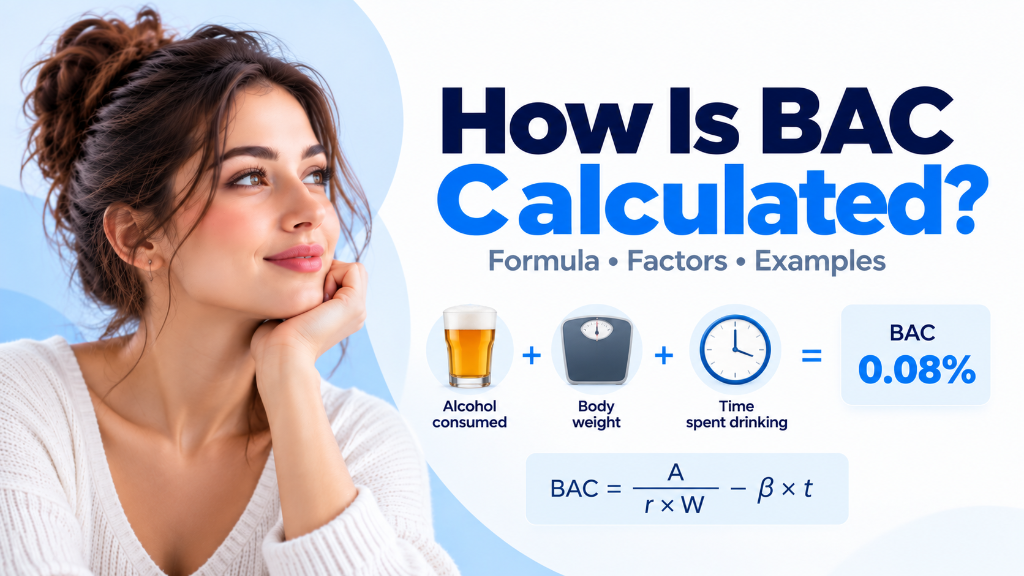
1. How Is BAC Calculated? (The Simple Answer)
At its most fundamental level, Blood Alcohol Concentration (BAC) is calculated by dividing the total weight of pure ethanol consumed by the total volume of water in your body, and then subtracting the alcohol your liver has already metabolized over time.
Because alcohol mixes freely with body water but does not enter fat cells, your body acts as a dilution reservoir. If you pour a shot of alcohol into a small bucket of water, the concentration is high; if you pour that exact same shot into a large tub, the concentration is substantially lower. As your liver enzymes break down ethanol at a steady hourly pace, the concentration steadily declines until it reaches zero.
If you are curious about what these numbers mean biologically for your organs and nervous system, read our foundational guide on What Is BAC? Blood Alcohol Concentration Explained. For an instant personal breakdown, you can also test your numbers directly with the Toolwingz BAC Calculator.
2. Estimated vs. Measured BAC: An Essential Difference
Before exploring the arithmetic, it is critical to distinguish between a mathematical estimate and an empirical chemical measurement. Confusion between these two concepts often leads people to misinterpret online calculators.
Estimated BAC (Formulas & Calculators)
Calculated using predictive mathematical algorithms (such as the Widmark equation). It assumes average absorption speeds, standard beverage volumes, generic body-water ratios, and linear metabolic clearance. It provides an excellent educational benchmark, but cannot measure what is currently inside your circulatory system.
Measured BAC (Clinical & Forensic Tests)
Determined through physical, chemical sampling. Forensic blood draws analyzed by headspace gas chromatography provide the gold-standard physical measurement. Evidential breathalyzers measure ethanol molecules in alveolar deep-lung air and mathematically convert them using a blood-to-breath partition ratio (typically 2,100:1).
3. The BAC Formula Explained: The Widmark Approach
Nearly every modern BAC calculation algorithm, hospital toxicology estimate, and online calculator relies on principles established by Swedish physician and analytical chemist Erik M. P. Widmark in his landmark 1932 monograph.
Variable Definitions & Units
| Variable | Scientific Meaning | Standard Unit | Typical Values / Benchmarks |
|---|---|---|---|
| A | Alcohol mass consumed | Ounces (US) or Grams (Metric) | 1 standard US drink = 0.6 oz pure ethanol (14.0 grams) |
| W | Total body weight | Pounds (lbs) or Kilograms (kg) | Your current physical scale weight |
| r | Gender distribution ratio | Dimensionless factor | 0.68 for biological males, 0.55 for biological females |
| 5.14 | Conversion constant | Mathematical factor | Reconciles fluid oz of ethanol, weight in lbs, and g/100 mL BAC |
| β (Beta) | Metabolic elimination rate | % BAC per hour | Average 0.015% / hr (range: 0.010% to 0.020% / hr) |
| t | Time elapsed | Hours | Duration from the first drink to current moment |
4. What Factors Affect a BAC Calculation?
Every variable within the formula corresponds directly to a distinct physiological mechanism. Understanding how these factors interact reveals why identical drinking sessions produce vastly divergent results.
Total Ethanol Ingested
The raw weight of pure alcohol consumed (A) is the primary numerator in the equation. Consuming high-proof spirits or high-ABV craft beer adds pure ethanol much faster than regular domestic beer.
Total Body Mass (Weight)
Body weight (W) determines the size of the dilution volume. A 220-pound individual has a substantially larger vascular and intracellular fluid volume than a 120-pound person, producing lower BAC for the same drink count.
Biological Sex & Body Water (r)
Water comprises roughly 68% of a biological male’s lean body mass versus 55% in biological females. Fatty adipose tissue retains almost no alcohol, causing ethanol to concentrate more densely in bodies with lower total water percentages.
Time Spent Drinking (t)
Alcohol metabolism begins almost immediately. Spreading four drinks across five hours allows the liver to eliminate roughly 0.075% BAC during the event, keeping peak BAC far lower than consuming those four drinks within 45 minutes.
Metabolic Clearance Rate (β)
The liver enzyme alcohol dehydrogenase (ADH) eliminates ethanol at a fixed speed (zero-order kinetics). While 0.015% per hour is the standard average, individuals with high enzyme activity may clear 0.020%, while slower metabolizers average 0.010%.
Stomach Food Contents
Food does not appear in the basic Widmark formula, yet it heavily dictates real-life outcomes. A full meal delays alcohol transfer to the small intestine, flattening the peak BAC curve by up to 30% to 50%.
5. What Counts as a Standard Drink?
When entering drink counts into a formula or calculator, one common source of error is treating every physical glass, can, or cocktail as "one drink." In the United States, official scientific agencies like the National Institute on Alcohol Abuse and Alcoholism (NIAAA) define a standard drink as containing exactly 14.0 grams (0.6 fluid ounces) of pure ethanol.
Regular Beer
Table Wine
Distilled Spirits
16 × 0.075 = 1.20 oz of pure ethanol. That single can equals 2.0 standard drinks, doubling the alcohol mass (A) used in your equation!6. Step-by-Step BAC Calculation Example
Let us walk through a complete, real-world calculation using the U.S. Customary Widmark equation to see how the numbers interact step by step.
Hypothetical Scenario: John
Biological male • 180 lbs (81.6 kg) • 3 standard 12 oz beers (5% ABV) • Consumed over 2 hours
Step 1: Calculate Total Pure Alcohol Consumed (A)
Three 12 oz beers at 5% ABV each contain 0.60 oz pure ethanol:
Step 2: Calculate Peak Theoretical BAC (Before Elimination)
Multiply alcohol ounces by 5.14, then divide by (weight in lbs × male distribution factor 0.68):
Step 3: Calculate Metabolic Alcohol Clearance Over Time
Multiply the average clearance constant (0.015% per hr) by the 2 hours elapsed:
Step 4: Subtract Elimination from Peak BAC
John’s estimated BAC after 2 hours is roughly 0.046%.
What if a 140 lb Female Drinks the Same 3 Beers Over 2 Hours?
Let us substitute Sarah’s numbers (W = 140 lbs, r = 0.55):
Minus 2 hrs metabolism = 0.1202% − 0.030% = 0.0902% (≈ 0.090% BAC)
Due to lower body weight and smaller body water distribution (r = 0.55), Sarah’s estimated BAC is almost double John’s—surpassing the 0.08% statutory DUI limit!
7. BAC Calculator vs. Manual Calculation
While calculating BAC on paper is a fantastic exercise in physiological mathematics, automated tools provide immense practical advantages in real-time estimation:
| Feature / Aspect | Manual Formula Calculation | Toolwingz BAC Calculator |
|---|---|---|
| Speed & Ease | Requires multi-step pencil-and-paper math | Instant interactive results as you type |
| Multi-Drink Combinations | Manual calculation of varying ABVs and ounces | Add distinct beers, wines, and spirits simultaneously |
| Unit Conversions | High risk of conversion errors (oz vs ml, lbs vs kg) | Flawless automatic conversion between US & Metric |
| Visual Status Gauges | Raw percentage number only | Visual color-coded impairment speedometer gauge |
| Time-to-Sober Projections | Must solve formula backwards for t | Dynamic hour-by-hour countdown estimation |
Regardless of whether you calculate by hand or use our online tool, remember that both methods share the same underlying mathematical model: they provide useful estimates, not laboratory medical measurements.
8. Why Your Actual BAC Can Be Different from a Calculation
If an individual blows into an evidential law-enforcement breathalyzer or receives a forensic blood test, the reading will rarely match a paper calculation down to the thousandth decimal place. Here is why clinical realities diverge from mathematical formulas:
1. Gastric Emptying & Absorption Dynamics
The Widmark equation assumes immediate or near-instant absorption of ingested ethanol. In reality, alcohol takes between 30 and 90 minutes to fully absorb. If you drank quickly on an empty stomach, absorption is rapid; if you ate a steak dinner with carbohydrates and fats, absorption will be delayed for hours, reducing your peak BAC.
2. First-Pass Gastric Metabolism
Before alcohol even reaches your liver or bloodstream, enzymes within the stomach lining (gastric alcohol dehydrogenase) metabolize a small fraction of the ethanol. Biological males typically have higher gastric ADH activity than females, meaning a portion of the drink is destroyed before entering circulation.
3. Individual Liver Enzyme Polymorphism
Genetic variations in the ADH and ALDH (aldehyde dehydrogenase) enzyme genes cause substantial variances in metabolism. Some populations metabolize alcohol into acetaldehyde exceptionally fast but break down toxic acetaldehyde slowly, altering degradation rates and physiological tolerance.
4. Hydration Status & Body Composition
Severe dehydration reduces the volume of body water available to dissolve ethanol, raising your actual BAC above formulaic projections. Conversely, highly athletic individuals with exceptional muscle mass carry more total body water than sedentary peers of identical scale weight.
9. Can You Use a BAC Calculation to Decide Whether to Drive?
An online BAC calculation or manual formula estimate should never, under any circumstances, be used to decide whether it is safe or legal to drive.
- Impairment precedes the legal limit: Crucial visual tracking, divided attention, emergency reaction time, and speed control degrade at BACs as low as 0.02% to 0.05%, long before the 0.08% statutory threshold.
- Rising BAC curves: If you drink recently and compute an estimate, your BAC may still be climbing rapidly while you are on the road, turning a theoretical 0.04% into a real 0.09% thirty minutes later.
- Zero-tolerance & actual impairment laws: In all 50 states, you can be charged with Driving Under the Influence (DUI/DWI) at any measurable alcohol level if officers observe physical impairment, regardless of what a mathematical formula projected.
- Commercial and underage drivers: Commercial drivers face strict 0.04% federal limits, while drivers under age 21 are subject to strict zero-tolerance laws (0.00% to 0.02%).
10. Frequently Asked Questions (FAQ)
What is the standard formula for calculating BAC?
The clinical benchmark is the Widmark formula: BAC = [A / (r × W)] × 100 − (β × t). In the United States using customary units (ounces and pounds), the equation is written as BAC = [(A × 5.14) / (W × r)] − (0.015 × t).
How fast does the body naturally lower BAC?
Human liver enzymes metabolize ethanol at a steady rate of roughly 0.015% BAC per hour. This pace is biological and constant; you cannot accelerate it with cold showers, hot coffee, excessive water, or exercise.
Why does the formula use different ratios for men and women?
Ethanol is hydrophilic (it dissolves only in water, not fat). Biological males have an average body water ratio of r = 0.68, while biological females average r = 0.55. With less water volume per pound to dilute alcohol, females experience higher BAC levels from equivalent consumption.
Does having food in your stomach change the mathematical calculation?
While simple mathematical formulas assume immediate absorption, having food in your stomach slows gastric emptying into the small intestine. This delays peak BAC and flattens your blood alcohol curve by up to 30% to 50% compared to drinking on an empty stomach.
Can an online BAC calculation be used as legal defense in court?
No. Online calculators and generic Widmark calculations are strictly educational tools and have zero legal standing. Courts and law enforcement rely exclusively on calibrated breathalyzer devices and certified forensic blood gas chromatography.
What is the difference between estimated BAC and measured BAC?
Estimated BAC is a theoretical calculation based on statistical averages and assumed intake. Measured BAC is an empirical chemical analysis performed through calibrated infrared breathalyzers or direct medical venous blood tests.
11. Conclusion & Next Steps
Calculating Blood Alcohol Concentration translates the physiological absorption and breakdown of ethanol into predictable mathematical terms. By tracking standard drink ounces, accounting for body weight and gender water ratios, and factoring in the steady hourly pace of liver metabolism, you can develop a clear, science-backed perspective on how alcohol affects human physiology.
Try the Interactive Toolwingz BAC Calculator
Skip manual conversions and explore instant visual blood alcohol projections based on your custom weight, drinks, and timeline—with 100% in-browser privacy.
Educational Disclaimer: Toolwingz BAC Calculator and guides are provided for educational and informational purposes only. Estimates do not constitute legal or medical advice and must never be used to evaluate driving ability.