

What Affects Your BAC? 10 Factors That Can Change Your Blood Alcohol Level
Blood Alcohol Concentration is never a simple one-to-one reflection of the glasses on your table. Discover the 10 critical physiological, biochemical, and circumstantial factors that determine your BAC, explore why two people react differently to the same drink, and debunk common sobering myths.
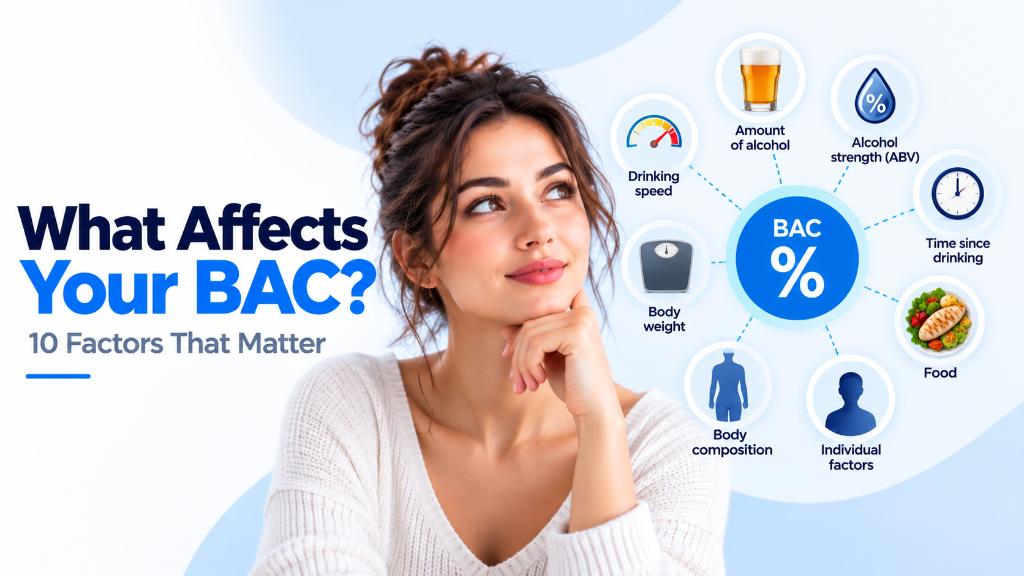
What Affects BAC? The Direct Answer
Your Blood Alcohol Concentration (BAC) is governed by a dynamic balance between two competing biological processes: how fast alcohol enters your bloodstream and how fast your liver removes it.
Specifically, your personal BAC at any given moment is determined by the amount and strength (ABV) of alcohol consumed, your drinking speed, your body weight and body composition, whether food is present in your stomach, the time elapsed since your first sip, and your unique biological and enzyme profile.
To better understand the biological fundamentals of blood alcohol, start with our companion guide on what BAC means, or explore the clinical formulas in our breakdown of how BAC is calculated. You can also test how modifying these variables shifts your personal numbers with the interactive Toolwingz BAC Calculator.
The 10 Key Factors That Determine Your BAC
Amount of Alcohol Consumed (Pure Ethanol Mass)
The total mass of pure ethanol you swallow is the foundational driver of your BAC. It is not the total volume of liquid in your cup that matters, but rather the exact grams or ounces of pure ethyl alcohol that liquid delivers into your digestive tract.
Every molecule of alcohol that enters your bloodstream must eventually be filtered through your hepatic tissues. If you double the pure ethanol ingested, you double the raw concentration of ethanol entering your circulatory system, all else being equal.
Alcohol Strength (ABV Percentage)
Alcohol by Volume (ABV) measures the percentage of pure alcohol in a beverage. Because drinks vary wildly in strength, container sizes are deceptive. A light beer at 4.2% ABV delivers a modest dose of ethanol, whereas a craft imperial stout or hazy IPA at 9.0% ABV packs more than double the alcohol per ounce.
Furthermore, highly concentrated alcohol (such as 80-proof spirits at 40% ABV) creates a steep concentration gradient across the gastrointestinal mucosa, which can accelerate passive diffusion into gastric capillaries compared to weak alcoholic solutions.
Drinking Speed (Rate of Consumption)
Your liver metabolizes alcohol at a constant, fixed rate—approximately 0.015% BAC per hour (equivalent to roughly one standard drink every 60 to 90 minutes). This metabolic limit is what pharmacologists call zero-order elimination kinetics.
When you drink faster than your liver can process ethanol (such as taking three shots in 30 minutes), the surplus alcohol cannot be degraded. It spills into your systemic bloodstream and circulates throughout your body, driving your BAC to steep, dangerous peaks. Conversely, nursing those same three drinks across four hours gives your liver time to eliminate a large fraction of the alcohol before it can accumulate.
Body Weight and the Dilution Principle
Body weight determines the total physical volume available to dilute ingested alcohol. Think of a 220-pound person as a large bucket and a 120-pound person as a small pitcher. If you pour 14 grams of pure ethanol into both containers, the concentration in the smaller container will be substantially higher.
However, body weight alone is not the sole determinant of BAC. While heavier individuals generally possess larger blood and fluid volumes, two people weighing exactly 160 pounds can still register dramatically different BACs based on their body composition.
Body Composition and Total Body Water
Ethanol is highly hydrophilic (water-loving) and lipophobic (fat-rejecting). When alcohol circulates, it dissolves almost entirely in the body’s water-rich tissues and blood plasma, bypassing adipose (fat) tissue almost completely.
Muscle tissue consists of approximately 75% water, while fatty tissue contains only 10% to 15% water. Consequently, an individual with a high percentage of lean muscle mass has a much larger effective dilution pool for alcohol than an individual of the same weight with a higher body fat percentage, leading to lower blood alcohol levels from the same drinks.
Biological Sex Differences
Biological females and biological males process alcohol through measurably different physiological pathways. These differences are primarily driven by body water proportions and gastric enzyme activity:
- Lower Total Body Water: On average, biological females have approximately 49% to 55% body water, compared to 58% to 68% in biological males. Because females have less fluid to dissolve ethanol, the resulting concentration is naturally higher per drink.
- Gastric ADH Activity: The stomach lining produces an enzyme called gastric alcohol dehydrogenase (ADH), which breaks down a small percentage of alcohol before it ever enters circulation (first-pass metabolism). Clinical research shows females typically produce lower levels of this stomach enzyme, allowing a greater fraction of alcohol to enter the bloodstream directly.
Food and Stomach Contents
Roughly 20% of alcohol is absorbed through the stomach lining, but the remaining 80% is absorbed in the upper small intestine (duodenum and jejunum). The small intestine boasts a vast absorptive surface area packed with capillaries.
When you drink on a full stomach, the pyloric sphincter (the muscular valve separating the stomach from the intestine) contracts to keep food inside for digestion. This traps alcohol in the stomach, dramatically slowing its delivery into the intestine. As a result, blood absorption is prolonged and the peak BAC is flattened by up to 30% to 50%.
Time Elapsed Since Drinking
Your BAC is constantly shifting along an absorption and elimination curve. Immediately after drinking, your BAC rises as alcohol is absorbed faster than the liver can degrade it. Once peak absorption is achieved, your BAC begins a steady downward trajectory as hepatic enzymes metabolize the ethanol.
While formulas subtract approximately 0.015% BAC per hour, it is dangerous to assume a guaranteed "sober by midnight" calculation. Absorption delays can cause BAC to keep rising for 30 to 90 minutes after your last sip, meaning you could be significantly more impaired an hour after stopping than when you set down your glass.
Serving Size vs. Standard Drink Benchmarks
One of the most pervasive calculation errors stems from equating a single physical container or glassware pour with "one drink." In the United States, an official standard drink contains exactly 14 grams (0.6 fluid ounces) of pure ethanol:
A large 9-ounce pour of wine in a restaurant represents nearly two standard drinks. Similarly, a pint (16 oz) of high-ABV craft ale or a potent mixed cocktail (like a Long Island Iced Tea) often packs 2.5 to 3.5 standard drinks into a single glass.
Individual Variation, Genetics & Medications
Even when two people have matching weight, sex, and drink counts, individual biochemical traits can create stark differences in their blood alcohol curves:
- Enzyme Polymorphism: Genetic variations in the alcohol dehydrogenase (ADH) and aldehyde dehydrogenase (ALDH) genes alter the speed of hepatic alcohol breakdown.
- Prescription Medications: Numerous pharmaceuticals—including antihistamines, anti-anxiety drugs, sleep aids, and antidepressants—compete for liver enzyme pathways or magnify central nervous system depressant effects.
- Age & Hydration: As the human body ages, total body water naturally declines, amplifying the concentration of ethanol in elderly adults compared to younger cohorts.
- Tolerance vs. BAC: Long-term heavy drinkers develop behavioral tolerance (the brain adapts to functioning while intoxicated), but tolerance does not significantly lower physical BAC readings on breathalyzers.
Why Can Two People Drink the Same Amount and Have Different BACs?
To see how these 10 factors interact in the real world, consider this hypothetical scenario involving two friends sharing drinks on a Friday evening:
Person A (David)
Estimated BAC ~0.038%- • Weight: 200 lbs (biological male)
- • Body Composition: High lean muscle mass (approx. 65% water)
- • Food: Ate a rich pasta and salmon dinner before going out
- • Pacing: Spaced 3 standard drinks evenly over 3 hours
- • Result: Large dilution reservoir, delayed gastric emptying, and ongoing metabolic clearance keep his estimated BAC well below the legal driving threshold.
Person B (Emma)
Estimated BAC ~0.092%- • Weight: 130 lbs (biological female)
- • Body Composition: Natural female body water ratio (approx. 50% water)
- • Food: Skipped dinner; drank on an empty stomach
- • Pacing: Finished the exact same 3 standard drinks in 75 minutes
- • Result: Smaller fluid reservoir, rapid intestinal absorption, and limited metabolic clearance cause her estimated BAC to exceed the 0.08% statutory limit.
* Note: Values represent hypothetical mathematical estimations for illustrative purposes. Real physiological blood levels require laboratory or breathalyzer verification.
What Doesn’t Quickly Lower Your BAC? (Debunking Common Myths)
Every year, thousands of people rely on folk remedies in an attempt to quickly sober up before driving or taking a test. From a biochemical perspective, none of these methods reduce your blood alcohol concentration:
Drinking Black Coffee
Caffeine is a central nervous system stimulant. It may make you feel less sleepy, creating a deceptive "wide-awake drunk" state, but it has zero effect on liver alcohol dehydrogenase enzymes. Your BAC remains identical.
Taking a Cold Shower
A shock of cold water triggers the sympathetic nervous system, temporarily elevating adrenaline and heart rate. It will wake you up, but the alcohol circulating in your blood and brain remains unchanged.
Chugging Water
Hydration is vital for preventing dehydration headaches, but drinking water after alcohol is absorbed cannot "flush out" ethanol from your bloodstream. The liver must chemically oxidize the alcohol over time.
Exercise or Sweating
Only 2% to 5% of alcohol is excreted unchanged through sweat, urine, or breath. The other 95%+ must be metabolized by the liver. Sweating in a sauna or jogging will not meaningfully lower your BAC.
See How Different Factors Affect Your Estimated BAC
Test the science for yourself. Open the Toolwingz BAC Calculator and adjust your weight, gender, drink strengths, and timeline to watch how mathematical estimates shift in real time.
Educational Disclaimer: Calculator results and formula estimates are for informational purposes only. They cannot measure real-time blood alcohol levels and should never be used to evaluate fitness to drive.
Frequently Asked Questions (FAQ)
What primarily affects your BAC level?
Your Blood Alcohol Concentration is determined by the total pure alcohol consumed, drink strength (ABV), body weight, body composition (water vs. fat), drinking speed, food in the stomach, and time elapsed.
Does eating food lower your BAC?
No. Food cannot remove alcohol that is already in your bloodstream. However, eating before or during drinking delays gastric emptying, slowing alcohol absorption into the small intestine and lowering your peak BAC.
Can you speed up how fast your liver clears alcohol?
No. Human liver enzymes eliminate alcohol at a fixed biological pace of roughly 0.015% BAC per hour. Coffee, cold showers, exercise, and water do not accelerate hepatic metabolism.
Why do two people drinking the same amount have different BACs?
Because ethanol dissolves only in water, differences in body weight, lean muscle mass vs. fat percentages, biological sex water distribution, stomach food, and genetic enzyme activity create completely different blood alcohol concentrations.
Does drinking water lower your BAC faster?
Water helps combat dehydration and reduces hangover symptoms, but it does not dilute alcohol already circulating in blood plasma or speed up liver oxidation.
How does drinking speed influence your peak BAC?
Drinking rapidly floods the digestive tract before the liver can clear alcohol, causing BAC to spike sharply. Pacing drinks gives the liver time to eliminate ethanol gradually, keeping peak BAC lower.