

What Is BAC? Blood Alcohol Concentration Explained
A comprehensive guide explaining what Blood Alcohol Concentration (BAC) means, how alcohol is absorbed and metabolized, standard drink benchmarks, and why the same drinks affect people differently.
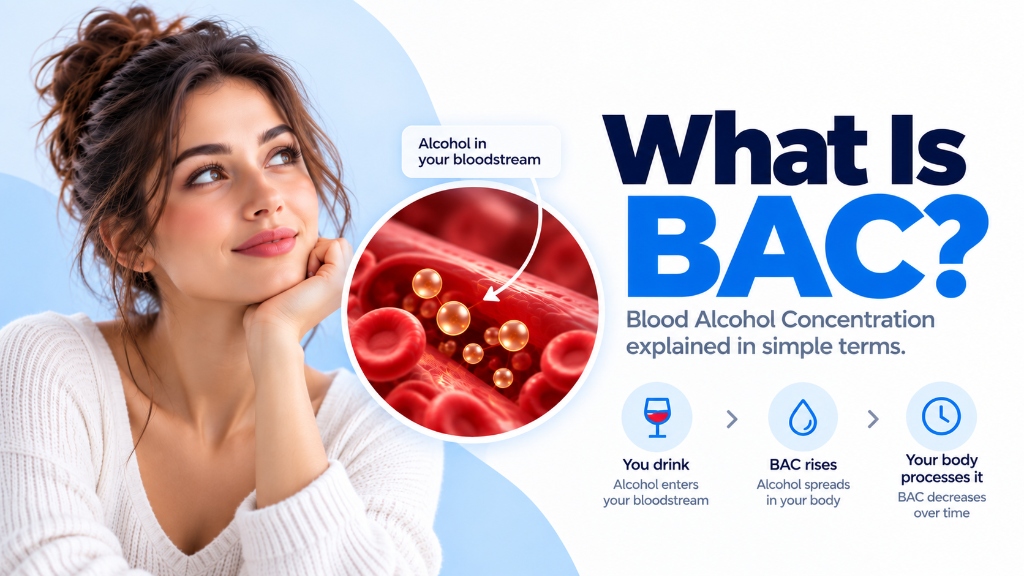
Blood Alcohol Concentration, commonly abbreviated as BAC, represents the percentage of pure alcohol circulating in a person’s bloodstream. Whenever you consume an alcoholic drink, the ethanol passes through your digestive tract, enters the circulatory system, and travels to every major organ—including your brain, lungs, and liver.
Measuring BAC provides a universal, standardized metric for determining physiological alcohol exposure and neurological impairment. Because alcohol affects individuals unevenly based on body size, gender, and digestion, knowing the raw number of drinks consumed tells only a fraction of the story. Want to explore the exact scientific formula and step-by-step math? Read our companion guide on how BAC is calculated or test your personal numbers with the Toolwingz BAC Calculator to explore interactive, educational estimates of blood alcohol levels over time.
What Does BAC Mean?
In clinical and forensic medicine, BAC measures the mass of alcohol present in a fixed volume of blood. In the United States and many global jurisdictions, BAC is formally defined as grams of alcohol per 100 milliliters of blood (written as g/dL) or as a direct percentage.
Understanding the Numbers: What Does 0.08 BAC Actually Mean?
A BAC reading of 0.08% means that your blood contains 0.08 grams of alcohol for every 100 milliliters of blood volume (or 0.8 grams per liter). Put into visual terms, that equates to roughly one drop of pure alcohol dissolved into 1,200 drops of blood.
While one part in 1,200 might seem like a tiny fraction, pure ethanol is a potent central nervous system depressant. Even at 0.02% or 0.05%, alcohol crosses the blood-brain barrier within minutes, altering neurotransmitters like GABA and glutamate, slowing neural transmission, and diminishing motor coordination.
How Does BAC Work?
The trajectory of your BAC follows a dynamic physiological curve. From the moment you take your first sip to the hour your body clears the last traces of alcohol, your system undergoes five continuous stages:
Consumption
Alcohol enters the mouth, travels down the esophagus, and collects inside the stomach. Unlike complex carbohydrates or proteins, ethanol requires no enzymatic digestion before absorption.
Gastrointestinal Absorption
Roughly 20% of the alcohol is absorbed directly into capillaries through the stomach lining. The remaining 80% passes into the upper small intestine (duodenum and jejunum), where a massive surface area absorbs alcohol rapidly into the bloodstream.
Bloodstream Distribution & Peak BAC
Once in the blood, alcohol diffuses readily throughout all water-containing tissues and organs. BAC continues climbing until the rate of absorption drops below the rate of elimination—a peak that usually occurs 30 to 90 minutes after finishing a drink.
Hepatic Metabolism
The liver processes over 90% of ingested alcohol using two key enzymes: alcohol dehydrogenase (ADH), which oxidizes ethanol into toxic acetaldehyde, and aldehyde dehydrogenase (ALDH), which converts acetaldehyde into non-toxic acetate.
Elimination
The remaining 2% to 8% of alcohol is excreted unchanged in breath, sweat, and urine. In healthy adults, the liver eliminates alcohol at an average rate of approximately 0.015% BAC per hour (often modeled between 0.010% and 0.020%).
Biological Note: Absorption and clearance timelines differ substantially across individuals. There is no universal timetable or mathematical trick that can guarantee when a specific individual will reach zero BAC.
How Is BAC Measured?
Accurately assessing blood alcohol concentration requires standardized clinical or chemical detection instruments. In practical applications, two primary methodologies dominate:
Direct Blood Testing
Laboratory blood analysis, conducted by gas chromatography on a venipuncture sample, is the medical and legal gold standard. It measures the exact milligrams of ethanol present per deciliter of whole blood, delivering unmatched forensic precision.
Breath Testing (Breathalyzers)
Evidential and preliminary breath testing instruments detect ethanol vapors exhaled from the deep alveolar sacs of the lungs. They apply a standardized breath-to-blood partition ratio (typically 2,100:1) to convert breath alcohol concentration (BrAC) into an estimated BAC.
An online BAC calculator does not draw blood, measure exhaled breath, or analyze body fluids. It is a mathematical modeling simulation based on population averages. Toolwingz provides an educational estimate, not a laboratory measurement or evidential breathalyzer reading.
What Do Different BAC Levels Mean?
As blood alcohol concentration rises, depressant effects systematically disrupt cognitive processing, sensory perception, and motor control. Clinical data documented by the National Institute on Alcohol Abuse and Alcoholism (NIAAA) and the National Highway Traffic Safety Administration (NHTSA) characterize predictable stages of alcohol influence:
| BAC Level | Clinical Stage | Observable Effects & Impairment |
|---|---|---|
| 0.00% | Sober | Baseline neurological behavior, normal reflexes, intact visual tracking, and full cognitive judgment. |
| 0.02% | Mild Mood Alteration | Slight body warmth and subtle relaxation. Early decline in rapid visual tracking and divided attention tasks. |
| 0.05% | Early Release of Inhibition | Lowered alertness, exaggerated behavior, reduced coordination, slower response to emergency driving stimuli, and impaired steering ability. |
| 0.08% | Legal Threshold (U.S.) | Substantial loss of motor coordination, balance, and muscle control. Severely impaired speed control, hazard detection, concentration, and short-term memory. |
| 0.10% | Marked Intoxication | Noticeable slurring of speech, pronounced slow reaction times, poor balance, difficulty maintaining lane positioning, and degraded braking response. |
| 0.15%+ | Severe Depression / Poisoning | Gross motor impairment, risk of blackouts, loss of consciousness, nausea, vomiting, and danger of respiratory depression at higher concentrations. |
Important: Measurable physical and psychological impairment begins well below statutory driving limits like 0.08%. There is no such thing as a "safe driving BAC" whenever any amount of alcohol is in your system.
What Affects Your BAC?
Blood alcohol concentration is not a simple linear equation of how many cups or glasses you drank. Seven primary physiological and circumstantial factors determine your personal BAC level:
1. Amount of Alcohol Consumed
The absolute mass of pure ethanol you ingest is the fundamental driver of BAC. Consuming drinks with higher alcohol concentrations immediately introduces greater quantities of ethanol into circulation.
2. Speed of Consumption
Drinking rapidly overwhelms the liver’s constant clearance capacity (~0.015% per hour). When alcohol absorption sharply outpaces metabolic conversion, BAC spikes to higher peaks than when the same quantity is consumed gradually over several hours.
3. Body Weight and Body Composition
Ethanol is water-soluble, not fat-soluble. Because muscle tissue contains approximately 75% water while adipose (fat) tissue contains only 10% to 15% water, individuals with larger total body water volumes dilute alcohol into a larger fluid reservoir, yielding a lower BAC than individuals with higher body fat percentages at identical body weights.
4. Biological Sex Differences
On average, biological females possess a lower percentage of total body water (approximately 49% to 52% vs. 58% to 68% in biological males) and produce lower concentrations of gastric alcohol dehydrogenase (ADH) enzymes in the stomach lining. Consequently, females generally absorb more alcohol directly into the bloodstream and reach higher BACs after drinking equal amounts.
5. Food and Stomach Contents
Drinking on a full stomach—particularly meals containing proteins, complex fats, or fibrous carbohydrates—forces the pyloric valve at the base of the stomach to stay closed for digestive processing. This delays alcohol from entering the small intestine, flattening the BAC peak and slowing overall absorption.
6. Alcohol Strength (ABV) & Container Volume
A 16-ounce craft double IPA at 9% ABV contains more than twice the pure alcohol of a standard 12-ounce domestic light beer at 4.2% ABV. Assuming that "one can equals one drink" is one of the most frequent sources of accidental overconsumption.
7. Time Elapsed Since Drinking
Time is the only biological factor that lowers BAC. Popular myths about cold showers, black coffee, heavy exercise, vomiting, or chugging water cannot increase the liver’s enzymatic breakdown rate by a single microgram.
What Counts as One Standard Drink?
In the United States, public health agencies including the NIAAA and CDC define a standard drink as any beverage containing approximately 14 grams (0.6 fluid ounces or 1.2 tablespoons) of pure ethanol.
Regular Beer
Standard 5% Alcohol by Volume (ABV). Yields ~14g of pure ethanol.
Table Wine
Standard 12% Alcohol by Volume (ABV). Yields ~14g of pure ethanol.
Distilled Spirits
Standard 40% ABV (80 proof gin, vodka, whiskey, tequila). Yields ~14g of pure ethanol.
Real-world beverages frequently exceed standard drink limits. A single 16-ounce pint glass, generous home wine pour, or mixed cocktail with multiple liquor shots often equates to 1.5 to 3 standard drinks in a single serving.
BAC vs. ABV: What is the Difference?
Consumers often confuse BAC with ABV because both metrics use percentages. However, they describe completely different dimensions of alcohol measurement:
| Attribute | BAC (Blood Alcohol Concentration) | ABV (Alcohol by Volume) |
|---|---|---|
| Subject | Relates to the person | Relates to the beverage |
| Definition | Grams of pure ethanol circulating per 100 mL of human blood. | Percentage of pure ethanol volume within the total liquid volume of a beverage. |
| Typical Values | 0.00% to 0.25%+ | 4% to 15% (beer/wine) or 40%+ (spirits) |
| Change Over Time | Dynamic: Rises during absorption and falls during liver metabolism. | Static: Fixed percentage printed on the product bottle or label. |
Drinking a high-ABV beverage will introduce ethanol into your system more quickly, but beverage ABV alone does not dictate your BAC. Your personal body size, gender, speed of drinking, and stomach contents dictate how that beverage translates into circulating blood alcohol.
Why Can Two People Have Different BACs After the Same Number of Drinks?
To illustrate how physiological factors alter blood alcohol concentration, consider a hypothetical scenario featuring two healthy adults at a social dinner:
Hypothetical Case Study: Alex vs. Jordan
- • Weight: 195 lbs (88 kg)
- • Total body water: ~68% (high muscle mass)
- • Food: Consumed a steak and potato dinner
- • Intake: 3 standard 12 oz beers over 2.5 hours
- Hypothetical Estimated BAC: ~0.02% – 0.03%
- • Weight: 125 lbs (57 kg)
- • Total body water: ~50%
- • Food: Drinking on an empty stomach
- • Intake: 3 standard 12 oz beers over 2.5 hours
- Hypothetical Estimated BAC: ~0.08% – 0.09%
Note: These values are hypothetical mathematical illustrations based on population averages. They are not predictions of real-world legal BAC.
Estimate Your BAC
Enter your details to get an educational BAC estimate with the Toolwingz BAC Calculator.
BAC and Driving
In the United States, driving with a BAC at or above 0.08% is universally illegal for non-commercial drivers aged 21 and older across 49 states (Utah enacted a stricter statutory threshold of 0.05%). Commercial vehicle drivers face an enforceable limit of 0.04%, while zero-tolerance laws strictly penalize underage drivers testing at 0.00% to 0.02%.
Crucially, statutory limits reflect maximum legal thresholds for criminal per se charges, not thresholds of actual driving safety. Extensive crash data from the NHTSA proves that critical faculties—including visual tracking, divided attention, emergency reaction time, and steering fidelity—degrade significantly at BAC levels as low as 0.02% to 0.05%.
Never use an online BAC estimate to decide whether you are safe to drive. If you have been drinking, use a sober driver, taxi, rideshare, public transportation, or another safe option.
Can a BAC Calculator Tell Your Exact BAC?
No.
No digital calculator or mobile app can determine your actual, biochemical blood alcohol concentration. Mathematical formulas—including the widely referenced Widmark equation—rely on population-wide biological averages.
Why Mathematical Estimates Differ From Clinical BAC:
- •Unknown Serving Volumes: Bartenders, restaurant servers, and mixed-drink recipes rarely match exact 1.5 oz or 5 oz standard liquid pours.
- •Actual ABV Fluctuations: Ciders, craft ales, and cocktails vary widely between 4% and 14%+ ABV.
- •Gastric Absorption Variances: The type, fat content, and timing of meals delay or accelerate alcohol entry into the bloodstream.
- •Individual Liver Kinetics: Genetic variations in ADH and ALDH enzyme concentrations cause metabolism to range between 0.010% and 0.020% per hour.
- •User Input Errors: Inaccurate weight inputs or miscalculating the elapsed drinking time skew calculations immediately.
While calculating your estimated BAC with the Toolwingz BAC Calculator is an outstanding educational exercise for understanding personal alcohol metabolism, it should never be interpreted as an official medical diagnostic or legal defense.
Frequently Asked Questions About BAC
What does BAC stand for?
What does 0.08 BAC mean?
Is BAC the same as alcohol percentage in a drink?
How is BAC tested?
Can food affect BAC?
Does drinking water lower BAC?
Can coffee lower BAC?
Can two people drinking the same amount have different BACs?
Is an online BAC calculator accurate?
Can I use a BAC calculator to determine whether I can drive?
Estimate Your BAC With Toolwingz
Understanding Blood Alcohol Concentration demystifies how ethanol circulates in the body, why drink counts are deceiving, and why two people can react so differently to identical beverages. By examining the math behind alcohol absorption and elimination, readers can make informed, evidence-based choices.
Explore the Toolwingz BAC Calculator
Input your weight, gender, drink details, and drinking timeline to visualize hypothetical BAC degradation curves with 100% client-side privacy.
Toolwingz provides BAC estimates for educational purposes only. Results are not a substitute for a breathalyzer, blood test, medical advice, or legal advice and should never be used to determine whether it is safe to drive.