

Does Drinking Water Lower BAC? What Hydration Can—and Can’t—Do
Explore why drinking water cannot lower your blood alcohol concentration (BAC) or dilute alcohol in your bloodstream, what hydration actually achieves, and why time is required to sober up.
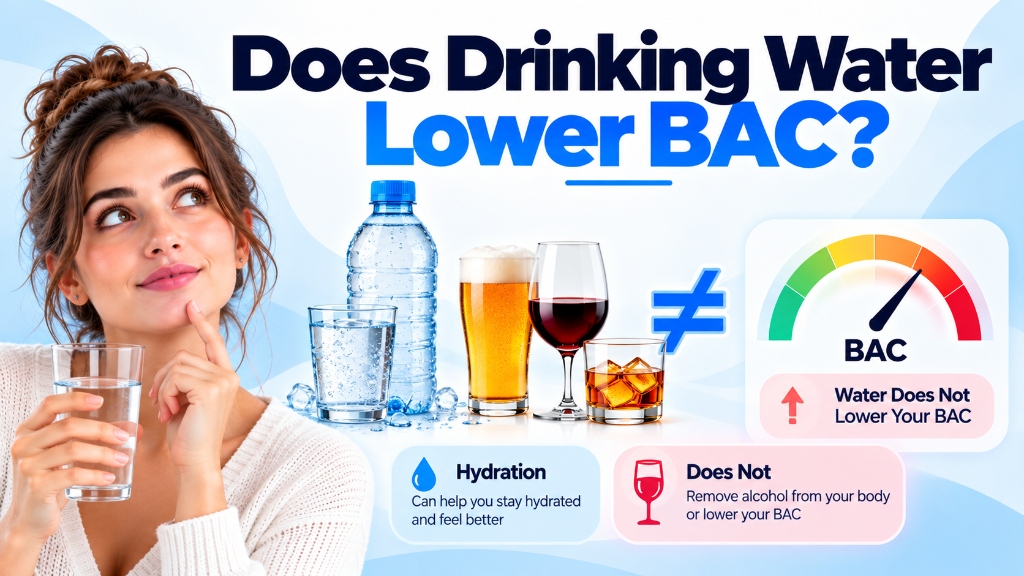
Does Drinking Water Lower Your BAC?
No. Drinking water does not rapidly lower the alcohol concentration already present in your bloodstream.
It is one of the most widely repeated health myths in social settings: if you drink several tall glasses of water after a night out, you will “flush the alcohol out” of your system and sober up before heading home. While drinking water supports hydration and can help you feel more comfortable the following morning, it should never be presented as a method for sobering up, rapidly decreasing your blood alcohol concentration (BAC), or making someone fit to drive.
The Fundamental Distinction
Hydration is not alcohol elimination.
Hydration replenishes extracellular water lost to alcohol-induced diuresis. Elimination, on the other hand, requires enzymatic liver metabolism. Once ethanol molecules are circulating through your vascular network, no amount of ingested water can wash them out of your bloodstream.
To understand why this is biologically impossible, we must examine how the body manages blood volume and how alcohol is cleared from circulation.
Why Water Doesn’t “Dilute” Alcohol Out of Your Blood
The intuition behind the water myth sounds superficially logical: blood alcohol concentration is expressed as a ratio—grams of alcohol per 100 milliliters of blood (g/dL). Many assume that if you chug a liter of water, you will expand your blood volume, dilute the ratio, and cause your BAC reading to plummet. In human physiology, however, blood volume regulation does not work like adding tap water to a pitcher of juice.
Alcohol Has Already Entered the Bloodstream
When you swallow an alcoholic drink, ethanol is rapidly absorbed through the mucosal lining of the stomach (approx. 20%) and the upper small intestine (approx. 80%). From there, it passes directly through the portal vein into the liver and quickly disperses throughout total body water—including blood plasma, organ tissue, and cerebrospinal fluid.
Once ethanol is distributed across body tissues, it equilibrates rapidly. Ingesting water hours later into your digestive tract does not create an isolated “rinse cycle” that pulls alcohol back into the gut or pushes it out of the vascular system.
Your Liver Still Has to Process the Alcohol
The human body maintains strict homeostatic control over blood plasma volume and serum osmolality via the kidneys and the antidiuretic hormone (vasopressin) axis. When you consume a large volume of water, your kidneys filter the excess fluid into your bladder as dilute urine within 20 to 45 minutes. The water does not permanently pool in your veins to dilute ethanol concentrations.
Furthermore, excess water intake does not stimulate the liver to synthesize more metabolic enzymes or process ethanol any faster. For a detailed breakdown of hepatic enzyme kinetics, read our clinical review on how the body metabolizes alcohol.
What Drinking Water Actually Does
Clarifying that water does not lower BAC does not mean hydration is useless. Water is an essential health tool whenever alcohol is consumed, but its benefits are physiological rather than sobering.
Alcohol acts as a chemical diuretic: it suppresses the pituitary gland from releasing vasopressin (antidiuretic hormone, or ADH). Without vasopressin signaling your kidneys to reabsorb water, your renal tubules dump large volumes of fluids directly into the bladder. For every 10 grams of pure alcohol consumed (slightly less than one standard drink), the kidneys excrete roughly 120 mL of additional urine. Drinking water replenishes this lost fluid volume, prevents severe dehydration, reduces oral dryness, and helps prevent electrolyte depletion.
However, it is critical to distinguish what water can accomplish from what it cannot:
| Drinking Water May... | Drinking Water Does NOT... |
|---|---|
| Support cellular and systemic hydration | Instantly remove alcohol from blood |
| Provide an enjoyable nonalcoholic beverage option | Rapidly lower blood alcohol concentration (BAC) |
| Replace fluids lost through alcohol-induced diuresis | Speed up sobriety or clear mental impairment |
| Help someone drink less alcohol when substituted for a drink | Prove someone is sober or safe to operate a vehicle |
Important Note on Hangovers: While drinking water mitigates dehydration headaches and dry mouth, scientific reviews demonstrate that hangovers are multi-factorial—driven by toxic acetaldehyde accumulation, sleep architecture disruption, gastric irritation, and inflammatory cytokine release. Water cannot prevent or “cure” a hangover caused by heavy drinking.
Does Water Make Alcohol Leave Your System Faster?
Answer: Water is not a shortcut for alcohol metabolism.
Many drinkers assume that drinking excess water increases urination, and therefore “urinates the alcohol out faster.” While intuitive, this reflects a basic misunderstanding of human renal clearance:
- Over 95% of Alcohol is Cleared by the Liver: Ethanol is cleared almost exclusively through oxidative metabolism by hepatocytes in your liver. Enzymes named alcohol dehydrogenase (ADH) and aldehyde dehydrogenase (ALDH) convert ethanol into acetaldehyde, then into acetate, and finally into water and carbon dioxide.
- Less than 2% to 5% is Excreted in Urine: Only a tiny fraction of intact alcohol leaves the body unchanged in urine, breath, and perspiration. When you chug water and urinate frequently, you are simply voiding water—not accelerated quantities of alcohol.
Official guidance from the Centers for Disease Control and Prevention (CDC) highlights that the liver can only process a small, limited amount of alcohol at any given time, regardless of how much fluid is consumed. Hepatic metabolism follows zero-order elimination kinetics: enzyme binding sites saturate at very low alcohol levels, processing alcohol at a steady rate averaging approximately 0.015% BAC per hour.
No amount of bottled water, electrolyte mix, or sports drinks can increase the enzymatic capacity of hepatic ADH. To learn more about standard metabolic timelines, review our guide on how long alcohol takes to be processed.
What About Drinking Water Between Alcoholic Drinks?
Public health campaigns frequently recommend the “one-for-one” rule: alternating every glass of alcohol with a full glass of water. This is an effective harm-reduction and pacing technique, but it must be understood correctly.
Drinking water between drinks helps because it slows down the tempo of alcohol consumption. It takes time to sip a glass of water, which introduces a delay between alcoholic servings and often leads someone to consume fewer total drinks over the course of an evening.
Crucial Caveat: The One-for-One Rule Does Not “Cancel Out” Alcohol
Drinking a glass of water does not chemically neutralize or erase the beer, wine, or cocktail you just finished. One glass of water does not cancel one drink. If you consume five alcoholic drinks alongside five glasses of water, your bloodstream will still absorb and process all five drinks.
Accurately monitoring your consumption requires knowing how much pure ethanol you are actually drinking. Before planning your pacing strategy, see what actually counts as one standard drink across beer, wine, and distilled spirits.
Can Water Prevent Your BAC From Rising?
There is a subtle but critical distinction between drinking less alcohol and neutralizing alcohol.
If substituting water for a cocktail prevents you from having a fourth drink, then water has effectively prevented your BAC from climbing higher. But it achieved that outcome purely through omission—by keeping ethanol out of your stomach.
Water itself possesses zero chemical-neutralizing capability. Drinking water after heavy alcohol intake does not prevent absorption or stop BAC from peaking 30 to 90 minutes later. Once alcohol enters your stomach and small intestine, your vascular system absorbs it regardless of how hydrated you are.
Does Water Help You Sober Up?
Clear Answer: Feeling better hydrated isn't the same as becoming sober.
After drinking two large glasses of cool water, you may feel refreshed, less parched, and more coherent. However, subjective comfort has no correlation with neurological sobriety.
Alcohol exerts sedative effects by modulating neurotransmitter receptors in the central nervous system—enhancing gamma-aminobutyric acid (GABA) and suppressing glutamate (NMDA) activity. Even if your mouth feels less dry and your stomach settles, your cerebellum, cerebral cortex, and visual processing centers remain depressed by circulating ethanol.
This deceptive gap between subjective feeling and objective impairment is identical to caffeine myths: see why coffee doesn't lower BAC or speed up sobriety despite making you feel awake.
Water vs. Coffee vs. Food: What Actually Affects BAC?
People often group water, coffee, and meals into a single “sobering up toolkit.” In reality, each interacts with alcohol in fundamentally different ways:
Water (Hydration Support)
Supports fluid balance and counters dehydration. However, it does not chemically neutralize ethanol, does not dilute blood plasma significantly, and does not accelerate hepatic clearance.
Coffee & Caffeine (Stimulant Alertness)
Caffeine blocks adenosine receptors to mask sleepiness, creating “wide-awake drunkenness.” The CDC warns that caffeine does not reduce alcohol's intoxicating effects or lower BAC. Learn more in our article on does coffee lower BAC.
Food (Absorption Rate Delay)
Food in the stomach delays gastric emptying into the small intestine, flattening and delaying peak BAC. The National Highway Traffic Safety Administration (NHTSA) identifies stomach food as a major factor affecting BAC. See how eating before drinking affects BAC.
Time & Hepatic Metabolism (Sole Eliminator)
The only biological mechanism that permanently removes alcohol from the bloodstream. Liver enzymes clear ethanol at a fixed rate of ~0.015% BAC per hour until blood levels return to 0.00%.
Can You Lower BAC Quickly?
Whenever someone searches for ways to lower BAC fast, they are often facing an urgent scenario: needing to drive home, prepare for work, or pass an unexpected sobriety check.
Medical literature is unanimous: there is no way to rapidly lower your BAC. Readers should be deeply skeptical of commercial “detox pills,” herbal charcoal capsules, electrolyte cocktails, or extreme sobering tricks. Scientific analysis of cold showers and BAC reveals that external thermal shocks merely trigger brief adrenaline without removing circulating ethanol.
You should also avoid relying on simplistic rules of thumb like “wait exactly one hour per drink and you will be at 0.00.” Real-world elimination varies considerably based on individual physiology, liver health, biological sex, body mass, and total alcohol consumed. NHTSA explicitly notes that these biological variables make self-assessment virtually impossible. For a broader look at biological dynamics, read our guide on factors that affect BAC and review what BAC actually means.
What Does a BAC Calculator Estimate?
Digital tools such as the Toolwingz BAC Calculator provide theoretical estimates of your estimated blood alcohol concentration by applying validated demographic models (such as the Widmark formula and Watson total body water equations).
These algorithms model alcohol concentration based on biological sex, body weight, total pure alcohol ounces consumed, and hours elapsed since your first drink. Water intake is not factored in as a variable that subtracts from the BAC estimate, because water does not accelerate clearance.
Why Feeling Better Doesn’t Mean You’re Safe to Drive
Feeling refreshed or rehydrated is not proof of driving competence.
According to the National Highway Traffic Safety Administration (NHTSA), alcohol degrades critical driving faculties at BAC levels as low as 0.02% to 0.05%. These impairments include reduced visual tracking of moving objects, slower emergency braking response, impaired divided attention, and compromised steering precision.
In the United States, the legal per-se limit for driving with a non-commercial license is 0.08 g/dL in every state except Utah, where the statutory limit is 0.05 g/dL. Furthermore, zero-tolerance laws establish much lower thresholds (typically 0.00% to 0.02%) for drivers under age 21 and commercial operators.
Never use water consumption, hydration status, or calculated estimates to justify getting behind the wheel. A driver can still be charged and convicted of Driving Under the Influence (DUI) below statutory per-se thresholds if observable impairment is documented. For a complete review of impairment stages, read our guide on BAC levels explained.
If you have consumed alcohol, always arrange a designated driver, book a rideshare, or call public transit. Respect the biological reality: hydration keeps you healthy, but only time makes you sober.
Estimate Your BAC with the Toolwingz BAC Calculator
Explore how body weight, biological sex, drink volume, and elapsed time influence your theoretical blood alcohol curve with 100% client-side privacy.
Educational Disclaimer: Toolwingz BAC Calculator results are estimates for informational purposes. They do not measure your actual BAC and cannot determine whether you are safe or legally permitted to drive.