Does a Cold Shower Lower BAC? The Truth About Sobering Up
Explore why taking a cold shower cannot lower your blood alcohol concentration (BAC) or accelerate liver metabolism, why alertness does not equal sobriety, and what actually clears alcohol.
Does a Cold Shower Lower Your BAC?
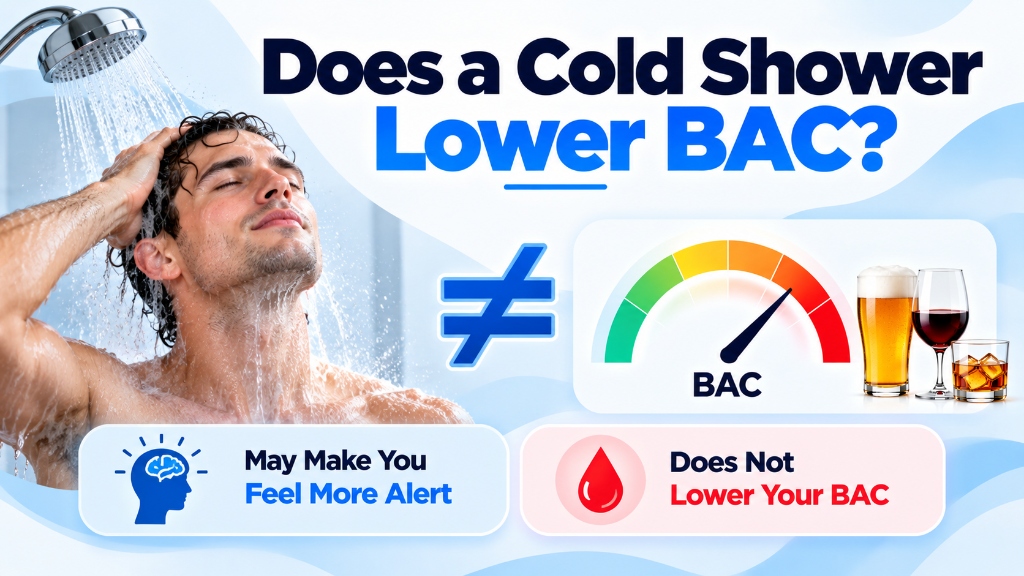
No. Taking a cold shower does not remove alcohol from your bloodstream or meaningfully speed up alcohol metabolism.
For generations, popular culture, movies, and party folklore have depicted cold showers as the ultimate emergency cure for intoxication. The scene is familiar: someone has had far too much to drink, gets pushed under a stream of icy water, gasps violently, and steps out seemingly “sobered up.”
While sudden contact with freezing water will certainly startle you awake and temporarily reduce sluggishness, that physical shock should never be confused with a reduction in blood alcohol concentration (BAC) or a recovery of cognitive faculties.
The Golden Principle of Alcohol Clearance
Feeling more alert does not equal a lower BAC.
Sensory shock affects your skin and autonomic nervous system. Blood alcohol concentration, however, is a measurement of pure ethanol circulating through your internal vascular system and brain tissue. Cold water on your skin cannot reach inside your veins to eliminate alcohol molecules.
Why a Cold Shower Can Make You Feel More Awake
The reason the cold shower myth persists is that cold water genuinely produces a powerful, instantaneous physiological reaction. Understanding why you feel different helps explain why that sensation is so dangerously misleading.
Cold Water Triggers an Autonomic Adrenaline Spike
When icy water strikes thermal cutaneous receptors in your skin, your brain registers an acute thermal stress threat. This immediately triggers the sympathetic nervous system's “fight-or-flight” response:
- Adrenaline & Norepinephrine Release: The adrenal glands flood your bloodstream with stress hormones, increasing cortical arousal.
- Peripheral Vasoconstriction: Surface capillaries rapidly tighten to preserve core body heat, shunting blood toward vital internal organs.
- Inspiratory Gasp Reflex: The sudden cold induces rapid, deep breathing, temporarily elevating oxygen intake.
- Elevated Heart Rate: Cardiac output surges to counteract the thermal shock.
This hormonal and cardiovascular jolt counteracts the heavy, sedating sensation that alcohol produces in the brain. You feel alert, your eyes open wide, and you no longer feel like nodding off on the couch.
Alertness Isn't Sobriety
Here lies the critical danger: subjective alertness has virtually zero correlation with objective sobriety.
Ethanol remains actively bound to gamma-aminobutyric acid (GABA) and NMDA glutamate receptors across your cerebral cortex, cerebellum, and limbic system. Even while standing upright and shivering with wide-open eyes, your peripheral visual tracking, divided attention capacity, emergency braking reaction speed, and risk perception remain severely degraded.
This exact same neurological illusion occurs with caffeine: why coffee doesn't lower BAC explains how stimulants merely mask feelings of fatigue, creating “wide-awake drunkenness” without removing a single milligram of circulating ethanol.
What Actually Makes BAC Go Down?
To understand why external remedies fail, consider the biological path alcohol travels through the human body:
Once swallowed, ethanol passes through the stomach and small intestine into the bloodstream. It diffuses evenly throughout all fluid compartments of the body, including the brain. At that stage, there is no physical, mechanical, or thermal action that can bypass the liver.
According to the National Institute on Alcohol Abuse and Alcoholism (NIAAA), over 90% to 95% of all circulating alcohol is broken down through oxidative enzymatic metabolism in the liver:
- Alcohol Dehydrogenase (ADH): Liver hepatocytes utilize ADH enzymes to oxidize ethanol into acetaldehyde, a highly toxic intermediate metabolite.
- Aldehyde Dehydrogenase (ALDH): ALDH enzymes rapidly convert toxic acetaldehyde into acetate.
- Cellular Fuel & Excretion: Peripheral tissues convert acetate into harmless water and carbon dioxide, which are naturally excreted.
Crucially, this enzymatic sequence operates under zero-order elimination kinetics. The rate is fixed because the liver's enzyme binding sites saturate at very low BAC levels. Regardless of whether you take an ice-cold shower, drink gallons of water, or run around the block, the human liver clears alcohol at an average rate of approximately 0.015% BAC per hour.
To explore the full metabolic timeline in detail, read our complete guide on how the body metabolizes alcohol.
Does Sweating Remove Alcohol Faster?
A closely related myth is that you can “sweat the alcohol out” through heavy perspiration in a hot shower, steam room, sauna, or vigorous workout.
While it is true that trace amounts of alcohol exit the body through non-hepatic routes—namely breath, perspiration, and urine—scientific research confirms that these secondary pathways collectively account for less than 2% to 5% of total alcohol elimination. Sweat glands excrete less than 1% of total ingested ethanol.
Trying to sweat out alcohol does not measurably reduce your blood alcohol concentration. Instead, profuse sweating simply flushes vital electrolytes and water from an already dehydrated system, significantly increasing the risk of severe cramping, heat exhaustion, and dangerously low blood pressure.
Cold Shower vs. Coffee vs. Water: What They Can and Can’t Do
When people want to sober up quickly, they almost always reach for one of three traditional home remedies: cold showers, hot coffee, or large glasses of water. Comparing them side by side clarifies their actual physiological boundaries:
| Sobering Method | What It May Do | What It Does NOT Do |
|---|---|---|
| Cold Shower | Triggers adrenaline and makes you feel more awake | Does not rapidly lower BAC or improve motor reflexes |
| Black Coffee | Blocks adenosine receptors to reduce drowsiness | Does not remove alcohol or accelerate liver clearance |
| Drinking Water | Supports cellular hydration and relieves dry mouth | Does not dilute circulating ethanol or neutralize drinks |
| Time & Metabolism | Allows liver enzymes to systematically oxidize ethanol | Does not provide an exact universal countdown for all |
For deeper insights on these specific strategies, explore our detailed investigations on does coffee lower BAC? and does drinking water lower BAC?.
What About a Hot Shower or Sauna?
If a cold shower doesn't work, what about stepping into a steaming hot shower, hot tub, or sauna?
From a medical standpoint, taking a very hot shower or entering a sauna after heavy drinking is not only ineffective—it is downright dangerous:
- Synergistic Vasodilation: Both alcohol and external heat dilate peripheral blood vessels. When combined, they can cause a precipitous drop in blood pressure (orthostatic hypotension), leading to sudden fainting, head trauma, and slip-and-fall injuries on hard bathroom tile.
- Severe Dehydration: Alcohol suppresses vasopressin, inducing diuresis. Adding intense sweating in high heat accelerates fluid and electrolyte depletion.
- Cardiovascular Strain: Alcohol increases resting heart rate while heat demands elevated cardiac output, placing excessive stress on the heart.
Hot showers and saunas do not provide any metabolic shortcut. Intoxicated individuals should steer clear of extreme heat exposure entirely.
Can Exercise Help You Sober Up Faster?
Another common myth suggests that going for a brisk run, doing push-ups, or engaging in intense calisthenics will burn off alcohol and sober you up faster.
Exercise increases muscular blood flow and ventilation rate, which can make you feel more energized. But muscular exertion does not clear alcohol from the body:
Skeletal muscles cannot metabolize ethanol. Your liver must still process virtually all circulating alcohol, and hepatic blood flow does not significantly increase enzyme capacity during exercise. In fact, intense exercise while intoxicated elevates injury risk, impairs motor coordination, and exacerbates dehydration.
The fundamental truth remains: feeling physically stimulated or breaking a sweat does not mean the alcohol has left your bloodstream. Read our complete physiological analysis on can exercise lower BAC? to learn why working out cannot accelerate sobriety.
How Long Does It Take to Sober Up?
Because there is no shower, drink, or pill that accelerates alcohol metabolism, the only real cure for intoxication is time. However, there is no universal waiting period that applies equally to every individual.
You should never rely on simplistic rules like “divide your BAC by 0.015 to know the exact minute you can drive.” Alcohol clearance and peak BAC curves depend on a complex array of biological variables:
- Total Alcohol Ingested: The total ounces of pure ethanol consumed across all beverages.
- Drinking Tempo: Rapid binge drinking spikes BAC far higher than sipping spaced drinks over several hours.
- Biological Sex & Body Water: Women generally have less body water per pound of body weight than men, producing higher BAC levels from identical drinks.
- Stomach Contents: Food in the stomach delays gastric emptying and flattens peak absorption curves.
- Individual Liver Genetics: Variations in ADH and ALDH enzyme expression influence metabolic clearance rates.
To learn how these variables interact in clinical practice, explore our guides on factors that affect BAC and how alcohol is metabolized.
Can a BAC Calculator Tell When You’re Sober?
Digital tools like the Toolwingz BAC Calculator help users understand theoretical alcohol absorption and elimination curves. By entering your biological sex, body weight, drink strength, and drinking duration, you can estimate your BAC and explore how time gradually lowers your estimated blood alcohol concentration.
However, digital calculators are educational models based on statistical population averages (such as the Widmark formula). A calculator cannot measure your actual blood chemistry, evaluate personal liver enzyme efficiency, or determine real-time physical impairment. Under no circumstances should a digital calculation be used as a guaranteed “safe to drive” timer.
Why a Cold Shower Doesn’t Make Driving Safe
A cold shower may change how awake you feel, but it cannot restore your driving ability.
Extensive crash data from the National Highway Traffic Safety Administration (NHTSA) reveals that alcohol-induced driving impairment begins at blood alcohol concentrations far below the commonly referenced 0.08% legal threshold. Critical driving faculties degraded by alcohol include:
- Braking Reaction Speed: Slower neural transmission across synapses delays emergency stopping distance by hundreds of milliseconds.
- Divided Attention: Inability to simultaneously maintain lane discipline, monitor speed, and anticipate sudden pedestrian movements.
- Visual Tracking: Alcohol impairs optical convergence and peripheral perception, causing “tunnel vision” in low-light conditions.
- Risk Judgment: Prefrontal cortex suppression leads drivers to overestimate their capabilities—an effect made far worse when a cold shower tricks them into feeling wide awake.
Never use a cold shower, fresh air, coffee, or subjective feelings of alertness to decide whether you or anyone else is safe to drive. In the United States, law enforcement can arrest and convict drivers for Driving Under the Influence (DUI) at any BAC if observable impairment is documented. For a complete analysis of impairment stages, read our guide on BAC levels explained and review what blood alcohol concentration means.
If you have been drinking, always arrange a designated sober driver, call a rideshare, or use public transportation. When it comes to alcohol, time is the only path to genuine sobriety.
Estimate Your BAC with the Toolwingz BAC Calculator
Explore how body weight, biological sex, standard drink units, and elapsed hours shape your theoretical blood alcohol curve with 100% privacy.
Educational Disclaimer: Toolwingz BAC Calculator results are estimates for informational purposes only. They do not measure your actual BAC or determine whether you are safe or legally permitted to drive.