Does Exercise Lower BAC? Can You Sweat Alcohol Out Faster?
Explore why exercise, sweating, and workouts cannot lower your blood alcohol concentration (BAC) or accelerate liver metabolism, why feeling alert is not sobriety, and how alcohol is eliminated.
Does Exercise Lower Your BAC?
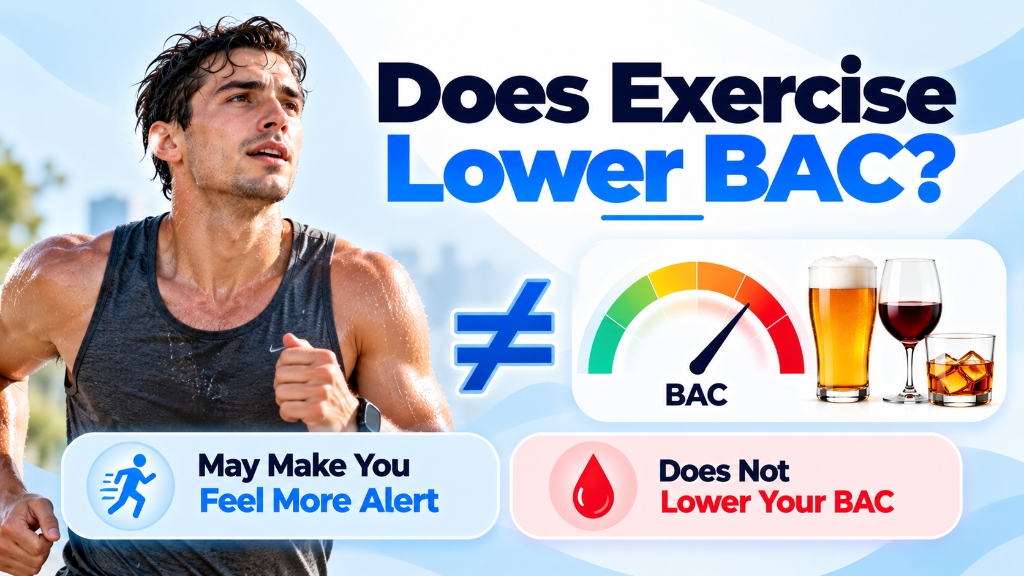
No. Exercise is not a reliable way to meaningfully speed up the removal of alcohol from your bloodstream or rapidly lower your BAC.
It is a widespread belief among gym-goers, athletes, and weekend partygoers alike: if you wake up with alcohol still in your system—or want to sober up quickly after having drinks—you can simply “sweat it out” by going for a fast run, hitting the exercise bike, or lifting weights.
While intense physical movement stimulates circulation, elevates your core body temperature, and temporarily makes you feel more awake, that subjective burst of energy does not mean your blood alcohol concentration (BAC) has fallen accordingly.
The Fundamental Physiological Rule
Feeling more awake does not equal being sober.
Cardiovascular exercise stimulates your skeletal muscles, heart, and lungs. However, skeletal muscle tissue does not possess the enzymatic pathways needed to metabolize ethanol. Over 95% of circulating alcohol must wait for steady, unaccelerated chemical breakdown in your liver.
Can You Sweat Alcohol Out?
The idea that you can “sweat alcohol out” of your body is one of the most persistent fitness myths. It captures millions of searches every year because on an intuitive level, it sounds plausible:
Why Sweating Feels Like It Should Work
Sweating is one of the body's primary thermoregulatory mechanisms. When your internal temperature climbs during a workout, eccrine and apocrine glands pump fluid onto the skin surface to cool you via evaporation. Because sweat expels water, salts, and trace organic compounds, many people naturally assume that profuse sweating can also purge alcohol out of the vascular system.
This belief is reinforced by smell: after drinking heavily, a person's sweat and breath often carry a sharp, pungent odor. However, that odor is primarily caused by trace acetic acid and airborne aromatic compounds, not massive volumes of expelled ethanol.
Where Most Alcohol Actually Goes
In human physiology, the sweat glands play a virtually negligible role in alcohol clearance. Peer-reviewed pharmacokinetic studies confirm that:
- Less than 1% Excreted Through Sweat: The total amount of intact ethanol eliminated through all perspiration combined represents under 1% of what was consumed.
- Less than 2% to 5% Across All Secondary Routes: Breath, sweat, and urine combined account for only a tiny fraction of clearance.
- Over 95% Metabolized by the Liver: According to the National Institute on Alcohol Abuse and Alcoholism (NIAAA), the overwhelming majority of ethanol is oxidized hepatically by enzymes including alcohol dehydrogenase (ADH) and aldehyde dehydrogenase (ALDH).
Because sweat glands cannot pull ethanol out of blood plasma in significant quantities, exercising to induce heavy sweating simply dehydrates you without reducing your BAC. For an in-depth review of hepatic pathways, explore how your body metabolizes alcohol.
Why Exercise Can Make You Feel More Alert
If working out doesn't eliminate alcohol, why do so many people swear they feel markedly “soberer” after twenty minutes of exercise?
The answer lies in autonomic neurochemistry. Physical movement triggers several acute physiological responses:
- Endorphin and Dopamine Release: Exercise activates reward pathways and elevates mood, counteracting alcohol's sedative emotional fog.
- Sympathetic Adrenaline Surge: Increased motor demand releases epinephrine, sharpening cortical arousal, dilating bronchial tubes, and accelerating heart rate.
- Elevated Core Body Temperature: Muscle contraction produces heat, dispelling the cold, lethargic sensation common during the post-drinking phase.
While this neurochemical surge successfully combats sleepiness, it is crucial to distinguish subjective alertness from objective physiological capacity:
What Exercise Changes:
• Perceived energy and wakefulness
• Temporary mental focus
• Heart rate and respiration volume
What Stays Impaired:
• Actual blood alcohol concentration (BAC)
• Emergency reaction time and reflexes
• Complex divided attention and risk assessment
Caution: Never attempt to “test” your sobriety by seeing if you can run in a straight line or perform physical balance exercises. Physical effort does not remove alcohol from your brain.
Does Running Lower BAC Faster?
Direct Answer: Running does not provide a dependable shortcut for alcohol metabolism.
Online fitness forums sometimes circulate dangerous pseudo-scientific calculations claiming that “a 30-minute jog burns off two beers” or “running five miles clears 0.04% from your BAC.”
These claims confuse caloric expenditure with ethanol oxidation. While running burns calories derived from carbohydrates and fats, it does not accelerate the enzymatic breakdown of ethanol in liver cells. There is zero biological conversion between distance run, sweat volume generated, calories expended, and milligrams of alcohol removed from your vascular system.
Does Working Out After Drinking Help You Sober Up?
Exercise should never be used as a sobering-up tool. In fact, attempting to work out while intoxicated—or during a severe hangover when BAC is still elevated—introduces serious clinical risks:
- Compounded Dehydration & Electrolyte Depletion: Alcohol suppresses vasopressin, causing heavy urinary water loss. Combining alcohol-induced diuresis with heavy workout sweating causes rapid dehydration, leading to painful muscle spasms, dizziness, and dangerous cardiac arrhythmias.
- Impaired Motor Coordination & Acute Injury: Alcohol degrades cerebellar fine motor control, proprioception, and balance. Lifting heavy barbells, operating complex gym machinery, or running on uneven trails significantly spikes the risk of dropped weights, joint sprains, torn ligaments, or head injuries.
- Cardiovascular Strain: Alcohol elevates resting heart rate and blood pressure variability. Imposing high-intensity interval training or heavy resistance loads places undue physiological stress on the myocardium.
- Suppressed Muscle Protein Synthesis (MPS): Clinical studies show that circulating alcohol blunts mTOR signaling and impairs protein synthesis, reducing the muscular benefits of the workout itself.
Exercise vs. Water vs. Coffee vs. Cold Showers
Across party culture, four remedies are perpetually cited as quick fixes for intoxication: working out, drinking water, taking cold showers, and sipping black coffee. Comparing them highlights their actual boundaries:
| Method | What It May Change | Does It Rapidly Lower BAC? |
|---|---|---|
| Exercise & Sweating | Alertness, heart rate, and mood | No. Less than 1% cleared via sweat. |
| Drinking Water | Hydration and fluid balance | No. Kidneys excrete water, not ethanol. |
| Black Coffee / Caffeine | Temporarily reduces sleepiness | No. Masks drowsiness without lowering BAC. |
| Cold Shower | Sensory shock and wakefulness | No. Adrenaline surge does not clear alcohol. |
| Hepatic Metabolism (Time) | Alcohol remaining in bloodstream | Yes. BAC declines as liver oxidizes ethanol. |
Note: Individual BAC trajectories vary based on body composition, drinking speed, biological sex, and liver health. This table should never be interpreted as a personal countdown to driving.
Learn more about each specific method in our detailed clinical guides: does drinking water lower BAC?, does coffee lower BAC?, and does a cold shower lower BAC?.
What Actually Causes BAC to Decrease?
The biological clearance of alcohol follows an orderly, immutable sequence:
Once ethanol is absorbed into circulating blood, your body simply requires time to process it. The liver clears alcohol at a relatively constant biological rate—averaging approximately 0.015% BAC per hour—though personal genetics, liver health, and enzymatic expression cause variations between individuals.
Because clearance proceeds under zero-order kinetics, no universal timetable or workout routine guarantees when an individual will reach 0.00%. To understand the science of liver clearance, read our guide on how alcohol is metabolized.
Can Exercise Change a BAC Calculator Result?
Digital tools like the Toolwingz BAC Calculator estimate your estimated blood alcohol concentration by applying validated scientific equations (such as the Widmark formula).
These algorithms calculate alcohol levels based strictly on biological sex, body weight, pure alcohol volume, and elapsed time since drinking began. Exercise duration, sweat production, and physical exertion are not factored in because workouts do not accelerate hepatic enzyme clearance.
Toolwingz BAC Calculator results are estimates for informational and educational purposes only. They cannot measure your actual blood chemistry, predict metabolic variations with laboratory precision, or determine whether you are safe or legally permitted to drive.
Can Exercise Make You Safe to Drive After Drinking?
Clear Answer: No.
Completing a workout, sweating profusely, or feeling an energetic post-exercise adrenaline boost does not establish that alcohol-induced impairment has ended.
Research from the National Highway Traffic Safety Administration (NHTSA) confirms that alcohol degrades critical driving faculties at BAC levels starting as low as 0.02% to 0.05%:
- Braking Reaction Speed: Neural latency across synapses slows reaction time by hundreds of milliseconds—enough to turn a routine stop into a severe collision.
- Divided Attention: Drivers cannot simultaneously process mirrors, speed, road signs, and sudden hazards.
- Optical Tracking: Alcohol degrades peripheral vision and dynamic visual acuity.
Never use a workout, run, or feelings of fitness to justify driving after alcohol consumption. Impairment begins well below statutory 0.08% legal limits. For detailed impairment stages, review our guide on BAC levels explained, understand what BAC means, and review factors that affect BAC.
The Bottom Line
You cannot reliably “sweat out” alcohol by exercising.
Physical activity may change how awake you feel, but circulating ethanol still needs to be metabolized by hepatic enzymes over time. Water, coffee, cold showers, saunas, and strenuous workouts are not shortcuts for rapidly reducing BAC.
Whenever you have consumed alcohol, protect yourself and others: stay hydrated, rest, arrange a designated sober driver or rideshare, and give your body the hours it needs to clear alcohol naturally.
Estimate Your BAC with the Toolwingz BAC Calculator
Calculate theoretical blood alcohol curves and explore how body weight, drink strength, and elapsed time influence clearance with 100% privacy.
Educational Disclaimer: Toolwingz BAC Calculator provides an estimate for informational purposes. It does not measure your actual BAC and cannot determine whether you are safe or legally permitted to drive.