
Does Sleeping Lower BAC? What Happens to Alcohol While You Sleep
Discover what happens to alcohol while you sleep, why sleep does not speed up clearance, and why waking up rested does not guarantee sobriety.
Reviewed against peer-reviewed metabolic literature and clinical guidance from the National Institute on Alcohol Abuse and Alcoholism (NIAAA) and the National Highway Traffic Safety Administration (NHTSA). This article is educational and does not replace medical advice. If you suspect acute alcohol poisoning or a medical emergency, call 911 immediately.
Does Sleeping Lower BAC?
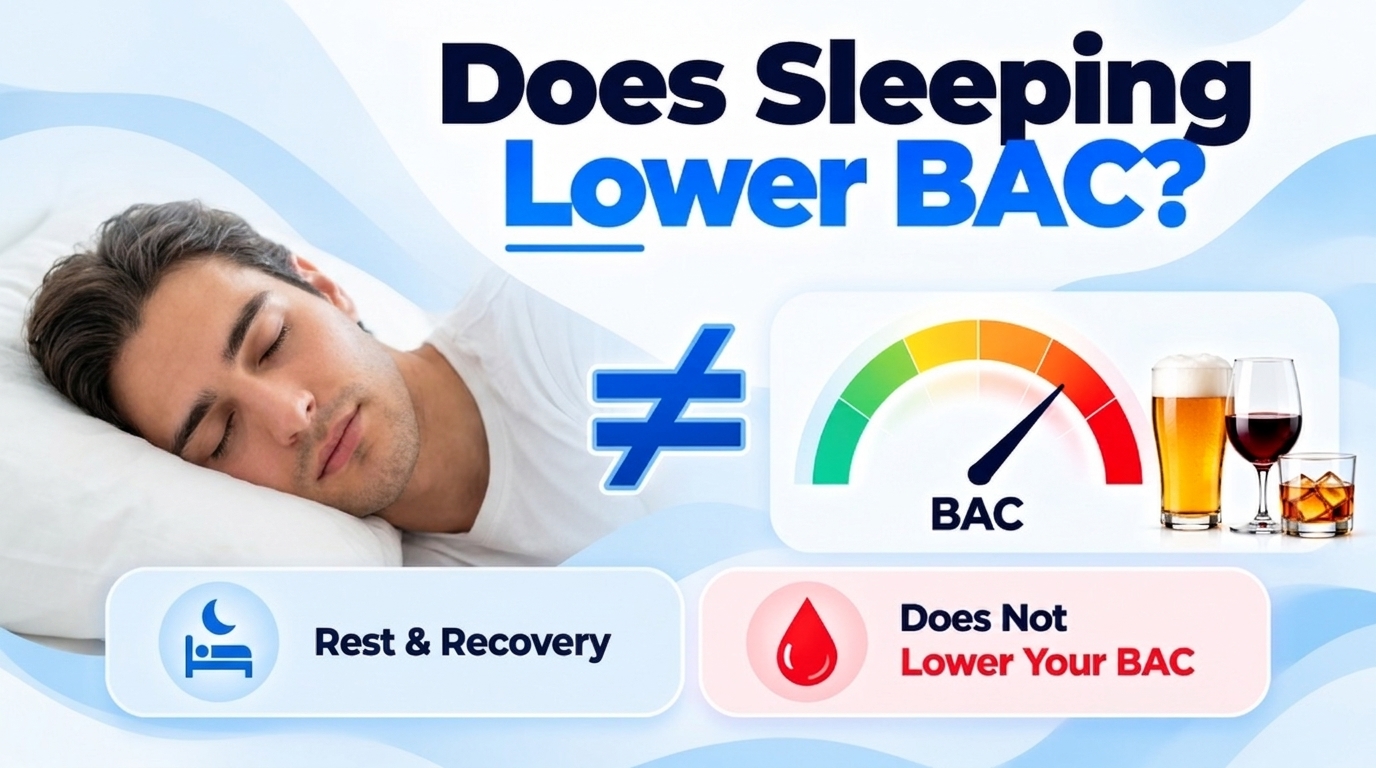
No, sleeping does not accelerate or speed up the rate at which your body eliminates alcohol. While your blood alcohol concentration (BAC) usually decreases while you sleep, that decline happens solely because real hours have elapsed—not because sleep functions as a sobering treatment.
This fundamental distinction between elapsed chronological time and the biological state of sleep is widely misunderstood. Many people believe that falling asleep acts like an enzymatic switch that resets the body's sobriety counter. In physiological reality, human hepatic metabolism operates at a steady, fixed biological pace regardless of whether your cerebral cortex is awake or unconscious.
To understand what happens overnight, we must separate three distinct biological concepts:
- Sleep: A period of vital neurological rest, physical cellular recovery, and altered consciousness during which standard vegetative bodily functions continue.
- Blood Alcohol Concentration (BAC): The physical mass ratio of pure ethanol circulating in your bloodstream, measured in grams per deciliter (g/dL).
- Hepatic Alcohol Elimination: The enzymatic oxidation of ethanol into acetaldehyde and acetate by liver enzymes (primarily alcohol dehydrogenase and CYP2E1).
According to the National Institute on Alcohol Abuse and Alcoholism (NIAAA), alcohol continues to exert pharmacological effects long after someone takes their final sip, and BAC can even continue rising during sleep if alcohol remains unabsorbed in the gastrointestinal tract (NIAAA Alcohol Overdose Clinical Guidance). Waking up feeling less exhausted or subjectively refreshed does not mean your blood alcohol concentration has reached zero.
Enzymes oxidize ethanol at ~0.015% per hour. Sleep adds zero metabolic speed.
Delayed stomach absorption can increase blood alcohol while you are asleep.
8 hours of sleep does not guarantee legal sobriety if heavy drinking occurred.
What Happens to Alcohol in Your Body While You Sleep?
When you go to sleep after an evening of drinking, your digestive and circulatory systems do not pause. Instead, two competing pharmacological processes occur simultaneously: ongoing gastrointestinal absorption and hepatic enzymatic clearance.
1. Alcohol Absorption Continues Across the Stomach and Intestines
When you take your last sip of beer, wine, or liquor, that alcohol does not instantaneously appear in your bloodstream. Roughly 20% of ingested ethanol absorbs slowly through the gastric lining of the stomach, while the remaining 80% must pass through the pyloric sphincter into the upper small intestine (duodenum and jejunum), where absorption happens rapidly.
If you ate food, drank high-sugar cocktails, or consumed drinks rapidly right before bed, your stomach retains a significant volume of unabsorbed alcohol. As you lie asleep, that ethanol continues diffusing into capillary blood vessels, entering the portal vein, and circulating through your central nervous system.
2. The Liver Breaks Down Ethanol at a Zero-Order Rate
Simultaneously, hepatic blood flow brings circulating alcohol to liver hepatocytes. The primary enzyme responsible for clearance, alcohol dehydrogenase (ADH), converts ethanol into acetaldehyde, an intermediate toxin. A second enzyme, aldehyde dehydrogenase (ALDH), rapidly metabolizes acetaldehyde into harmless acetate, which peripheral muscles convert into carbon dioxide and water.
Crucially, this enzymatic process exhibits zero-order pharmacokinetics. This means liver enzymes process a constant quantity of ethanol per unit of time—approximately 0.015% BAC per hour (roughly 7 to 10 grams of pure alcohol per hour for an average adult)—regardless of your blood concentration or sleep state. For a detailed review of clearance timelines and metabolic biology, explore our clinical overview on how the body metabolizes alcohol over time.
Can Your BAC Continue Rising While You Sleep?
Yes. Your BAC can continue climbing for 30 to 90 minutes (or longer) after you fall asleep.
This is one of the most hazardous physiological realities of acute alcohol consumption. A person who feels “moderately tipsy” at 0.06% BAC when their head hits the pillow at midnight may continue absorbing pending stomach alcohol while sleeping, unknowingly peaking at 0.10% or 0.12% BAC around 1:30 AM.
Why the Last Drink Is Not the Peak of Intoxication
Pharmacokinetic absorption follows an inverted U-curve. Peak blood concentration occurs only when the rate of gastrointestinal absorption matches and then falls below the liver's elimination rate. To understand how food, beverage temperature, and carbonation alter this curve, read our comprehensive analysis on when BAC peaks after drinking.
⚠️The Fatal “Sleep It Off” Danger
When an individual consumes multiple shots or binge drinks in rapid succession, high quantities of alcohol pool in the stomach. Putting that person to bed to “sleep it off” can lead to a fatal overdose hours later as stomach alcohol continues surging into the bloodstream, depressing brainstem respiratory centers.
Never leave an unresponsive, heavily intoxicated person alone to sleep. If they cannot be roused, vomit while unconscious, or exhibit slow, irregular breathing, call 911 immediately.
Why Can You Still Feel Drunk After Sleeping?
Waking up groggy, disoriented, or distinctly impaired after 6 to 8 hours in bed is a common experience. There are two primary physiological reasons why sleep does not automatically guarantee complete morning sobriety:
1. Pure Mathematical Math: The Alcohol Has Not Finished Clearing
Consider a typical social scenario: An individual reaches a peak BAC of 0.18% around 1:00 AM after a heavy night of celebrations. At an average elimination pace of 0.015% per hour:
Even after a full 8 hours of sleep, this individual wakes up at 9:00 AM with a 0.060% BAC. Under U.S. traffic safety laws, operating a vehicle with residual alcohol can lead to an immediate DUI arrest.
2. Alcohol Fragmented Sleep Architecture
Even if your BAC has dropped to zero by morning, alcohol severely degrades sleep architecture. While ethanol initially induces sedation, it suppresses Rapid Eye Movement (REM) sleep and causes a severe “rebound effect” during the second half of the night characterized by frequent micro-arousals, elevated heart rate, dehydration, and autonomic nervous system stress. What feels like “still being drunk” is often a combination of residual blood ethanol and profound neurological sleep deprivation.
Does Sleeping Longer Help Lower BAC Faster?
Sleeping 10 hours instead of 6 hours will indeed result in a lower BAC upon waking, but not because sleeping longer accelerates elimination. It lowers your BAC simply because your liver had four additional hours of calendar time to clear ethanol.
Staying in bed does not boost hepatic blood circulation, elevate ADH transcription, or induce cellular clearance. If you stayed awake sitting on a couch for those same four hours, your BAC would drop by the exact same amount.
Why Generic Rules of Thumb Fail
Popular adages such as “sleep one hour for every drink” are statistically flawed and medically unreliable. A petite woman weighing 115 lbs who drinks three 8% craft IPAs absorbs more pure ethanol into less total body water than a 210 lb man drinking three light lagers. The woman may require 8 to 10 hours for full clearance, whereas the man may clear his drinks in 4 to 5 hours. Universal rules fail to account for biological sex, body water fraction, and real beverage strength.
Can Coffee, Water, or a Cold Shower Help You Sober Up While Sleeping?
In social settings, people frequently combine sleep with common home remedies in an attempt to sober up before morning. None of these methods speed up hepatic metabolism:
☕ Coffee
Caffeine stimulates adenosine receptors, masking sleepiness. However, as documented in our clinical review on does coffee lower BAC, caffeine has zero effect on blood alcohol levels and can create a dangerously deceptive “wide-awake drunk” state.
💧 Water
Hydration combats ethanol-induced diuresis and eases morning dehydration headaches. Yet, as analyzed in our guide on does drinking water lower BAC, drinking water cannot dilute alcohol already circulating in cellular tissue.
🚿 Cold Showers
Cold water triggers an adrenaline spike and peripheral vasoconstriction that increases alertness. But as detailed in our guide on does a cold shower lower BAC, cold showers do not accelerate liver oxidation by even one minute.
Is It Safe to Let Someone Sleep After Drinking Too Much?
While normal fatigue after a couple of drinks is benign, severe alcohol intoxication is a medical emergency. One of the most catastrophic mistakes in social environments is assuming an unconscious or heavily intoxicated friend will “sleep it off” safely.
Critical Signs of Acute Alcohol Poisoning (Overdose)
According to emergency clinical guidelines from the NIAAA and the CDC, you must watch for the following life-threatening symptoms:
- Inability to wake up: The person cannot be roused with verbal shouting or a firm sternum rub.
- Depressed respiration: Fewer than 8 breaths per minute, or irregular pauses of more than 10 seconds between breaths.
- Hypothermia & pallor: Clammy, pale, or bluish skin around the lips and fingertips.
- Vomiting while semi-conscious: Lack of active gag reflex leading to deadly pulmonary aspiration (choking on vomit).
- Seizures: Sudden uncontrolled convulsions triggered by alcohol toxicity or acute hypoglycemia.
🚨Emergency Life-Saving Protocol
- Call 911 immediately. Do not wait for all symptoms to appear. Good Samaritan laws in most states protect minors and callers from prosecution for underage drinking.
- Never leave the person alone. Stay beside them until emergency paramedics arrive on scene.
- Put them in the BARK Recovery Position. If the person is lying down, roll them onto their side with their top knee bent to prop their body and prevent rolling onto their back. Tilt their head back slightly to keep their airway open and prevent choking if they vomit.
- Never induce vomiting, administer cold showers, or force coffee. Depressed gag reflexes make forced liquids a severe aspiration pneumonia hazard.
Does a BAC Calculator Account for Sleeping?
When utilizing digital pharmacokinetic tools such as the ToolWingz BAC Calculator, users often ask whether the algorithm includes a “sleep mode”.
What the Calculator Estimates
A mathematical BAC calculator models alcohol clearance by applying established pharmacokinetic formulas (such as the Widmark model). It relies on elapsed hours as its primary time parameter. For example, if you input that 8 hours have passed since your first drink, the equation applies an average elimination rate (typically 0.015% per hour) over those 8 elapsed hours. To explore the exact algebraic steps behind this modeling, see our reference breakdown on how BAC is calculated.
What the Calculator Cannot Establish
The calculator does not adjust its metabolic rate because you went to sleep, nor can it account for variable overnight gastric emptying, individual enzyme genetics, or residual morning impairment. A digital tool illustrates mathematical projections for educational clarity—it does not provide legal clearance or clinical diagnostic certainty.
Try the ToolWingz BAC Calculator
Explore the ToolWingz BAC Calculator to simulate how body mass, beverage alcohol by volume (ABV), and elapsed hours interact over an extended multi-hour timeline.
Disclaimer: ToolWingz BAC Calculator results are mathematical estimates for informational and educational purposes only. They cannot measure actual real-time blood alcohol concentration and must never be used to determine whether someone is safe, unimpaired, or legally permitted to drive.
Can You Drive the Morning After Drinking and Sleeping?
A substantial percentage of morning DUI arrests in the United States occur between 6:00 AM and 10:00 AM. Motorists driving to work, running morning errands, or taking children to school often assume that getting a night of sleep automatically eradicated their legal liability.
Why Eight Hours of Sleep Is Not a Guarantee
If you consume a large volume of alcohol late into the evening (for example, finishing drinks at 2:00 AM with an elevated BAC of 0.20%), 8 hours of sleep will only clear roughly 0.12% BAC. At 10:00 AM, you may still register at 0.08% BAC—making you legally intoxicated under standard per se state laws (and significantly above Utah's 0.05% threshold or commercial 0.04% rules). For a complete overview of state thresholds and driver categories, see our guide on legal BAC limits in the United States.
The Safe Strategy
If you drank heavily the previous night, do not rely on subjective feelings of alertness or alarm clocks. Plan ahead: arrange to work remotely, utilize public transportation, or designate a completely sober driver. The National Highway Traffic Safety Administration (NHTSA) strongly advises that if you have been drinking heavily, driving the morning after carries substantial legal and safety hazards.
The Bottom Line
Key Scientific & Safety Takeaways:
- 1.Sleep Does Not Accelerate Clearance: Your liver metabolizes alcohol at a constant pace of ~0.015% BAC per hour whether you are asleep or awake.
- 2.BAC Can Rise Overnight: Ongoing gastrointestinal absorption can cause blood alcohol levels to spike while you are unconscious.
- 3.Feeling Rested ≠ Being Sober: Subjective morning alertness is not an indicator of zero BAC or driving fitness.
- 4.“Sleeping It Off” Can Be Deadly: An unresponsive, heavily intoxicated person may be experiencing alcohol overdose. Never leave them alone; call 911 immediately.
- 5.Calculators Provide Estimates Only: Never rely on digital calculations or sleep duration to decide whether you can safely or legally operate a vehicle.
Explore the ToolWingz BAC Calculator
Simulate how biological sex, body weight, standard drinks, and multi-hour elapsed timelines influence estimated blood alcohol degradation curves.
Educational Disclaimer: ToolWingz BAC Calculator results are mathematical estimates for informational purposes only. They cannot measure real-time blood alcohol levels and must never be used to evaluate driving fitness or legal compliance.